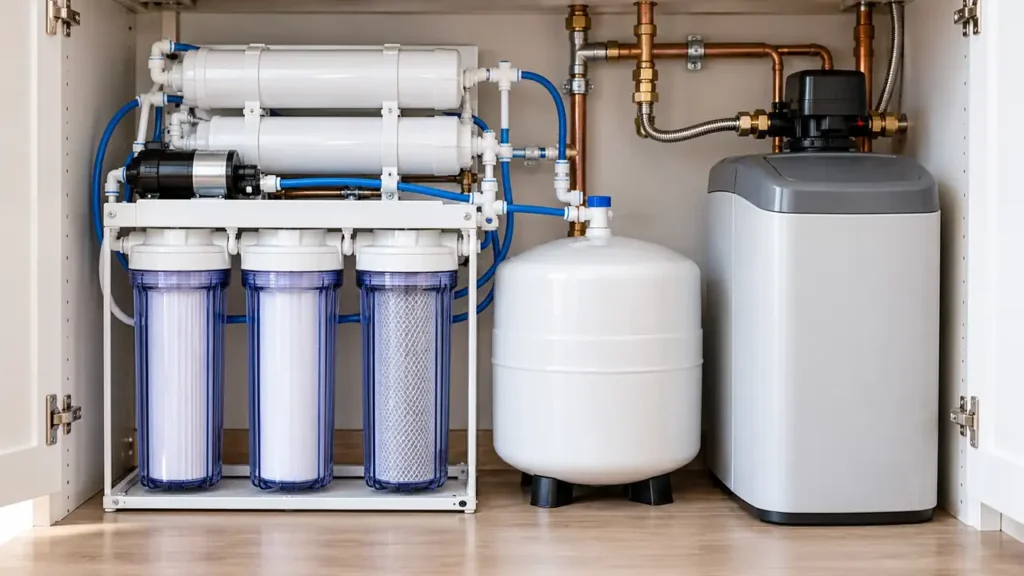
Hard water leaves a familiar trail: white scale around faucets, cloudy glassware, stiff-feeling laundry, and mineral buildup that can shorten the working life of plumbing equipment. A reverse osmosis system can reduce many dissolved substances at the drinking-water tap, but it should not automatically be treated as a whole-house softener. That distinction matters most for this category, because source-water hardness can affect membrane performance and maintenance while a separate softening stage may be needed for broader household protection.
The strongest choices here take different approaches. The Aquasure bundle pairs a 64,000-grain water softener with a 75 GPD drinking-water RO system, making it the most directly relevant option for a home where hardness affects multiple bathrooms. For point-of-use filtration, the iSpring RCC7AK-BN adds a remineralization stage and lists specific NSF/ANSI 58 reduction claims. Other buyers may prefer a booster pump for lower pressure, a tankless design to save cabinet space, a countertop unit that avoids under-sink plumbing, or a UV-equipped system for an added treatment stage.
Do not rank these systems by stage count or GPD alone. Check whether the product addresses hardness at the source, whether its certification claim applies to the complete system, whether electricity or drilling is required, and how replacement filters fit your routine. A household with scale throughout the home has different priorities from an apartment resident who only wants better water at one faucet, so the best selection depends on the installation and water problem in front of you.
Quick Answer
- Best Overall: Aquasure 64,000-Grain Water Filter Bundle for homes needing a softener plus a drinking-water RO system.
- Best Under-Sink RO: iSpring RCC7AK-BN for a certified, 75 GPD system with alkaline remineralization.
- Best for Low Water Pressure: iSpring RCC7P-AK for buyers who need a supplied booster pump.
- Best Tankless Option: Waterdrop G3P600 for a 600 GPD tankless system with stated TDS monitoring and a 2:1 pure-to-drain ratio.
Best Reverse Osmosis Systems for Hard Water Comparison Table
| Product | Best For | System Type | Rated Capacity | Hard-Water Relevance |
|---|---|---|---|---|
| Aquasure 64,000-Grain Bundle | Whole-home hardness control | Softener plus under-sink RO | 64,000 grains; 75 GPD RO | Dedicated softener included |
| iSpring RCC7AK-BN | Certified point-of-use filtration | Under-sink, tank-based | 75 GPD | Reduces listed calcium and other minerals |
| iSpring RCC7P-AK | Lower-pressure homes | Under-sink RO with pump | Not clearly specified | Booster pump supports RO operation |
| Waterdrop G3P600 | High stated output and small cabinet footprint | Tankless under-sink | 600 GPD | Lists calcium reduction among tested claims |
| GLACIER FRESH GFU03 | High capacity without electricity | Electric-free tankless under-sink | 800 GPD | RO filtration addresses listed dissolved minerals |
| APEC Water ROES-PH75 | Alkaline point-of-use water | Under-sink, tank-based | 75 GPD | Lists calcium-based mineral addback |
| iSpring RCC7AK-UV | RO with UV and remineralization | Under-sink, tank-based | Not clearly specified | Lists calcium reduction and mineral addback |
| iSpring RCC7-BN | Traditional five-stage filtration | Under-sink, tank-based | 75 GPD | Lists calcium and sodium reduction |
| DREO Countertop RO System | Renters and no-plumbing setups | Countertop | Not clearly specified | RO treatment at one location |
The reviews below separate whole-home hardness control from point-of-use RO filtration, then explain which installation and maintenance compromises accompany each choice.
1. Aquasure 64,000-Grain Whole House Water Filter Bundle — Best Overall

This is the clearest match for a hard-water household because it addresses two separate jobs in one bundle. The automatic digital metered softener is rated for 64,000 grains of hardness, while the included Aquasure RO drinking system is rated at 75 GPD. That combination is more relevant to a home with scale appearing at several fixtures than a standalone under-sink RO unit, which treats water only after it reaches one point of use.
The product information describes the bundle as suitable for homes with four to five bathrooms and up to six family members. It also identifies an Aquatrol control head, high-strength construction, built-in safety features, up to a five-year manufacturer warranty, and lifetime technical support. The listing does not clearly specify the RO system’s stage count, contaminant reduction percentages, or recovery ratio, so its main advantage is the softener-plus-RO configuration rather than a long list of detailed filtration claims.
Pros
- Combines a 64,000-grain water softener with a 75 GPD RO drinking system.
- Addresses hardness across the home rather than at one drinking-water faucet.
- Uses an automatic digital metered control head.
- Listed for homes with four to five bathrooms and up to six family members.
- Includes up to five years of manufacturer warranty coverage according to the product information.
Cons
- The bundle is more involved than a point-of-use RO system because it includes whole-home treatment equipment.
- The supplied information does not clearly identify the RO system’s recovery ratio or detailed filtration stages.
This bundle makes the most sense for homeowners who see hard-water effects throughout the house and want drinking-water RO included in the same purchase. Apartment residents or buyers who only need filtered water at one tap will likely find its whole-home format excessive, while households with a defined softening need should view the separate softener as the central feature.
To buy this product, click here.
2. iSpring RCC7AK-BN — Best Certified Under-Sink Option

The RCC7AK-BN is aimed at buyers who want point-of-use RO with mineral addback rather than a whole-house softening system. It is rated at 75 GPD and uses six stages, including an AK remineralization stage. The supplied information identifies NSF/ANSI 58 certification for the complete RO system and gives specific reduction claims for TDS, PFAS, chlorine, fluoride, lead, and several other substances. Those details give this model a more clearly documented filtration profile than many generic listings.
Hard water can leave calcium and magnesium scale, and this system’s RO process is described as reducing hard-water minerals. That does not make it an ion-exchange softener, so it should be installed with the expectation of treating drinking water rather than protecting every shower, appliance, and pipe. The top-mounted faucet fastener, transparent first-stage housing, quick-fitting connections, and stated replacement sets make ownership easier to plan, although the system still occupies under-sink space.
Pros
- Rated at 75 GPD.
- Product information identifies complete-system NSF/ANSI 58 certification.
- Includes a six-stage configuration with AK remineralization.
- Lists specific reduction claims for PFAS, fluoride, lead, TDS, and hard-water minerals.
- Has a transparent first-stage housing and top-mounted faucet fastener.
Cons
- It treats water at the drinking-water point and does not replace a whole-house softener.
- The supplied information does not clearly state a pure-to-drain ratio.
Choose this model for a kitchen-focused solution where certification detail and remineralization matter more than whole-home scale control. A homeowner trying to stop mineral deposits in multiple bathrooms should pair point-of-use RO with separate hardness treatment, while a buyer focused on one faucet gets a more targeted and documented setup here.
To buy this product, click here.
3. iSpring RCC7P-AK — Best for Low Water Pressure

The defining feature here is the electric booster pump. A reverse osmosis membrane depends on suitable feed pressure, and the supplied information positions this six-stage system for homes where low pressure can interfere with RO performance. That makes it a more specialized pick than a conventional tank-based unit, especially for a home where hard water and weak incoming pressure create a difficult operating combination.
The RCC7P-AK also includes alkaline remineralization and a transparent first-stage housing. Its product information lists reduction of up to 99% of over 1,000 contaminants, with named claims covering lead, chlorine, fluoride, arsenic, PFAS, asbestos, calcium, and sodium. The supplied details do not identify a specific GPD rating, minimum inlet pressure, or recovery ratio, so buyers should verify that the electrical connection and available cabinet space suit the installation before committing.
Pros
- Includes an electric booster pump for consistent RO pressure support.
- Uses a six-stage configuration with alkaline remineralization.
- Lists reduction claims for calcium, PFAS, fluoride, lead, and other substances.
- Has a transparent first-stage housing for visual inspection.
- Includes a 100-240V, 50/60Hz pump power adapter.
Cons
- Requires electricity for the booster pump.
- The supplied specifications do not clearly state GPD capacity, minimum inlet pressure, or recovery ratio.
This is the practical choice for a low-pressure home that still wants under-sink RO and mineral addback. If pressure is already adequate and electrical simplicity matters, a non-pumped iSpring model may be easier to own; if pressure is the stumbling block, the pump is the reason to choose this model.
To buy this product, click here.
4. Waterdrop G3P600 — Best Tankless Option

For a hard-water household that wants a high stated capacity without a conventional storage tank, the G3P600 takes a different path. Its tankless design is rated at 600 GPD, and the listing states that an eight-ounce cup can fill in eight seconds. It also identifies a 2:1 low-drain ratio, described as one cup of wastewater for every two cups of pure water. The ratio is useful buying information, though it should not be confused with a guarantee of output under every household condition.
The system uses an eight-stage configuration and includes a smart display faucet with TDS monitoring and filter-life tracking. Certification information identifies NSF/ANSI 58 for TDS reduction, NSF/ANSI 372 for lead-free material, and NSF 42 for chlorine, taste, and odor reduction. The unit requires under-sink electricity and measures 18.12 by 5.67 by 17.72 inches, so its narrow profile saves some cabinet width while still demanding a careful measurement.
Pros
- Tankless under-sink format with a stated 600 GPD capacity.
- Published information gives a 2:1 pure-to-drain ratio.
- Includes TDS monitoring and filter-life tracking at the faucet.
- Lists NSF/ANSI 58, NSF/ANSI 372, and NSF 42 certification information.
- Filter changes are described as tool-free and possible without moving the system.
Cons
- Requires under-sink electricity.
- Its stated capacity does not prove whole-house suitability or eliminate the need for hardness pretreatment.
The G3P600 suits households that value cabinet efficiency, monitoring, and a high stated production rating. Buyers who want a completely non-electric installation should look elsewhere, and anyone dealing with heavy hardness should still evaluate softening or pretreatment rather than assuming tankless RO handles the entire source-water problem.
To buy this product, click here.
5. GLACIER FRESH GFU03 — Best High-Capacity Electric-Free Option
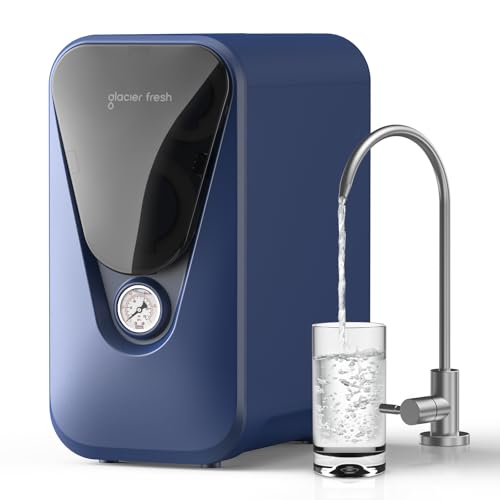
The GFU03 combines a tankless, water-powered design with an 800 GPD stated capacity. Its electric-free configuration may appeal to buyers who want a compact under-sink system without a powered pump, while the product information says the unit can fill an eight-ounce cup in eight seconds under suitable inlet conditions. A built-in pressure gauge provides a way to watch system pressure, and the listing recommends at least 40 PSI for the stated flow performance.
Water efficiency is a major part of this model’s identity. The published information gives a 3:1 pure-to-drain ratio, described as three cups of purified water for each cup of wastewater. It also identifies a pull-out filter cartridge, a 0.0001μm RO membrane, and stated NSF/ANSI 58, 372, and 401 standards. Installation requires drilling a 1/2-inch to 1-inch faucet hole, and the 13.58 by 8.27 by 16.54-inch dimensions still need to fit the cabinet.
Pros
- Electric-free tankless design.
- Rated at 800 GPD according to the product information.
- Lists a 3:1 pure-to-drain ratio.
- Includes a pressure gauge and pull-out filter cartridge.
- Published information identifies NSF/ANSI 58, 372, and 401 standards.
Cons
- Requires drilling a faucet hole for installation.
- The stated output depends on inlet pressure, and the listing does not establish a whole-house application.
This system fits buyers who want high stated capacity, low electrical dependence, and a compact tankless format. It is less attractive for renters who cannot drill or for homes with pressure below the stated recommendation, while a hard-water household may still need separate source-water treatment to protect the RO membrane.
To buy this product, click here.
6. APEC Water ROES-PH75 — Best Alkaline Alternative
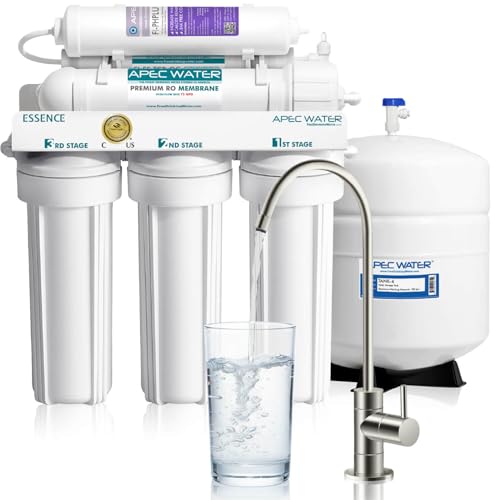
The ROES-PH75 is a six-stage under-sink system rated at 75 GPD, with a calcium-based mineral cartridge for pH enhancement and mineral addback. That configuration appeals to people who prefer the taste profile associated with remineralized RO water, while the five preceding filtration stages handle the main treatment sequence described by the product information. The listing also gives a feed-water pressure range of 40 to 85 PSI and a maximum TDS figure of 2,000 ppm.
Its published claims include reduction of chlorine, taste, odor, VOCs, fluoride, arsenic, lead, heavy metals, and more than 1,000 impurities. The system is identified as WQA certified, which is a different certification organization and claim from NSF certification. For hard water, the key limitation is scope: calcium addback does not soften incoming water, and the supplied information does not identify a dedicated softening stage.
Pros
- Rated at 75 GPD.
- Includes six stages and a calcium-based mineral cartridge.
- Lists a 40 to 85 PSI feed-water range.
- Product information identifies WQA certification.
- Lists reduction claims for fluoride, arsenic, lead, VOCs, and heavy metals.
Cons
- Mineral addback does not serve as whole-house water softening.
- The published information does not clearly identify a pure-to-drain ratio.
The ROES-PH75 is a sensible match for buyers who want a 75 GPD under-sink system and a calcium-based mineral stage, especially when the stated pressure range fits the home. Those facing widespread scale should use it as drinking-water treatment rather than a substitute for a softener, while shoppers seeking complete-system NSF/ANSI 58 evidence may prefer one of the iSpring alternatives.
To buy this product, click here.
7. iSpring RCC7AK-UV — Best With UV and Remineralization

This seven-stage under-sink system adds two features that separate it from a conventional five-stage RO design: an AK remineralization stage and a mercury-free LED UV stage. The UV light activates when water flows, according to the product information, while the mineral stage is described as restoring minerals and balanced alkalinity. The model also uses layered filter cartridges and a transparent first-stage housing for visual inspection.
Certification information identifies NSF/ANSI 58 and 372 for the complete system, along with named reduction claims for TDS, lead, fluoride, asbestos, barium, cadmium, chromium, copper, and selenium. The listing does not provide a GPD rating in the supplied specifications, so this model is better understood as a feature-rich point-of-use system than a capacity leader. Its UV stage adds an extra treatment feature, but it should not be interpreted as a universal guarantee of microbiological safety.
Pros
- Combines RO filtration, alkaline remineralization, and LED UV.
- Product information identifies complete-system NSF/ANSI 58 and 372 certification.
- Lists specific reduction claims for lead, fluoride, TDS, and several metals.
- Uses flow-activated, mercury-free LED UV technology according to the listing.
- Includes a top-mounted faucet fastener and transparent first-stage housing.
Cons
- The supplied specifications do not clearly state a GPD capacity.
- UV treatment adds complexity without replacing a whole-house softener for hardness control.
Buyers who want UV alongside remineralization and documented RO certification will find a clear reason to choose this model. A simpler five-stage system may be easier to maintain for routine drinking-water filtration, while households with scale on fixtures still need to address hardness before or beyond this point-of-use unit.
To buy this product, click here.
8. iSpring RCC7-BN — Best Traditional 75 GPD System

The RCC7-BN keeps the configuration straightforward with five filtration stages and a 75 GPD rating. Its supplied information identifies NSF/ANSI 58 certification, a brushed nickel faucet, a storage tank, food-grade tubing, a check valve, and a transparent first-stage housing. For hard-water users who want a conventional under-sink system without UV, a pump, or mineral addback, this model keeps the feature set easier to understand.
The listing gives reduction claims for PFAS, chlorine, fluoride, lead, arsenic, asbestos, calcium, sodium, and TDS. It also describes a 0.0001-micron filtration level and a final GAC polishing stage. Those claims apply to drinking-water treatment, not whole-home softening. A storage tank also means buyers should measure the cabinet and plan around a tank-based layout rather than expecting the narrow profile of a tankless system.
Pros
- Rated at 75 GPD.
- Product information identifies NSF/ANSI 58 certification.
- Lists reduction claims for calcium, PFAS, fluoride, lead, arsenic, and TDS.
- Includes a storage tank and brushed nickel faucet.
- Operates without a power source according to the supplied information.
Cons
- Does not include a dedicated softener for whole-home hardness.
- The tank-based design requires cabinet space that a tankless unit may avoid.
This is a good fit for buyers who want a familiar five-stage under-sink layout and a stated 75 GPD capacity without extra UV or alkaline hardware. Choose a different model if mineral addback, low-pressure pumping, or a tankless cabinet footprint is central to the purchase, and pair this system with separate hardness treatment when scale extends beyond the drinking tap.
To buy this product, click here.
9. DREO Countertop Reverse Osmosis System — Best Countertop Option

The DREO takes hard-water filtration away from the cabinet and places it on the countertop. Its install-free format, two autofill pitchers, self-cleaning function, TDS display, and filter-life information target buyers who do not want to modify plumbing. That can be valuable in a rental or temporary home, although countertop operation still requires room near a suitable water and power setup, and it treats water for a limited point of use.
The listing describes a seven-in-one RO system and states that SGS testing found performance meeting NSF/ANSI 58 standards. It also names PFOA, PFOS, chlorine, fluoride, and other possible contaminants in its filtration claims. The supplied information does not clearly identify the system’s rated GPD capacity or explain a dedicated hardness-softening stage, so it is best viewed as a convenient drinking-water filter rather than a solution for scale across the home.
Pros
- Countertop format avoids under-sink installation.
- Includes two autofill pitchers according to the product information.
- Provides TDS and filter-life information.
- Lists a self-cleaning function.
- Product information identifies SGS testing against NSF/ANSI 58 standards.
Cons
- The supplied information does not clearly state a GPD capacity.
- It does not replace a whole-house softener or treat hard water at every fixture.
This system suits renters and anyone who wants point-of-use RO without drilling or connecting an under-sink drain line. A permanent homeowner with scale throughout the property should look first at a softener-plus-RO bundle, while a countertop buyer should reserve enough surface area for the unit and its pitchers.
To buy this product, click here.
Buying Guide
Separate Hardness Control From Drinking-Water RO
Hardness and dissolved-contaminant reduction overlap in the source-water problem, but they are not the same treatment goal. A softener is intended to address hardness throughout the plumbing system, while an under-sink RO system treats water at a drinking tap. The Aquasure bundle is the only selected product that explicitly combines a 64,000-grain softener with a drinking-water RO system, so it has a different role from the iSpring, APEC, Waterdrop, GLACIER FRESH, and DREO units.
Check the Source-Water Pressure
RO production depends on operating conditions, so a stated GPD number should not be read as guaranteed household output. The iSpring RCC7P-AK includes a booster pump for homes where pressure is a concern. The APEC ROES-PH75 lists a 40 to 85 PSI feed-water range, and the GLACIER FRESH listing recommends at least 40 PSI for its stated flow performance. If your pressure is uncertain, obtain that information before choosing a high-capacity system.
Compare Tank, Tankless, and Countertop Layouts
Tank-based systems such as the RCC7-BN use a storage tank and need cabinet room. Tankless models such as the Waterdrop G3P600 and GLACIER FRESH GFU03 reduce dependence on an external tank, but the Waterdrop requires electricity while the GLACIER FRESH listing describes a water-powered design. The DREO sits on the counter and avoids under-sink installation, making it a different solution rather than a direct replacement for a permanent under-sink system.
Read Certification Wording Carefully
Certification language varies across these listings. The iSpring products identify NSF/ANSI 58 certification, while the APEC product information identifies WQA certification. Waterdrop lists NSF/ANSI 58 for TDS reduction, NSF/ANSI 372 for lead-free material, and NSF 42 for chlorine, taste, and odor reduction. DREO is described as tested by SGS against NSF/ANSI 58 standards. Those statements should remain separate because testing, certification, standard scope, and material certification are different claims.
Review Recovery and Wastewater Claims
Water efficiency matters more in a hard-water home that may already use substantial water for maintenance or treatment. Waterdrop lists a 2:1 pure-to-drain ratio, while GLACIER FRESH lists a 3:1 pure-to-drain ratio. Do not transfer either figure to another system, and do not assume tankless architecture automatically means low waste. The other supplied products do not clearly state comparable ratios.
Plan for Filter and Membrane Maintenance
Transparent housings on several iSpring systems let owners visually inspect the first stage, while Waterdrop provides filter-life tracking and GLACIER FRESH uses a pull-out cartridge design. APEC states that filter replacement may occur every six to 24 months depending on incoming water quality. Hard source water can make maintenance planning more significant, so look for exact replacement parts and keep the product’s stated schedule available rather than relying on a generic interval.
Best Reverse Osmosis Systems for Hard Water FAQ
Can Reverse Osmosis Replace a Water Softener?
A point-of-use RO system should not be treated as a replacement for a whole-house softener. RO can reduce listed dissolved substances at the treated faucet, including hardness-related minerals in some product claims, but it does not protect every fixture or appliance. The Aquasure bundle combines both functions, while the other products are primarily drinking-water systems.
Which System Is Best for Hard Water Throughout a House?
The Aquasure 64,000-grain bundle is the strongest fit among these products because its listing identifies a dedicated softener alongside a 75 GPD RO drinking system. It is aimed at larger homes with multiple bathrooms, unlike the under-sink and countertop products that serve a specific water outlet.
Does Hard Water Damage an RO Membrane?
Hard-water minerals can contribute to scale and affect membrane operation, although the supplied product information does not provide a universal hardness limit for these systems. Buyers with substantial hardness should examine pretreatment and maintenance requirements rather than assuming any residential RO unit can handle unlimited mineral loading.
Is a Higher GPD Rating Better for Hard Water?
Not automatically. GPD is a rated production-capacity figure, not a direct measure of filtration quality, hardness tolerance, or contaminant reduction. The Waterdrop G3P600 and GLACIER FRESH GFU03 list high capacities, but those ratings do not turn either unit into a whole-house softener.
Do Remineralization Systems Make Hard Water Worse?
A remineralization stage adds minerals after RO treatment according to the product description. It should not be confused with untreated hard source water, but the supplied information does not establish a universal mineral concentration or resulting pH for every system. Buyers focused on taste may prefer remineralization, while buyers focused on scale should still address the incoming water.
Should I Choose a Tankless RO System for Hard Water?
Tankless systems can offer a smaller cabinet arrangement and, in some listings, stated recovery or monitoring features. They do not automatically provide better hardness control. Check electricity requirements, pressure conditions, replacement filters, and any stated wastewater ratio. The Waterdrop G3P600 requires electricity, while the GLACIER FRESH GFU03 is described as electric-free.
Is Countertop RO Suitable for a Hard-Water Apartment?
A countertop system can provide RO-treated water at one location without under-sink plumbing, which makes the DREO relevant for renters. It will not stop scale in showers, laundry equipment, or other fixtures. Check the countertop footprint, pitcher handling, electrical needs, and the product’s stated maintenance requirements before choosing this format.
Final Verdict
The Aquasure 64,000-Grain Bundle is the strongest overall recommendation for hard-water homes because it addresses the central distinction that many point-of-use comparisons miss: whole-house hardness control and drinking-water RO are separate jobs. Its stated softener capacity, automatic metered control, and included 75 GPD RO system make it the most directly aligned option for a multi-bathroom household dealing with scale beyond the kitchen faucet.
For a single drinking-water outlet, the iSpring RCC7AK-BN offers the clearest balance of 75 GPD capacity, complete-system NSF/ANSI 58 certification information, named reduction claims, and remineralization. The RCC7P-AK is the better fit where pressure support matters, Waterdrop and GLACIER FRESH offer distinct tankless approaches, and the DREO makes more sense for a countertop installation. Match the system to the extent of the hardness problem, the available pressure, the installation rules, and the maintenance you are prepared to handle.
