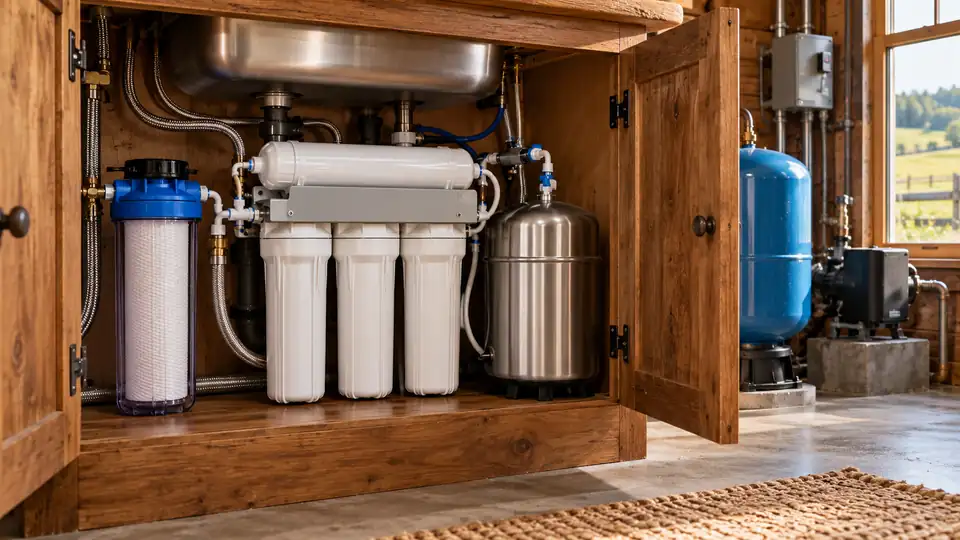
Well water can look clear in a bucket and still create a difficult job for a reverse osmosis membrane. Sediment, hardness, iron, manganese, sulfur, arsenic, nitrate, and changing pressure can vary dramatically from one property to the next. That is why a system marketed for ordinary tap water should not automatically be treated as a complete well-water solution. The first step is a current water test, followed by a review of pretreatment needs before choosing a drinking-water RO system.
The most useful differences in this group are system architecture, stated contaminant evidence, production rating, electricity requirements, filter maintenance, and installation. Tank-based units such as the iSpring RCC7AK-BN, iSpring RCC7-BN, VIVA21, and APEC ROES-50 store purified water, while tankless models trade storage for direct production and often require power. A well with low pressure may need additional evaluation, since most supplied listings do not clearly establish minimum inlet pressure. For the strongest combination of documented certification, named reduction claims, remineralization, and a conventional under-sink format, the iSpring RCC7AK-BN is the leading general-purpose pick, provided the source water has suitable pretreatment.
Different homes need different answers. A small cabin may benefit from the DREO countertop format, a high-demand property may look toward the iSpring CRO1000, and a buyer who wants UV plus remineralization may prefer the iSpring RCC7AK-UV. None of the supplied products is explicitly identified as a complete well-water treatment train, so the reviews below separate drinking-water RO features from claims that would require additional source-water evidence.
Quick Answer
- Best Overall: iSpring RCC7AK-BN for a certified under-sink system with stated PFAS, fluoride, lead, and TDS reduction claims plus remineralization.
- Best High-Capacity Option: iSpring CRO1000 for higher-demand installations, commercial-style filtration, and a stated 1,000 GPD rating.
- Best With UV: iSpring RCC7AK-UV for buyers who want a listed LED UV stage alongside NSF/ANSI 58 and 372 certification claims.
- Best Countertop Option: DREO Countertop Reverse Osmosis Water Filter for a no-plumbing countertop format, though the listing does not establish well-water suitability.
Best Reverse Osmosis Systems for Well Water Comparison Table
| Product | Best For | System Type | Rated Capacity | Supported Evidence |
|---|---|---|---|---|
| iSpring RCC7AK-BN | Overall under-sink choice | Tank-based, 6-stage | 75 GPD | NSF/ANSI 58 claim, named contaminant reductions, remineralization |
| iSpring CRO1000 | High daily demand | Tankless commercial-style | 1,000 GPD, 0.7 GPM stated | Pressure gauges, large-format filters, optional booster pump reference |
| Waterdrop G3P600 | Tankless monitoring | Tankless, 8-stage | 600 GPD | NSF/ANSI 58, 42, and 372 claims, TDS display, 2:1 ratio |
| GLACIER FRESH GFU03 | Electric-free high flow | Tankless, 5-stage | 800 GPD | NSF/ANSI 58, 372, and 401 claims, pressure gauge, 3:1 ratio stated |
| iSpring RCC7AK-UV | UV and remineralization | Tank-based, 7-stage | Not clearly specified | NSF/ANSI 58 and 372 claims, LED UV, remineralization |
| Waterdrop WD-T4-A | Dual-flow alkaline option | Tankless, 10-stage | 450 GPD | NSF/ANSI 372 claim, 2:1 ratio, dual purified-water paths |
| DREO Countertop RO | Countertop installation | Countertop, 7-in-1 | Not clearly specified | SGS testing claim referencing NSF/ANSI 58, 3:1 ratio stated |
| iSpring RCC7-BN | Simple tank-based setup | Tank-based, 5-stage | 75 GPD | NSF/ANSI 58 claim, stated reduction of selected contaminants |
| APEC ROES-50 | Traditional 50 GPD system | Tank-based, 5-stage | 50 GPD | Stated claims for arsenic, chlorine, lead, fluoride, and other impurities |
The detailed reviews separate documented features from unanswered well-water questions, so you can match the system to your source-water test and installation limits.
1. iSpring RCC7AK-BN — Best Overall

The iSpring RCC7AK-BN is the most balanced pick here for a household that needs an under-sink drinking-water system and has already addressed the rougher side of well water upstream. Its published information identifies a 75 GPD, six-stage configuration and an NSF/ANSI 58 certification claim for the complete system. It also lists specific reduction claims for PFAS, chlorine, fluoride, lead, arsenic-related? No, arsenic is not listed in the supplied RCC7AK-BN claims, so buyers should not assume that contaminant is covered by the product-specific evidence. The supplied figures do identify TDS, PFAS, fluoride, lead, barium, cadmium, chromium, copper, and selenium reductions.
The AK stage adds minerals after RO treatment, which may appeal to someone who dislikes the taste profile of demineralized water. That feature should be viewed as a configuration preference, not a medical benefit or proof of a particular final pH. The transparent first-stage housing gives a quick visual check for sediment buildup, a useful detail if a private well sends fine particles toward the filter. The top-mounted faucet fastener and quick-fitting connections may simplify installation, although the listing does not establish that every well-water setup will be compatible without pretreatment.
Pros
- Published as a 75 GPD, six-stage under-sink RO system.
- Product information claims NSF/ANSI 58 certification for the complete system.
- Lists specific reduction claims for TDS, PFAS, fluoride, lead, and several metals.
- Includes an AK remineralization stage.
- Transparent first-stage housing and listed replacement-filter sets support maintenance checks.
Cons
- The supplied information does not identify specific well-water suitability or pretreatment requirements.
- The listing does not clearly specify minimum inlet pressure or wastewater performance.
This is the best fit for a buyer who wants the strongest mix of documented filtration claims and a familiar tank-based under-sink layout. A home with substantial sediment, hardness, iron, sulfur, or pressure problems should look at source-water treatment first rather than expecting the RCC7AK-BN to solve every issue by itself.
To buy this product, click here.
2. iSpring CRO1000 — Best High-Capacity Option

The CRO1000 is the outlier in this group. It is presented as a commercial-grade, tankless system with a stated 1,000 GPD capacity and a 0.7 GPM flow rate. That makes it relevant for a property with unusually high drinking-water demand, an office, a small food-service operation, or a setup feeding several listed endpoints. It comes on a freestanding metal frame with wheels and locking brakes, so it is a different ownership proposition from a compact cabinet-mounted residential unit.
Its four-stage layout uses a 20-inch sediment filter, two 20-inch carbon block filters, and a 1,000 GPD RO membrane in a stainless steel housing. The built-in inlet and outlet gauges are especially useful for a well-water evaluation because pressure is a central question, although the supplied information does not say that the gauges diagnose every well-water problem. The listing recommends an optional PMP1000 booster pump below 80 psi and gives an 80 to 130 psi working range. That is more pressure information than most products here provide, but it also signals that installation planning matters.
Pros
- Published with a 1,000 GPD rated capacity.
- States a 0.7 GPM flow rate for the tankless design.
- Uses large-format sediment and carbon filters plus a commercial-size RO membrane.
- Includes inlet and outlet pressure gauges.
- Product information identifies connections for faucets, dispensers, ice makers, refrigerators, and other listed applications.
Cons
- Its freestanding commercial-style frame is less suited to a conventional under-sink cabinet.
- The supplied information does not establish complete well-water treatment or a recovery ratio.
Choose this system for capacity and pressure visibility rather than compact residential convenience. It may be excessive for a single kitchen tap, while a high-demand property with suitable pretreatment can benefit from the larger filters and stated output. The booster-pump reference also means a low-pressure well should be evaluated before installation.
To buy this product, click here.
3. Waterdrop G3P600 — Best Tankless Monitoring

The Waterdrop G3P600 targets buyers who want a tankless under-sink system with more information at the faucet. Its published specifications state a 600 GPD rating, an eight-stage configuration, a 2:1 pure-to-drain ratio, and an eight-ounce fill time of eight seconds. It also lists a display faucet with TDS and filter-life information. Those readouts can help track the system, but a TDS display is not a test for lead, PFAS, bacteria, or every other well-water concern.
The supplied certification information is unusually detailed for this group. It identifies NSF/ANSI 58 certification for TDS reduction, NSF/ANSI 372 for lead-free material, and NSF 42 testing or certification language related to chlorine, taste, and odor. The product information also references SGS testing for a range of named substances. Buyers should keep those claims tied to their stated scope. This model requires under-sink electricity, and its listed dimensions of 18.12 by 5.67 by 17.72 inches deserve a cabinet check before ordering.
Pros
- Published with a 600 GPD tankless configuration.
- Lists NSF/ANSI 58, NSF/ANSI 372, and NSF 42-related evidence.
- Includes a faucet display for TDS and filter-life information.
- States a 2:1 pure-to-drain ratio.
- Lists a quick filter-change design that does not require moving the system or using tools.
Cons
- Requires under-sink electricity.
- The published information does not identify specific well-water pretreatment or minimum inlet pressure.
This model suits a homeowner who wants tankless storage, a stated water-efficiency ratio, and visible maintenance information. It is less attractive for a remote well installation with uncertain power or pressure unless those conditions are addressed first. The monitor adds useful feedback, but it should not replace a laboratory water test.
To buy this product, click here.
4. GLACIER FRESH GFU03 — Best Electric-Free High-Flow Option
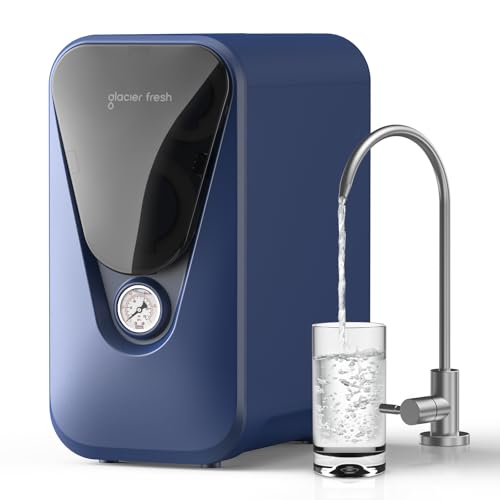
The GFU03 takes a different route to high stated output. It is described as an electric-free, water-powered tankless system with an 800 GPD rating, an internal tankless design, and a built-in pressure gauge. The listing says a cup can fill in eight seconds under appropriate conditions and recommends at least 40 PSI, while also warning that actual output depends on inlet pressure. That pressure qualification matters for well owners because pump cycling, elevation, and household demand can affect the conditions at the filter.
The product information states a five-stage configuration and claims NSF/ANSI 58, 372, and 401 compliance or certification language. It also names PFOA, PFOS, chlorine, lead, fluoride, and heavy metals among its reduction targets. The listed 3:1 pure-to-drain ratio is attractive for buyers watching wastewater, although the article should preserve the listing’s stated ratio rather than translate it into a broader recovery claim. A pull-out filter design and a compact 13.58 by 8.27 by 16.54-inch footprint may simplify cabinet planning, but the faucet requires drilling.
Pros
- Published with an 800 GPD rated capacity.
- Electric-free design does not require an under-sink power connection according to the listing.
- Includes a built-in water-pressure gauge.
- States a 3:1 pure-to-drain ratio.
- Lists NSF/ANSI 58, 372, and 401 evidence plus a pull-out filter cartridge.
Cons
- The system still requires adequate water pressure, and the listing states that output depends on inlet conditions.
- Faucet installation requires drilling a 1/2-inch to 1-inch hole.
The GFU03 is worth a look for a well owner who wants high stated capacity without adding an electrical appliance under the sink, provided pressure and pretreatment are verified first. It is a weaker fit for a rental or installation where drilling is prohibited. The gauge is helpful, but it does not establish that the source water is ready for RO treatment.
To buy this product, click here.
5. iSpring RCC7AK-UV — Best With UV

The RCC7AK-UV is aimed at buyers who want more layers in a conventional under-sink arrangement. Its seven-stage design combines RO filtration with an AK remineralization stage and an LED UV stage. The supplied information says the UV light is mercury-free, maintenance-free, and activated when water flows. That is a specific feature distinction, although the product information does not establish universal protection against every organism or make the system a substitute for broader well-water disinfection planning.
Certification evidence is one of this model’s strongest points. The listing identifies NSF/ANSI 58 and 372 certification for the entire system, along with stated reduction figures for TDS, fluoride, lead, chromium, copper, selenium, barium, cadmium, and asbestos. It also includes the top-mounted faucet fastener and a transparent first-stage housing. The remineralization stage may influence taste and mineral content, while the UV stage adds an electrical component to a system whose other functions should still be matched to the actual source-water test.
Pros
- Published as a seven-stage under-sink RO system.
- Lists NSF/ANSI 58 and 372 certification for the complete system.
- Includes an LED UV stage with flow activation according to the product information.
- Includes an AK remineralization stage.
- Lists specific reduction figures for TDS and several inorganic contaminants.
Cons
- The supplied information does not identify a GPD rating or wastewater ratio.
- UV functionality does not establish complete well-water microbiological treatment for every source.
This is the better choice for someone who specifically wants UV and remineralization in the same under-sink system. A buyer focused on output, pressure data, or water efficiency may find the G3P600 or GFU03 easier to compare. Before selecting it for a private well, verify whether separate sediment, hardness, iron, or disinfection equipment is needed.
To buy this product, click here.
6. Waterdrop WD-T4-A — Best Dual-Flow Option
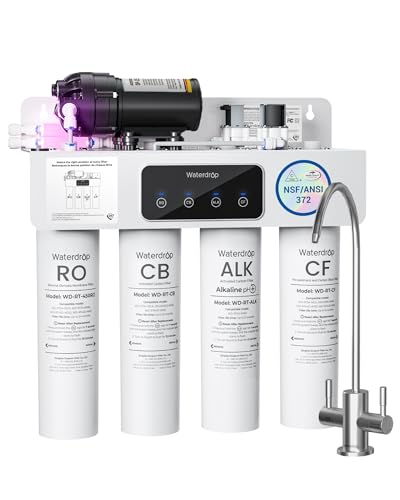
The WD-T4-A gives users two listed purified-water paths: a standard RO stream and a mineral-enhanced alkaline stream. That distinction can be useful for households where people prefer different water profiles, though alkaline labeling does not prove a particular final pH and remineralization should not be treated as a health claim. The system is tankless, rated at 450 GPD, uses 10 listed stages, and requires an electrical connection.
Its published specifications state a 2:1 pure-to-drain ratio and include indicator lights and buzzer alerts for filter changes. The listed schedule identifies a six-month CF filter, a 12-month CB filter, a 24-month RO membrane, and a 12-month alkaline mineralizer. Those are product-published intervals, not guarantees for every well. Faucet installation requires drilling, and the NSF/ANSI 372 claim concerns lead-free material rather than establishing complete-system NSF/ANSI 58 certification.
Pros
- Provides separate standard RO and mineral-enhanced water paths.
- Published with a 450 GPD tankless configuration.
- States a 2:1 pure-to-drain ratio.
- Includes filter reminders with lights and buzzer alerts.
- Lists replacement intervals for its carbon, RO, and alkaline components.
Cons
- Requires electricity and a drilled faucet installation.
- The supplied certification information identifies NSF/ANSI 372, but does not establish NSF/ANSI 58 certification for the complete system.
This model suits buyers who place real value on dual-flow dispensing and maintenance alerts. It is less appropriate for a property where electricity, drilling, or well-water pretreatment is unresolved. Compared with the iSpring RCC7AK-BN, it offers a more flexible tankless interface but has less complete-system certification evidence in the supplied information.
To buy this product, click here.
7. DREO Countertop Reverse Osmosis Water Filter — Best Countertop Option

The DREO is the only countertop model in this selection, which makes it relevant for a cabin, temporary setup, or kitchen where under-sink plumbing changes are unwelcome. Its listing describes an install-free format with two autofill pitchers, self-cleaning, TDS and filter-life information, and a stated 3:1 pure-to-drain ratio. Those features shift the work from plumbing to countertop management, reservoir filling, and keeping the unit supplied with water.
The product information describes a seven-in-one RO system and says it was tested by SGS to meet NSF/ANSI 58 standards. That wording should remain separate from a claim that the complete system is NSF/ANSI 58 certified. The listing names PFOA, PFOS, chlorine, and fluoride among possible reduction targets, but it does not provide a well-water suitability statement, rated GPD figure, minimum pressure, or detailed filter schedule in the supplied information. For a private well, that makes source-water testing especially important.
Pros
- Countertop format avoids the under-sink installation approach described by the other residential systems.
- Includes two autofill pitchers according to the product information.
- Lists TDS and filter-life displays.
- States a 3:1 pure-to-drain ratio.
- Product information references SGS testing against NSF/ANSI 58 standards.
Cons
- The supplied information does not identify a rated GPD capacity.
- Testing to a standard is not the same as a clearly stated complete-system certification.
The DREO makes the most sense where countertop convenience matters more than cabinet integration. It may be easier to deploy in a small seasonal property, but it does not remove the need to address well-water sediment, hardness, or pressure. Buyers wanting a permanently plumbed faucet, pressure data, or complete-system certification evidence should look elsewhere in this list.
To buy this product, click here.
8. iSpring RCC7-BN — Best Conventional Value

The RCC7-BN is a straightforward five-stage, tank-based under-sink system with a stated 75 GPD rating. Its product information identifies NSF/ANSI 58 certification and lists reduction claims for PFAS, chlorine, fluoride, lead, arsenic, asbestos, calcium, sodium, and other substances. That makes it a practical comparison point against the RCC7AK-BN. The main difference is the absence of a listed AK remineralization stage, so the RCC7-BN is the simpler pick for buyers who want standard RO treatment without mineral addback.
The compact design requires no power source according to the listing, and the transparent first-stage housing lets owners inspect sediment buildup. A check valve, food-grade tubing, and a lead-free faucet are also identified in the product information. Those details may be useful in a conventional kitchen installation, but they do not establish that the unit can accept untreated well water with heavy sediment or scaling. The listing also does not provide a specific wastewater ratio or minimum inlet pressure.
Pros
- Published with a 75 GPD, five-stage configuration.
- Product information claims NSF/ANSI 58 certification.
- Lists reduction claims for PFAS, fluoride, lead, arsenic, chlorine, and other substances.
- Does not require a power source according to the listing.
- Includes a transparent first-stage housing and a check valve.
Cons
- Does not include the AK remineralization stage listed for the RCC7AK-BN.
- The supplied information does not specify well-water pretreatment, pressure requirements, or a drain ratio.
Pick this model if you prefer a conventional tank-based RO system and do not need remineralization. The RCC7AK-BN is the stronger alternative for buyers who want mineral addback and a broader listed feature set. For a well installation, both should be paired with a source-water plan rather than connected blindly to the raw supply.
To buy this product, click here.
9. APEC ROES-50 — Best Traditional 50 GPD System

The APEC ROES-50 is a traditional five-stage under-sink system with a stated 50 GPD capacity, a storage tank, a brushed nickel faucet, and an installation kit. Its lower stated capacity separates it from the 75 GPD iSpring systems and the tankless models rated at 450 GPD or more. For a home with modest point-of-use demand, that may be sufficient, while a busy household should compare the storage and production details rather than focusing on the model’s broad contaminant language.
The supplied information lists arsenic, chlorine, lead, fluoride, heavy metals, PFAS, microplastics, and more than 1,000 impurities among its reduction claims. Those claims are product-specific statements from the listing, not a substitute for testing a private well. The colored tubing and quick-connect fittings are presented as installation aids, while the recommended filter replacement window spans six to 24 months depending on incoming water quality. That range reinforces the importance of source-water conditions, especially where sediment or dissolved minerals are elevated.
Pros
- Published as a five-stage, 50 GPD under-sink RO system.
- Includes a storage tank, faucet, installation kit, and filter set.
- Lists reduction claims for arsenic, lead, fluoride, chlorine, PFAS, and microplastics.
- Uses colored tubing and quick-connect fittings according to the product information.
- Provides a replacement guidance range tied to incoming water quality.
Cons
- The 50 GPD rating is lower than the capacity stated for several competing picks here.
- The supplied information does not identify an NSF/ANSI 58 certification or a wastewater ratio.
The ROES-50 is best for buyers who want a familiar tank-based system and a broad list of stated reduction targets without moving to a high-output tankless platform. A household with heavy demand may prefer the 75 GPD RCC7 models or a higher-rated tankless unit. For well water, confirm that pretreatment and pressure are suitable before relying on the published filter interval.
To buy this product, click here.
Buying Guide
Start With a Well-Water Test
Reverse osmosis is a point-of-use treatment method, not a universal answer for every private-well problem. A current test should identify the substances that matter at your property, along with indicators such as hardness, iron, manganese, sulfur, sediment, nitrate, arsenic, and microbial concerns where applicable. The supplied product information does not establish complete treatment for those categories across this group. A clear sample can still contain dissolved contaminants, while a cloudy sample may signal pretreatment needs before the RO membrane.
Testing also gives the installer a better idea of whether the system may face rapid sediment loading or scaling. A transparent sediment housing, such as the one listed for several iSpring models, can help owners observe buildup, but visual inspection cannot replace a water analysis. Treat the RO unit as one part of a treatment train when the well report identifies a problem outside the product’s documented claims.
Separate Pretreatment From Drinking-Water RO
Well water may need sediment filtration, iron treatment, manganese treatment, sulfur control, softening, or disinfection before it reaches a small under-sink membrane. None of the supplied products is clearly identified as a complete whole-property pretreatment system. The CRO1000 provides large sediment and carbon filters, but its listing still does not establish that it handles every well-water condition without additional equipment.
Hardness deserves special attention. An RO system can reduce some dissolved substances, but that does not make it a whole-house water softener. If scaling is present, ask a qualified water-treatment professional to evaluate membrane protection and pretreatment rather than assuming a higher GPD rating solves the issue.
Check Pressure Before Choosing Tankless
Tankless systems often use powered components and are more dependent on installation conditions than their capacity number suggests. The Waterdrop G3P600, Waterdrop WD-T4-A, and iSpring CRO1000 include different forms of tankless architecture, while the GFU03 is described as water-powered. The CRO1000 listing provides the clearest pressure information, including a stated operating range and an optional booster-pump reference.
Do not transfer that pressure information to another model. The G3P600 and WD-T4-A listings do not establish the same minimum pressure, and the GFU03 specifically says output depends on inlet pressure while recommending at least 40 PSI. A well pump that delivers acceptable pressure at rest may behave differently during simultaneous household use.
Use GPD as a Rating, Not a Guarantee
Gallons per day is a rated production figure. It is useful for comparing a stated 50, 75, 450, 600, 800, or 1,000 GPD system, but it does not guarantee that a household will receive that volume under its actual pressure and water conditions. It also says nothing by itself about certification, contaminant reduction, maintenance, or wastewater.
Flow rate and storage are separate questions. The CRO1000 lists a 0.7 GPM flow rate, while the G3P600 lists an eight-ounce fill time. Those figures should not be treated as interchangeable with GPD. Tank-based systems may rely on stored water for short periods of higher demand, while tankless systems produce water directly according to their operating conditions.
Read Certification Language Precisely
Certification evidence varies across these products. The iSpring RCC7AK-BN, RCC7-BN, RCC7AK-UV, VIVA21, and Waterdrop G3P600 listings use specific NSF or WQA language, while the DREO listing references SGS testing against NSF/ANSI 58 standards. Testing to a standard and certification to a standard are different statements. The WD-T4-A listing identifies NSF/ANSI 372, which concerns lead-free material, rather than establishing complete-system NSF/ANSI 58 certification in the supplied information.
Certification also has a scope. NSF/ANSI 58 evidence should not be expanded into proof of every contaminant claim, and NSF/ANSI 372 should not be treated as a contaminant-reduction standard. Keep each claim attached to the model, standard, and function actually identified in the product information.
Compare Wastewater Claims Carefully
Several products publish ratios, including 2:1 for the Waterdrop G3P600 and WD-T4-A, 3:1 for the GFU03 and DREO, and no clearly stated ratio for several tank-based systems. Those figures are useful only when the direction of the ratio is clear. Do not turn an ambiguous marketing ratio into a calculated recovery percentage or assume that every system uses the same definition.
A lower stated drain ratio can matter for a property with limited water supply, but it does not prove better contaminant reduction. Ask how the figure was defined and under what conditions it applies, especially if the well has unusual pressure or mineral content.
Plan Filter Access and Replacement
Private-well owners may face heavier sediment or mineral loading than city-water users, so access to prefilters matters. The iSpring units and APEC model use visible or accessible components, while the Waterdrop G3P600 and GFU03 emphasize quick cartridge changes. Those convenience claims concern the replacement process, not guaranteed filter life.
The CRO1000 provides the most detailed published maintenance schedule in this group, listing three-to-six-month replacement for the first filter, six-to-12-month replacement for the second and third filters, and two-to-three years for the membrane depending on water quality. The APEC listing gives a six-to-24-month filter range. Treat these as manufacturer guidance, then adjust only with evidence from water testing, pressure behavior, and actual filter condition.
Best Reverse Osmosis Systems for Well Water FAQ
Is reverse osmosis enough for well water?
Usually, that cannot be answered from the RO product listing alone. Well water varies widely, and the supplied products do not establish complete treatment for every possible issue. Test the source water first. Sediment, hardness, iron, manganese, sulfur, nitrate, arsenic, and microbial concerns may require separate treatment or pretreatment before water reaches the RO membrane.
Which system is best for a private well?
The iSpring RCC7AK-BN is the strongest general-purpose pick in this group because its listing combines a 75 GPD under-sink format, an NSF/ANSI 58 certification claim, named reduction claims, and remineralization. That recommendation assumes the well water has been tested and prepared appropriately. A different model may be better if your priority is high capacity, tankless operation, UV, countertop use, or electric-free operation.
Do I need a water softener before an RO system?
That depends on the water test and the treatment design. The supplied information does not provide a universal hardness limit for these systems, so a softener cannot be prescribed from the product names alone. Hardness can contribute to scaling, and pretreatment may help protect an RO membrane, but softening and reverse osmosis perform different jobs.
Can an RO system remove iron and manganese from well water?
Do not assume that it can handle every concentration or chemical form. Some listings name iron or heavy metals, but those claims should remain tied to the exact product wording and test scope. A well-water treatment plan may need dedicated iron or manganese equipment before the RO unit. Use a current laboratory report to determine the appropriate approach.
Do these systems require electricity?
Some do and some do not. The Waterdrop G3P600 and WD-T4-A listings require electricity, while the iSpring RCC7-BN is described as requiring no power source. The GFU03 is described as electric-free and water-powered. The CRO1000 is a tankless commercial-style system with pressure monitoring and an optional booster-pump reference. Confirm the exact model requirements before installation.
Is a higher GPD rating better for well water?
Not automatically. GPD describes a rated production capacity, not universal filtration quality, contaminant reduction, pressure tolerance, or well-water suitability. Higher capacity may matter for heavier demand, but source-water chemistry and pressure can be more important than the number printed in the product title.
Should I choose a tank or tankless RO system for a well?
A tank-based system stores treated water and may be simpler where electricity is limited. A tankless system can save cabinet space and may publish a higher production rating, but it can require electricity and closer attention to pressure. Compare the exact model’s pressure, flow, storage, installation, and drain information instead of assuming one architecture is always superior.
Final Verdict
The iSpring RCC7AK-BN is the strongest overall recommendation for this group because it combines a conventional 75 GPD under-sink format with a published NSF/ANSI 58 certification claim, named contaminant-reduction figures, a transparent sediment housing, and an AK remineralization stage. Its evidence is more useful for comparison than a broad promise of clean water, but it still should not be connected to untreated well water without reviewing a current source-water test and any necessary pretreatment.
For high daily demand, the iSpring CRO1000 offers the clearest capacity and pressure-monitoring story, while the Waterdrop G3P600 is the more feature-focused tankless alternative. The RCC7AK-UV fits buyers who specifically want UV and remineralization, the GFU03 suits those interested in an electric-free design with a stated 3:1 ratio, and the DREO is the practical countertop route. Match the final choice to the well report, available pressure, installation limits, electricity, maintenance access, and the exact contaminant evidence that matters at your property.
