Category: RO Basics & Technology
Understand how reverse osmosis works, from membranes, GPD and water pressure to rejection rates, recovery, wastewater and certification standards. This section explains the technology behind RO systems and the numbers that matter when comparing their performance.
Posted on November 12, 2026 by Mikel
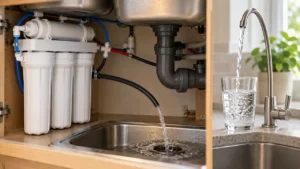
A reverse osmosis (RO) system may send several gallons of water to the drain for each gallon of drinking water it produces, but there is no single wastewater ratio that applies to every system. A conventional under-sink unit might use […]
Continue reading How Much Water Does Reverse Osmosis Waste? →

Posted on November 4, 2026 by Mikel
NSF/ANSI 58 is a standard for reverse osmosis (RO) drinking-water treatment systems. It sets requirements for system safety and performance, including materials safety, structural integrity, reduction of total dissolved solids (TDS), and information supplied to users. It also provides a […]
Continue reading What Is NSF/ANSI 58 for Reverse Osmosis Systems? →

Posted on November 2, 2026 by Mikel
NSF certification matters most when a reverse osmosis system will supply drinking and cooking water every day. A familiar stage count or a dramatic contaminant-removal headline does not tell the whole story. The useful question is whether the complete system, […]
Continue reading Best NSF Certified Reverse Osmosis Systems: 9 Picks in 2026 →
Posted on October 31, 2026 by Mikel
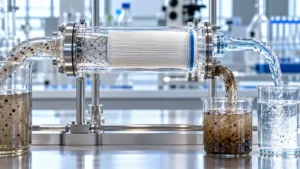
Recovery rate and rejection rate measure two different parts of reverse osmosis performance. Recovery rate tells you how much feed water becomes product water. Rejection rate tells you how effectively the membrane keeps dissolved material out of that product water. […]
Continue reading Reverse Osmosis Recovery Rate vs Rejection Rate →
Posted on October 27, 2026 by Mikel
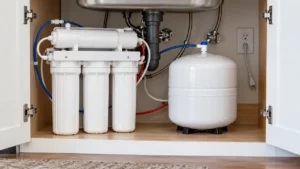
No, a reverse osmosis (RO) system does not necessarily need electricity. A conventional under-sink system can use water-supply pressure to push water through its filters and RO membrane, then store the filtered water in a pressurized tank. Other designs, including […]
Continue reading Does a Reverse Osmosis System Need Electricity? →

Posted on October 19, 2026 by Mikel
GPD means gallons per day. On a reverse osmosis (RO) membrane or system, it describes a rated capacity to produce filtered water over 24 hours under specified test conditions. A 75 GPD label does not guarantee 75 gallons of filtered […]
Continue reading What Does GPD Mean in a Reverse Osmosis System? →
Posted on October 7, 2026 by Mikel
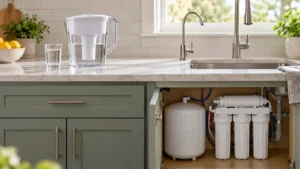
Reverse osmosis and water filtration both improve water quality, but they do not describe two completely separate categories. Reverse osmosis is itself a membrane-based water-treatment process. In everyday use, however, water filtration often refers to conventional systems that rely on […]
Continue reading Reverse Osmosis vs Water Filtration: What’s the Difference? →
Posted on October 5, 2026 by Mikel
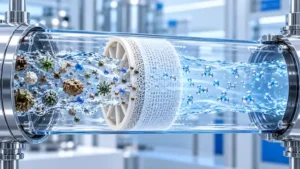
Reverse osmosis is a water-treatment process that uses pressure to move water through a semipermeable membrane. The membrane preferentially allows water to pass while rejecting much of the dissolved material in the feed water, including many salts, minerals, metals, and […]
Continue reading What Is Reverse Osmosis and How Does It Work? →

Posted on October 2, 2026 by Mikel
A reverse osmosis system for home use has to fit two spaces at once: the water-treatment plan and the cabinet beneath the sink. A high-capacity tankless unit may suit a busy household, while a conventional tank system can make more […]
Continue reading Best Reverse Osmosis Systems for Home: 9 Picks in 2026 →