
A well-water treatment setup has to solve two separate problems at once. Sediment, iron, sulfur, hardness, and unpleasant odors can affect the whole plumbing system, while reverse osmosis is usually aimed at producing more highly filtered water for drinking and cooking. That distinction matters because a whole-house filter with a softener is not automatically a whole-house RO system, and an under-sink RO unit is not automatically suitable for every tap in a home.
The products in this group vary sharply in architecture. The PRO+AQUA Elite and Aquasure bundles combine whole-house treatment with a dedicated RO stage, while the iSpring CRO1000 is a high-capacity tankless RO system intended for homes and light commercial applications. Look closely at stated capacity, pretreatment, pressure requirements, installation location, replacement intervals, and the exact contaminants named in the product information. A household with rusty well water has different priorities from a home that mainly needs high-volume purified water at a selected outlet.
Among the eligible options, the PRO+AQUA Elite is the strongest overall fit because it combines well-water pretreatment, softening, whole-house filtration, and an RO system in one package. Aquasure is a practical alternative for buyers who want a bundle with a stated 75 GPD RO rating and automatic softener controls, while the iSpring CRO1000 is better suited to buyers prioritizing high rated RO production and tankless operation.
Quick Answer
- Best Overall: PRO+AQUA Elite 5-Stage Whole House Water Softener and Filter Bundle for households seeking combined well-water treatment and RO filtration.
- Best Bundled Alternative: Aquasure Whole House Water Filtration Bundle for a whole-house softener, pre-filter, and stated 75 GPD RO system.
- Best High-Capacity RO Option: iSpring CRO1000 for buyers who need a tankless system with a stated 1,000 GPD rating.
Best Whole House RO Systems for Well Water Comparison Table
| Product | Best For | System Type | Stated RO Capacity | Notable Details |
|---|---|---|---|---|
| PRO+AQUA Elite Bundle | Integrated well-water treatment | Whole-house filter, softener, and RO bundle | Not clearly specified | Automatic regeneration, well-water contaminant claims |
| Aquasure Whole House Bundle | Homes wanting bundled softening and RO | Whole-house filter, softener, and RO bundle | 75 GPD | 4-stage RO, digital metered control head |
| iSpring CRO1000 | High-volume RO production | Tankless commercial-style RO system | 1,000 GPD | 0.7 GPM stated flow, pressure gauges, optional booster pump |
The detailed reviews explain which of these three systems aligns most closely with different well-water treatment and purified-water demands.
1. PRO+AQUA Elite 5-Stage Whole House Water Softener and Filter Bundle System — Best Overall
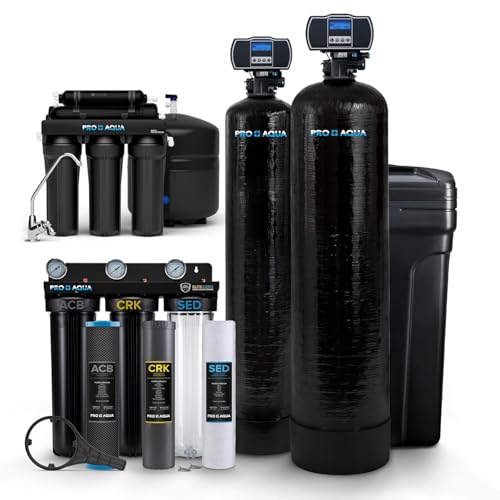
A well-water home can have a treatment problem that reaches far beyond the drinking faucet. Hardness may leave scale on fixtures, while iron, sulfur, sediment, and heavy metals can affect the smell and appearance of water throughout the property. The PRO+AQUA Elite bundle addresses that broader scenario with a five-stage package that combines a whole-house filter, water softener, and an RO system. The product information specifically identifies well-water use and names iron, sulfur, sediment, chlorine, heavy metals, and hardness among its treatment targets.
The bundle is aimed at small to medium households with roughly three to four bathrooms, according to the product description. Its separate systems are described as regenerating automatically, which may reduce the amount of routine manual attention compared with a setup that relies on frequent hands-on control. The RO portion is included in the bundle, but the supplied information does not clearly state its GPD rating, recovery rate, wastewater ratio, or exact membrane specifications. That makes this package strongest for buyers focused on broad well-water treatment rather than shoppers comparing RO output alone.
Pros
- Combines whole-house filtration, water softening, and an RO system in one bundle.
- Product information specifically identifies use with well water.
- Names iron, sulfur, sediment, chlorine, heavy metals, and hardness among its treatment targets.
- Whole-house components are described as having automatic regeneration.
- Includes stated warranty coverage and lifetime technical support.
Cons
- The supplied product information does not clearly identify the RO system’s GPD rating.
- Recovery rate, wastewater characteristics, and specific RO certification details are not clearly specified.
This is the most sensible pick for a homeowner who wants the well-water side of the installation addressed before relying on RO treatment for purified water. Buyers mainly interested in a clearly stated RO production rate may prefer the Aquasure bundle or iSpring CRO1000. The central trade-off is breadth of treatment versus detailed RO performance information.
To buy this product, click here.
2. Aquasure Whole House Water Filtration Bundle With Water Softener and RO System — Best Stated RO Capacity in a Bundle

Aquasure takes a bundled approach that may appeal to homeowners who want softening, whole-house pre-filtration, and RO treatment purchased together. The package is described for homes with one to six bathrooms and includes a 72,000-grain water softener, a dual-purpose sediment and GAC pre-filter, and a four-stage RO system rated at 75 GPD. That stated RO figure gives shoppers a clearer capacity reference than the PRO+AQUA listing provides, although it should still be read as a rated specification rather than a promise of identical daily output under every well-water condition.
The pre-filter is described as addressing soil, silt, sand, rust, sediment, odors, chlorine, VOCs, and heavy metals, while the softener is intended to treat hardness. A programmable digital metered control head handles automatic regeneration and backwashing for the softener system. The RO filters are listed for replacement every six to twelve months for best filtration and flow rate, but the product information does not provide a specific membrane replacement schedule or recovery figure. This makes Aquasure attractive for buyers who value a defined bundle and digital controls, with some RO ownership details still left open.
Pros
- Includes a stated 75 GPD, four-stage RO system.
- Combines a water softener, sediment/GAC pre-filter, and RO system.
- Listed for homes with one to six bathrooms.
- Digital metered controls support automatic regeneration and backwashing.
- Product information identifies a fiberglass-lined tank, bypass valve, and prefilled resin.
Cons
- The published information does not clearly specify the RO system’s recovery rate or wastewater ratio.
- The supplied details do not establish a specific NSF/ANSI certification for the complete RO system.
Aquasure fits households that want a broad treatment package and prefer seeing a stated RO capacity before purchase. It may be less suitable for a buyer who needs a high-output tankless RO platform or who wants detailed information about water efficiency. Compared with the PRO+AQUA Elite, its 75 GPD figure offers clearer RO capacity information, while the PRO+AQUA package presents a more specifically well-water-focused treatment description.
To buy this product, click here.
3. iSpring CRO1000 4-Stage Tankless Commercial Reverse Osmosis Water Filtration System — Best High-Capacity RO Option

The iSpring CRO1000 is a different proposition from the two bundled systems above. It is a tankless, commercial-style RO unit with a stated 1,000 GPD capacity and a listed 0.7 GPM flow rate. The product information describes applications including houses, restaurants, offices, and small businesses, along with connections for drinking-water faucets, dispensers, refrigerators, ice makers, espresso machines, and other equipment. Those details make it appealing for a property that needs substantial purified-water production rather than a conventional household RO outlet.
Pressure deserves close attention here. The supplied specifications identify a working range of 80 to 130 psi and recommend the optional PMP1000 booster pump below 80 psi. That is particularly relevant for well-water homes, where pressure conditions can vary and pretreatment may be needed before water reaches the RO membrane. The four-stage arrangement includes a 20-inch sediment filter, two carbon block filters, and a 1,000 GPD RO membrane. Filter replacement intervals are stated, but the product information does not clearly establish a whole-house treatment package for iron, manganese, hardness, or sulfur.
Pros
- Provides a stated 1,000 GPD rated RO capacity.
- Tankless design supplies a listed 0.7 GPM flow rate.
- Includes inlet and outlet pressure gauges for monitoring.
- Uses a 20-inch sediment filter, two carbon block filters, and a 1,000 GPD RO membrane.
- Product information identifies an optional booster pump for pressure below 80 psi.
Cons
- The system is not presented as a complete well-water softening and pretreatment package.
- The supplied specifications do not clearly identify a recovery rate or wastewater ratio.
The CRO1000 makes the most sense for buyers who already have suitable well-water pretreatment or need high-volume RO production for selected outlets and equipment. A home with untreated hardness, iron, sulfur, or heavy sediment may need additional treatment before this system. Compared with the bundled options, it offers much higher stated RO capacity, but it leaves more of the well-water preparation and installation planning to the purchaser.
To buy this product, click here.
Buying Guide
Separate Whole-House Treatment From RO Treatment
Well water often carries issues that affect every fixture, while RO is typically used for a more focused purified-water supply. A sediment filter can address particles, a softener targets hardness, and carbon-based stages may address certain taste, odor, or chlorine-related concerns. RO treatment serves a different purpose. A bundle such as PRO+AQUA or Aquasure is therefore easier to compare with the iSpring CRO1000 if you first identify whether the home needs broad pretreatment, high-capacity RO, or both.
Read the Well-Water Claims Carefully
Iron, manganese, sulfur, hardness, and sediment are separate water-quality concerns. A product that names one does not automatically establish performance for the others. The PRO+AQUA and Aquasure listings provide broader well-water and whole-house treatment descriptions, while the CRO1000 supplies more detail about RO capacity and pressure. A laboratory analysis of the home’s source water can help determine which claims are relevant before equipment is selected.
Use GPD as a Capacity Reference
Gallons per day is a rated production figure, not a guarantee that a system will deliver that amount under every pressure, temperature, and water-quality condition. Aquasure lists 75 GPD, while the iSpring CRO1000 lists 1,000 GPD. Those numbers describe a major capacity difference, but they do not establish which system removes more contaminants or produces less wastewater.
Check Pressure Before Choosing a High-Output Unit
The iSpring CRO1000 product information identifies an 80 to 130 psi working range and recommends an optional booster pump below 80 psi. That detail matters for well-water installations. A high rated capacity does little practical good if the feed-water conditions do not support the unit’s stated operating range. The PRO+AQUA and Aquasure listings emphasize automatic softener controls, but their supplied information does not provide comparable RO pressure details.
Ask About Recovery, Wastewater, and Maintenance
None of the three eligible products provides a clearly stated recovery rate or wastewater ratio in the supplied information. Avoid assuming that tankless operation means zero wastewater or that a larger GPD figure means better water efficiency. Also review replacement schedules. Aquasure lists RO filter replacement every six to twelve months, while iSpring identifies three to six months for its first-stage filter, six to twelve months for the second and third filters, and two to three years for the membrane, depending on water quality.
Verify Certification Scope
Certification language needs careful reading. The iSpring CRO1000 information describes its membrane as removing up to 99% of more than 1,000 contaminants, but that product claim should not be expanded into a general certification statement. Aquasure and PRO+AQUA also have different supplied claims and do not provide the same certification details. A reference to tested components or a named standard does not automatically establish certification of the complete system.
Best Whole House RO Systems for Well Water FAQ
Can A Whole-House Water Filter Replace A Whole-House RO System?
No. A whole-house filter may address sediment, chlorine, odors, iron, manganese, or hardness depending on its configuration, while RO is a separate membrane-based treatment process. The product must explicitly include or support RO treatment before it should be described as a whole-house RO system.
Which Product Is The Best Overall For Well Water?
The PRO+AQUA Elite is the strongest overall fit among these eligible options because its bundle combines well-water filtration, softening, and an RO system. Its listing specifically names several common well-water concerns. The RO capacity and recovery details are less clearly stated than those of the other products, so buyers focused on output should review the Aquasure and iSpring alternatives.
Is The iSpring CRO1000 A Complete Well-Water Treatment System?
The supplied information describes the CRO1000 as a tankless commercial-style RO system for homes and other applications. It does not present the unit as a complete softener or whole-house pretreatment package for iron, sulfur, manganese, hardness, and sediment. A home with those concerns may need separate pretreatment before the RO stage.
Does A Higher GPD Rating Mean Better Filtration?
No. GPD describes rated production capacity. It does not by itself prove higher contaminant reduction, better certification, lower wastewater, or superior water quality. The iSpring CRO1000 has a much higher stated GPD rating than Aquasure, but the two systems serve different buying priorities.
Do These Systems Remove Hardness From Well Water?
The PRO+AQUA and Aquasure bundle descriptions include water-softening components and identify hardness or hard minerals among their treatment purposes. The iSpring CRO1000 listing does not provide the same whole-house softening description. Do not treat RO capacity alone as proof that a system softens all household water.
Does Tankless RO Mean There Is No Wastewater?
No. Tankless architecture describes the absence of a conventional storage tank. It does not establish a zero-waste design or a particular recovery rate. The supplied information for the iSpring CRO1000 does not clearly state its recovery rate or wastewater ratio.
How Often Do RO Filters Need Replacement?
Schedules vary by system and water quality. Aquasure lists its RO filters for replacement every six to twelve months for best filtration and flow rate. The iSpring CRO1000 listing identifies three to six months for the first-stage filter, six to twelve months for the second and third filters, and two to three years for the membrane, depending on conditions. The PRO+AQUA information does not provide an equivalent RO replacement schedule.
Final Verdict
The PRO+AQUA Elite is the best overall match for a homeowner searching for a combined well-water and RO package. Its stated treatment scope reaches beyond purified drinking water and includes whole-house filtration and softening, which is meaningful for homes dealing with several source-water problems at once. The main limitation is the lack of clearly supplied RO capacity, recovery, and wastewater figures.
Aquasure is the better alternative for buyers who want a stated 75 GPD RO rating alongside automatic softener controls and a broad pre-filter. The iSpring CRO1000 is the specialist choice for high rated RO production, with 1,000 GPD capacity, a listed 0.7 GPM flow rate, and pressure gauges, but it should not be mistaken for a complete well-water pretreatment system. Match the final selection to the water analysis, pressure conditions, required outlets, and maintenance plan rather than choosing by GPD alone.
