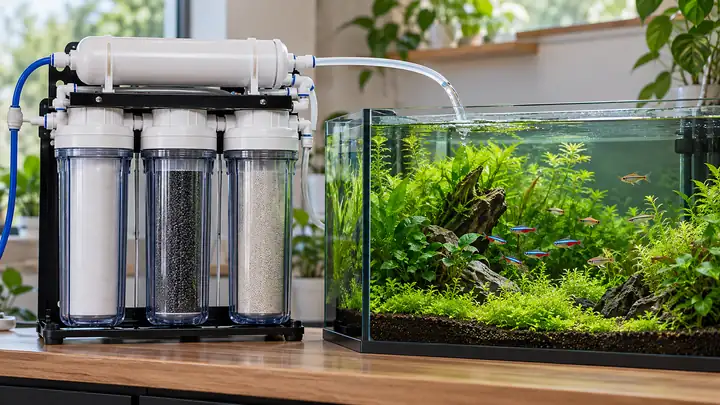
A reef tank can look crystal clear while its source water quietly carries dissolved solids, chlorine, metals, or other substances that complicate mixing and maintenance. That is why aquarists search for the best reverse osmosis systems for aquariums, especially when tap water varies from season to season or a sensitive setup demands repeatable water preparation. An RO/DI system removes much of the uncertainty by combining sediment and carbon filtration with a reverse osmosis membrane and, in these picks, a final deionization stage.
The common mistake is choosing by GPD alone. A higher rated production figure does not automatically mean better filtration, lower wastewater, or a better fit for a small fish room. Aquarium buyers should also check whether the system includes DI resin, whether it addresses chloramine, how replacement status is shown, whether a pressure gauge or flush valve is included, and whether the installation suits the available space. A freshwater keeper, reef aquarist, shrimp breeder, and aquarium store may all prioritize different details.
For the broadest combination of aquarium-focused filtration, output, monitoring, and maintenance features, the AquaticLife 4-Stage RO/DI Filter with Carbon Plus is the strongest overall recommendation here. Its 100 GPD rating, Carbon Plus stage, color-changing DI resin, pressure gauge, automatic shutoff, and flush valve give it a well-rounded specification sheet, while other options offer better portability, higher stated output, simpler cartridge changes, or a lower entry cost.
Quick Answer
- Best Overall: AquaticLife 4-Stage RO/DI Filter with Carbon Plus for chloramine-conscious aquarium owners who want monitoring and automatic operating features.
- Best High-Capacity Option: iSpring RCC1DP Tankless RO/DI System for buyers who value a 150 GPD rating and pump-assisted operation.
- Best for Simple Maintenance: Aquatic Life Twist-in 4-Stage RO/DI Aquarium Filter for quick-change cartridges and a 75 GPD rating.
- Best Budget RO/DI: Aquatic Life RO Buddie 4-Stage Aquarium Water Filter System for smaller aquarium setups seeking a four-stage RO/DI layout.
Best Reverse Osmosis Systems for Aquariums Comparison Table
| Product | Best For | System Type | Rated Capacity | Notable Feature |
|---|---|---|---|---|
| AquaticLife 4-Stage RO/DI Filter with Carbon Plus | Chloramine-conscious aquarists | 4-stage RO/DI | 100 GPD | Carbon Plus, pressure gauge, ASO, flush valve |
| iSpring RCC1DP Tankless RO/DI System | High stated output | 5-stage tankless RO/DI with pump | 150 GPD | Published 0 to 1 ppm TDS claim |
| Bulk Reef Supply 4 Stage Value Plus | Monitoring-focused reef keepers | 4-stage RO/DI | 75 GPD | Built-in TDS meter and pressure gauge |
| Max Water 6 Stage Aquarium System | Multi-stage aquarium filtration | 6-stage RO/DI | 100 GPD | Color-coded connections and labeled housings |
| Aquatic Life Twist-in 4-Stage RO/DI | Simple cartridge changes | 4-stage RO/DI | 75 GPD | Tool-free twist-in cartridges |
| 4-Stage Aquarium RO System with Flushing Valve | Portable installations | 4-stage RO/DI | 100 GPD at 60 psi | Flush valve, wall hardware, long hose |
| Aquatic Life RO Buddie | Smaller aquarium setups | 4-stage RO/DI | 50 GPD | Color-changing DI resin |
| 4 Stage Reverse Osmosis Aquarium Water Filter | Wall-mounted fish rooms | 4-stage RO/DI | 100 GPD | Pressure gauge and quick-change filters |
| Geekpure 4 Stage Portable RO System | Portable aquarium use | 4-stage portable RO/DI | 100 GPD at 60 psi | Stated 1:2 pure-to-waste ratio |
The detailed picks below separate output ratings, DI design, chloramine handling, monitoring, installation, and maintenance so you can match the system to your aquarium routine.
1. AquaticLife 4-Stage RO/DI Filter with Carbon Plus — Best Overall
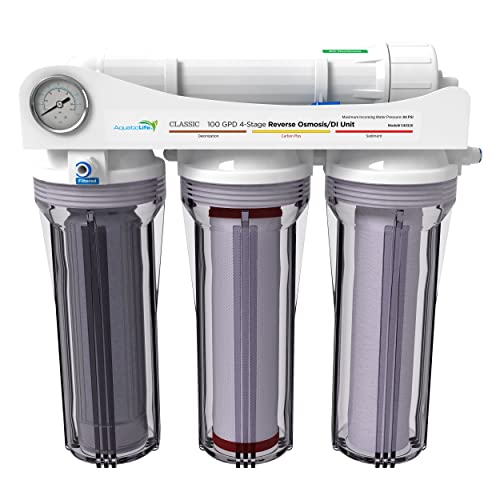
Aquarium water preparation gets easier to monitor when the system gives you more than a membrane and a DI cartridge. This AquaticLife model combines a sediment cartridge, Carbon Plus cartridge, 100 GPD membrane, and refillable 10-inch color-changing DI cartridge. The supplied information specifically describes Carbon Plus as reducing up to 98% of chloramines and 99% of chlorine, a meaningful distinction for aquarists whose municipal water uses chloramine treatment.
The built-in liquid-filled pressure gauge adds a useful visual checkpoint, while the automatic shutoff solenoid and flush valve give the setup more control during operation and maintenance. The listing says this system is not intended for drinking water, which is perfectly relevant to an aquarium-focused buyer but makes its application clear. A reef keeper preparing regular batches has more operating information at hand than with a basic four-stage unit, although the 100 GPD figure remains a rated capacity rather than a guaranteed daily output in every installation.
Pros
- Includes sediment, Carbon Plus, RO membrane, and DI stages.
- Published Carbon Plus claims address chlorine and chloramines.
- Rated capacity is up to 100 GPD.
- Built-in pressure gauge helps track system conditions.
- Automatic shutoff solenoid and flush valve are included.
Cons
- The listing clearly says it is not intended for drinking water.
- The supplied information does not identify a wastewater ratio.
This is the most complete fit for aquarium owners who want RO/DI filtration plus practical monitoring and chloramine-focused carbon treatment. Buyers who only need occasional water for a small tank may prefer the lower-capacity RO Buddie, while those needing a stated 150 GPD rating may look toward iSpring.
To buy this product, click here.
2. iSpring RCC1DP Tankless RO/DI System — Best High-Capacity Option

The iSpring RCC1DP is aimed at aquarium owners who want a higher stated production figure and pump-assisted filtration. Its tankless five-stage configuration includes RO and DI treatment, and the listing gives a 150 GPD membrane rating. The supplied product information also says the pump technology supports consistent performance in low-pressure environments, although it does not provide a specific minimum inlet-pressure figure.
For reef systems, the published 0 to 1 ppm TDS claim is the detail most likely to attract attention. That figure describes the product information’s stated output target, not a universal guarantee under every source-water condition. The system is also described for aquariums, reefs, and fish tanks, making its application clearer than a general under-sink drinking unit. A tankless layout may appeal to fish rooms with repeated water-making sessions, though the listing does not provide a wastewater ratio or detailed replacement schedule.
Pros
- Explicitly described for aquariums, reefs, and fish tanks.
- Rated 150 GPD RO membrane capacity.
- Includes pump-assisted operation.
- Published product information states 0 to 1 ppm TDS output.
- Uses a five-stage RO/DI configuration.
Cons
- The supplied specifications do not identify a wastewater ratio.
- The listing does not provide a specific minimum inlet-pressure requirement.
Choose this model for a larger aquarium routine where the stated 150 GPD rating and pump are more useful than a simpler, lower-capacity frame. A smaller setup may gain better value from a 50 or 75 GPD system, and buyers who want an integrated TDS meter should look at Bulk Reef Supply instead.
To buy this product, click here.
3. Bulk Reef Supply 4 Stage Value Plus — Best for Monitoring

Reef keepers often want a clear signal that the membrane and DI stage are still doing their jobs. This four-stage system addresses that need with a built-in TDS meter that measures pre-DI and post-membrane conditions, plus a pressure gauge that helps track the sediment pre-filter. Those readings do not identify every contaminant, but they can make routine maintenance less of a guessing exercise.
The system is rated at 75 GPD and uses sediment removal, chlorine and VOC reduction, RO filtration, and final DI polishing. Its automatic shutoff solenoid and flush valve add useful operating controls, while the supplied installation accessories include a garden hose connection, sink adapter, and canister wrench. The listing describes up to 99% efficiency for the membrane stage, but does not identify a specific certification for the complete system, so buyers should keep that distinction in view.
Pros
- Built-in TDS meter provides pre-DI and post-membrane readings.
- Pressure gauge tracks the sediment pre-filter condition.
- Includes RO and final DI polishing stages.
- Automatic shutoff solenoid and flush valve are included.
- Installation accessories and canister wrench are supplied.
Cons
- Rated capacity is 75 GPD rather than 100 or 150 GPD.
- The supplied information does not identify complete-system certification.
This is a sensible match for an aquarist who checks TDS regularly and wants pressure information visible on the unit. It is less compelling for someone who simply wants the highest stated output, and TDS readings should be treated as maintenance information rather than proof of removal for a specific contaminant.
To buy this product, click here.
4. Max Water 6 Stage Aquarium System — Best Multi-Stage Configuration

The Max Water system gives buyers a six-stage RO/DI layout and a 100 GPD rating. Its aquarium-specific description identifies sediment, carbon, RO, and DI treatment within the broader configuration, while the product information claims 0 TDS after the DI stage and discusses reduction of odors, lead, fluoride, copper, and other listed substances. Those claims belong to this product listing and should not be generalized to every RO/DI system.
Practical setup details are a major part of the appeal. Color-coded quick connections and labeled filter housings can make it easier to follow tubing and identify replacement points, especially for a first aquarium filtration station. The components are described as BPA-free, and the listing notes that a float valve is separate rather than included. The six-stage count may sound impressive, but the useful buying distinction is the stated configuration and installation guidance, not stage count by itself.
Pros
- Rated capacity is 100 GPD.
- Uses RO and DI treatment for aquarium water preparation.
- Color-coded quick connections support installation.
- Filter housings are labeled for replacement guidance.
- Product information identifies BPA-free components.
Cons
- A float valve is identified as a separate purchase.
- The supplied information does not specify a wastewater ratio.
This model fits aquarists who want a more elaborate configuration and clear tubing labels, particularly when setting up a dedicated water-preparation area. A simpler four-stage unit may be easier to compare and maintain, while an owner concerned about chloramine should favor a product with an explicit chloramine claim.
To buy this product, click here.
5. Aquatic Life Twist-in 4-Stage RO/DI Aquarium Filter — Best for Simple Cartridge Changes
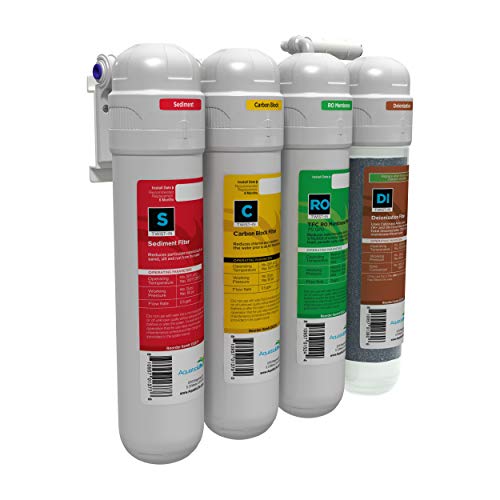
Filter changes can become a messy interruption when an aquarium system relies on tightly installed housings and awkward access. This Aquatic Life model uses twist-in cartridges, allowing the sediment, carbon, RO membrane, and color-changing DI stages to be changed without tools according to the supplied information. The resin shifts from blue to tan as it becomes exhausted, giving the aquarist a visible maintenance cue.
The 75 GPD rating places it between the 50 GPD RO Buddie and several 100 GPD alternatives. Its product information states a 1:10,000 TDS reduction ratio for the RO membrane and identifies aquarium use, while also warning that the carbon stage does not remove chloramines. That limitation matters for municipal water treated with chloramine, where the Carbon Plus model is a more directly supported match.
Pros
- Includes sediment, carbon, RO membrane, and DI resin stages.
- Rated capacity is up to 75 GPD.
- Twist-in cartridges are described as tool-free to change.
- Color-changing DI resin provides a visual replacement cue.
- Product information states aquarium use.
Cons
- The listing says the carbon stage does not remove chloramines.
- The supplied information does not identify a pressure gauge or TDS meter.
This is a strong fit for aquarists who value uncomplicated cartridge servicing and need more output than a basic 50 GPD system. It is less suitable for a chloramine-focused setup or for buyers who want built-in pressure and TDS monitoring on the main unit.
To buy this product, click here.
6. 4-Stage Aquarium RO System with Flushing Valve — Best Portable Installation
This four-stage system is aimed at aquarium owners who need flexibility around placement. The product information describes a compact and portable design for apartments, motorhomes, boats, and other temporary or space-limited settings. It includes PP cotton, activated carbon, RO membrane, and DI resin filtration, with a stated 100 GPD rating at 60 psi.
The flushing valve is central to the maintenance routine. The listing instructs users to flush the RO membrane for five minutes at first use, and it says the resin changes from purple or blue to brown as replacement approaches. A 13-foot hose, wall clips, expansion screws, and operating instructions are included according to the product information. Those details help with placement, although the listing does not provide a wastewater ratio or a complete-system certification claim.
Pros
- Uses four-stage RO/DI filtration.
- Rated 100 GPD at 60 psi.
- Includes a flushing valve for membrane maintenance.
- Supplies a 13-foot hose and wall-mounting hardware.
- Color-changing DI resin indicates replacement status.
Cons
- The supplied information does not identify a wastewater ratio.
- Initial membrane flushing is required before use.
Renters, mobile aquarists, and fish-room owners who cannot dedicate a permanent installation may appreciate the included hose and mounting hardware. A fixed aquarium station with frequent quality checks may be better served by the Bulk Reef Supply model’s TDS meter and pressure gauge.
To buy this product, click here.
7. Aquatic Life RO Buddie 4-Stage Aquarium Water Filter System — Best for Smaller Setups
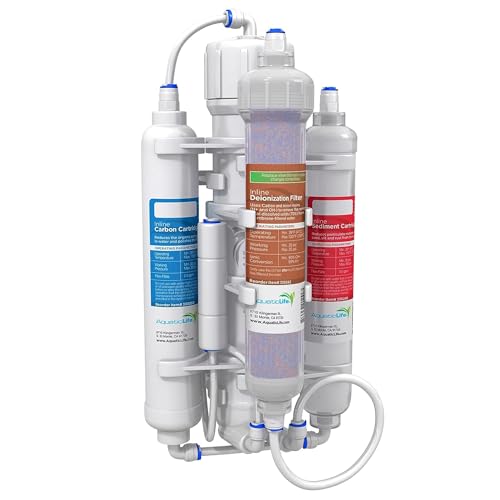
The RO Buddie keeps the aquarium filtration path familiar and focused: sediment filtration, carbon filtration, an RO membrane, and a final color-changing DI resin stage. The 50 GPD rating is the lowest among these selected systems, but that may be entirely adequate for a smaller freshwater tank, shrimp setup, or an owner who makes water in batches rather than maintaining several large systems.
The carbon block is described as helping remove chlorine and odors, while the product information specifically says it does not remove chloramines. After the membrane, the DI resin provides a final polish and changes from blue to tan as it needs replacement. That visual cue is useful for routine care, although the supplied information does not identify a pressure gauge, flush valve, wastewater ratio, or exact membrane performance figure.
Pros
- Four-stage RO/DI configuration suits aquarium water preparation.
- Rated capacity is 50 GPD.
- Includes sediment and carbon pre-filtration.
- Color-changing DI resin helps show replacement status.
- Product information identifies fish tanks and fountains as applications.
Cons
- The listing says the carbon stage does not remove chloramines.
- The supplied information does not identify a pressure gauge or flush valve.
This is the sensible lower-capacity pick for a smaller aquarium routine where a 100 or 150 GPD rating would add little practical value. Larger reef systems or chloramine-treated municipal supplies point toward a higher-capacity unit or a system with an explicit chloramine reduction claim.
To buy this product, click here.
8. 4 Stage Reverse Osmosis Aquarium Water Filter — Best Wall-Mounted Option
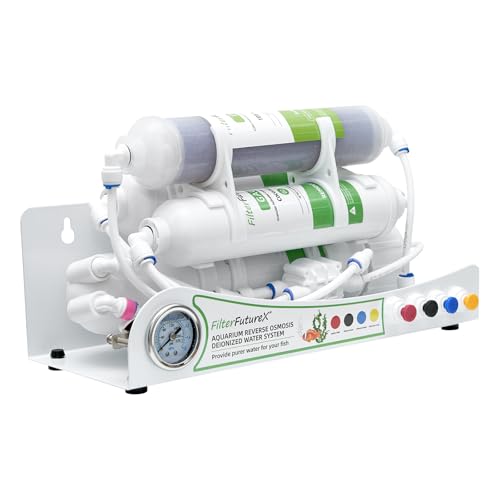
A wall-mounted bracket can make a difference in a fish room where hoses, mixing containers, and test supplies already compete for floor and shelf space. This four-stage system includes PP cotton, activated carbon, an RO membrane, and DI resin, with a stated 100 GPD capacity. The listing specifically mentions aquarium applications involving corals, crystal shrimp, marine tanks, breeding tanks, and planted tanks.
Maintenance information is visible in two ways. The transparent shell lets users watch the DI resin change color, and the integrated pressure gauge provides a way to monitor water pressure through the system. Standard 10-inch quick-change cartridges are also identified. The listing claims a low wastewater ratio, but it does not define the ratio clearly enough to calculate recovery or compare it directly with another model, so buyers should treat that claim cautiously.
Pros
- Rated capacity is 100 GPD.
- Includes four-stage RO/DI filtration.
- Wall-mounted bracket saves work-area space.
- Integrated pressure gauge supports system monitoring.
- Transparent housing and quick-change cartridges aid maintenance.
Cons
- The supplied wastewater claim does not clearly define the ratio.
- The product information does not identify a complete-system certification.
This model suits a dedicated fish room or aquarium shop where wall mounting and visible maintenance information are valuable. Buyers who need a clearly stated ratio, installation accessories, or a built-in TDS meter should compare the Geekpure and Bulk Reef Supply options more closely.
To buy this product, click here.
9. Geekpure 4 Stage Portable RO System — Best for Portable RO/DI Use

Geekpure’s four-stage portable system combines a PP sediment filter, carbon block, RO membrane, and mixed-bed DI filter. The listing gives a 100 GPD rating at 60 psi and describes the system for aquariums, apartments, RVs, boats, and other locations where portability matters. It is tankless and does not include a faucet, which keeps the arrangement focused on producing water for a container or aquarium workflow.
The product information states a 1:2 pure-water-to-wastewater ratio and identifies 1/4-inch tubing, color-coded connections, and quick fittings. It also gives feed-water conditions of 40 to 100 psi, 40 to 110°F, pH 3.0 to 11.0, and maximum TDS of 1,000 ppm. New filters should be flushed for 30 minutes before first use, and the listing says the DI filter generally lasts three to six months, although actual replacement needs depend on use and source water.
Pros
- Four-stage configuration includes a dedicated DI filter.
- Rated capacity is 100 GPD at 60 psi.
- Published information states a 1:2 pure-to-wastewater ratio.
- Includes color-coded tubes and quick connections.
- Feed-water pressure, temperature, pH, and TDS limits are provided.
Cons
- The tankless system cannot turn on and off automatically according to the listing.
- New filters require a 30-minute flush before first use.
This is a useful option for aquarists who move equipment between locations or need a straightforward tankless unit without a permanent faucet setup. A fixed reef station may benefit more from automatic shutoff, a pressure gauge, or integrated TDS monitoring found on other picks.
To buy this product, click here.
Buying Guide
Start With RO/DI, Not RO Alone
For aquarium use, the final DI stage is a major dividing line. RO filtration reduces dissolved solids before the water reaches the resin, and DI treatment then removes remaining ions according to the supplied product descriptions. That configuration appears across all nine selected systems. An ordinary drinking-water RO system without DI should not be treated as interchangeable with an aquarium-focused RO/DI unit.
Match Rated Capacity to Your Routine
The products here range from 50 to 150 GPD. A 50 GPD unit may suit a single smaller aquarium where water is collected in batches, while a 100 or 150 GPD rating may be more practical for several tanks or frequent saltwater changes. GPD is a rated production figure, not a guarantee of exact daily output. Water pressure and operating conditions can affect real production.
Check Chloramine Information
Several listings identify chlorine treatment but specifically say chloramines are not removed. That distinction matters if your municipal water uses chloramine. The AquaticLife Carbon Plus model is the clearest pick in this group because its product information includes a chloramine reduction claim. Do not transfer that claim to the other Aquatic Life models.
Use TDS Monitoring Correctly
A TDS meter can show changes before and after filtration and help signal that a membrane or DI resin needs attention. It cannot identify every contaminant or prove that a particular substance has been removed. Bulk Reef Supply includes pre-DI and post-membrane monitoring, while other models use color-changing resin as the main visual maintenance cue.
Look at DI Resin Replacement Signals
Color-changing resin appears throughout this selection, but the colors differ. Some products describe a blue-to-tan shift, while others identify purple or blue changing to brown. The signal is useful only when read according to that model’s instructions. A visible color change does not replace a product-specific maintenance routine or a TDS check where one is available.
Plan for Wastewater and Flushing
RO systems generally send some water to drain, but the supplied listings do not define their ratios consistently. Geekpure states a 1:2 pure-to-wastewater ratio, while another product uses a less clearly defined low-waste claim. Do not invert an ambiguous ratio or compare percentages that the product information does not establish. Flush valves and first-use instructions also matter, particularly for a new membrane.
Choose the Installation Style Carefully
Portable units can suit apartments, boats, RVs, and temporary aquarium stations. Wall-mounted models can free shelf space in a fish room. A system with a pressure gauge, automatic shutoff, or supplied hose may reduce day-to-day uncertainty, but the product listing should guide the actual connections. Confirm the available water pressure, cold-water requirement where stated, drain arrangement, and container setup before committing to a placement.
Best Reverse Osmosis Systems for Aquariums FAQ
Do aquariums need an RO/DI system instead of an RO system?
Many aquarium keepers choose RO/DI because the DI stage follows the RO membrane and removes remaining dissolved ions according to the product descriptions. This can be especially relevant for reef, shrimp, breeding, and other sensitive setups where consistent source water is a priority. The correct choice still depends on the aquarium type and the source water.
Is a higher GPD rating always better for an aquarium?
No. A higher GPD rating means a higher stated daily production capacity, but it does not establish better filtration, lower wastewater, or higher contaminant removal. A 50 GPD system may be adequate for one smaller tank, while a 100 or 150 GPD system may better suit frequent water changes or multiple aquariums.
Can an aquarium RO/DI system remove chloramine?
Only use a product-specific chloramine claim. The AquaticLife Carbon Plus listing describes reduction of up to 98% of chloramines, while the Aquatic Life RO Buddie and Twist-in listings state that their carbon filtration does not remove chloramines. Generic RO/DI wording does not prove chloramine performance for every model.
What does a color-changing DI resin tell me?
It provides a visual indication that the resin is approaching exhaustion. The exact color change varies by product. A blue-to-tan or purple-to-brown shift should be interpreted using the system’s instructions. TDS monitoring can add another maintenance signal, but a TDS reading does not identify individual contaminants.
Does a tankless RO/DI system produce no wastewater?
No such conclusion should be drawn from a tankless design alone. Tankless describes the system architecture, not its recovery rate or drain behavior. Check for a clearly stated wastewater ratio or recovery figure. The iSpring RCC1DP is tankless, while the Geekpure listing separately states a 1:2 pure-to-wastewater ratio.
Should aquarium RO/DI water be used directly in a fish tank?
RO/DI water has very few dissolved minerals after treatment, so aquarium owners generally need to follow the requirements of their specific livestock and aquarium method before adding it. The product information supplied here focuses on filtration and aquarium applications rather than providing water-mixing or remineralization instructions. Follow the guidance for the particular fish, plants, shrimp, or reef system.
How often should aquarium RO/DI filters be replaced?
Replacement timing depends on the filter type, usage, and source water. The Geekpure listing gives a general DI range of three to six months, while other products rely on color-changing resin indicators without a universal interval. Treat published intervals as product-specific guidance, monitor output, and replace resin or cartridges when the relevant indicator or water-quality check shows decline.
Are these systems suitable for drinking water?
Do not assume that an aquarium RO/DI system is a drinking-water system. The AquaticLife Carbon Plus listing specifically says it is not intended for drinking water. Aquarium filtration objectives differ from household drinking-water requirements, so use each product only for the application supported by its product information.
Final Verdict
The AquaticLife 4-Stage RO/DI Filter with Carbon Plus is the strongest overall fit because it combines a 100 GPD rating with a clearly described carbon stage for chlorine and chloramines, color-changing DI resin, a pressure gauge, automatic shutoff, and a flush valve. Those details address several aquarium maintenance decisions at once. It is also clearly positioned for filtered water production rather than presented as a general household drinking system.
Different aquariums call for different compromises. The iSpring RCC1DP is the higher-capacity choice with pump-assisted, tankless operation and a published 0 to 1 ppm TDS claim. Bulk Reef Supply is better for visible TDS and pressure monitoring, while the Twist-in model simplifies cartridge changes. Smaller tanks may need only the RO Buddie, and portable setups may favor Geekpure or the flushing-valve system. Match the final pick to aquarium demand, source-water treatment, maintenance visibility, available pressure, and the installation space.
