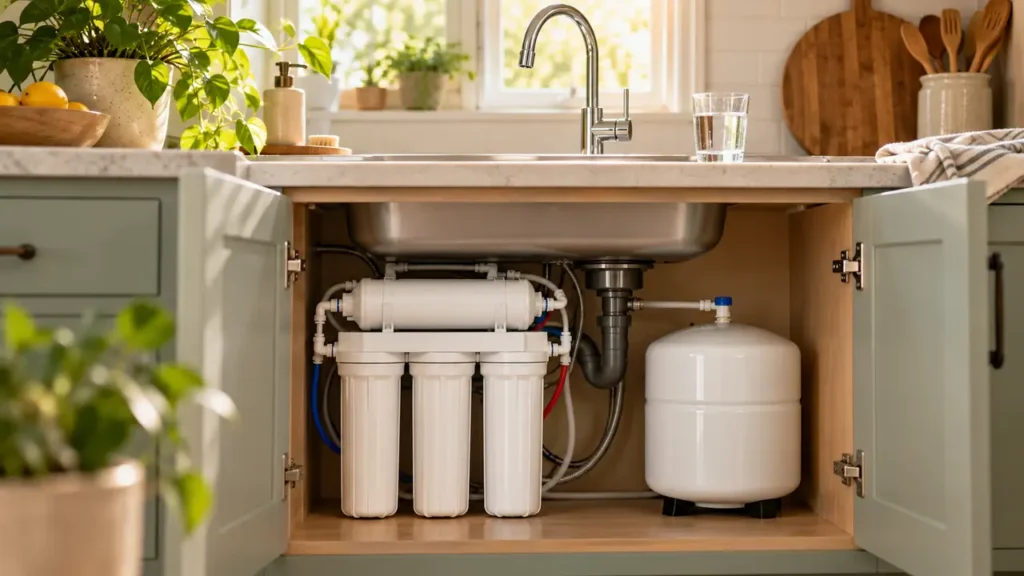
Under-sink reverse osmosis systems can turn a cramped cabinet into a useful point-of-use water station, but the hardware choices are easy to blur together. A traditional tank system stores treated water, a tankless model saves cabinet room, and a higher-rated GPD figure says something about rated production capacity without proving superior filtration. The best match depends on how much water you use, whether electricity is available beneath the sink, and how much installation work your cabinet can accommodate.
Common buying mistakes include treating every five-stage system as equivalent, assuming a TDS figure proves removal of a particular contaminant, and overlooking the drain connection, faucet hole, replacement filters, or available cabinet height. Certification language also deserves close reading. NSF/ANSI 58, NSF/ANSI 372, NSF 42, and WQA certification describe different things, so a broad phrase such as “tested to NSF standards” should not be treated as a complete system certification.
For most households, the iSpring RCC7AK-BN is the strongest all-around starting point because it combines a 75 GPD rating, an alkaline remineralization stage, stated NSF/ANSI 58 certification for the system, and a faucet design intended to simplify installation from above. It is not the right answer for every cabinet or water-use pattern, though. Tankless systems suit shoppers who want fast dispensing and less storage-tank clutter, while a booster-pump model makes more sense where inlet pressure is a concern.
Quick Answer
- Best Overall: iSpring RCC7AK-BN for balanced features, 75 GPD capacity, remineralization, and stated NSF/ANSI 58 certification.
- Best Tankless Option: Waterdrop G3P600 for a compact tankless layout, 600 GPD rated capacity, display faucet, and stated 2:1 drain ratio.
- Best for Low Water Pressure: iSpring RCC7P-AK for its electric booster pump and alkaline remineralization stage.
- Best Water-Efficiency Pick: GLACIER FRESH GFU03 for its stated 3:1 pure-to-drain ratio and electric-free design.
Best Under-Sink Reverse Osmosis Systems Comparison Table
| Product | Best For | System Type | Rated Capacity | Certification or Stated Feature |
|---|---|---|---|---|
| iSpring RCC7AK-BN | Best overall balance | Tank-based, six-stage | 75 GPD | NSF/ANSI 58, alkaline stage |
| Waterdrop G3P600 | Tankless performance | Tankless, eight-stage | 600 GPD | NSF/ANSI 58, 2:1 drain ratio, display faucet |
| iSpring RCC7-BN | Certified five-stage filtration | Tank-based, five-stage | 75 GPD | NSF/ANSI 58 |
| APEC Water ROES-50 | Simple traditional setup | Tank-based, five-stage | 50 GPD | Brushed nickel faucet, tank included |
| Waterdrop G2P600 | High-capacity tankless use | Tankless, seven-stage | 600 GPD | NSF/ANSI 372, 2:1 drain ratio |
| iSpring RCC7P-AK | Lower-pressure homes | Tank-based, six-stage | Not clearly specified | Electric booster pump, alkaline stage |
| iSpring RCC7AK-UV | Alkaline filtration with UV | Tank-based, seven-stage | Not clearly specified | NSF/ANSI 58 and 372, LED UV |
| VIVA21 V21RS5S01 | Certification-focused buyers | Tank-based, five-stage | Not clearly specified | WQA Gold Seal, NSF/ANSI 58 and 372 |
| GLACIER FRESH GFU03 | Electric-free, water-efficient use | Tankless, five-stage | 800 GPD | Stated 3:1 pure-to-drain ratio |
The reviews below focus on the practical differences between tank, tankless, pumped, remineralizing, UV-equipped, and water-efficiency-oriented systems.
1. iSpring RCC7AK-BN — Best Overall

The RCC7AK-BN brings together the features many under-sink buyers are trying to balance. Its 75 GPD rating is higher than the APEC ROES-50’s 50 GPD figure, while the six-stage layout adds a mineral AK stage after reverse osmosis. That setup may appeal to people who dislike the taste profile of conventional RO water and specifically want mineral addback. The supplied information describes the stage as restoring minerals and balanced alkalinity, but it does not establish a particular final pH.
Certification is a major reason this model ranks first. The product information identifies NSF/ANSI 58 certification for the complete RO system and lists specific reduction claims for substances including TDS, PFAS, fluoride, lead, and several metals. The transparent first-stage housing gives users a quick visual check, and the top-mounted faucet fastener can be helpful under a sink where reaching the rear of the faucet hole feels like wrestling with a toolbox. Buyers still need room for the tank and should verify the plumbing layout before installation.
Pros
- 75 GPD rated capacity is stated.
- Whole-system NSF/ANSI 58 certification is identified in the product information.
- Includes a six-stage configuration with an alkaline remineralization stage.
- Top-mounted faucet fastener can simplify faucet installation from above.
- Transparent first-stage housing makes sediment buildup easier to inspect.
Cons
- The system uses a storage-tank layout, so it needs more cabinet planning than a tankless model.
- The published information does not clearly specify a wastewater ratio.
This model fits buyers who want a conventional under-sink system with documented certification, mineral addback, and a moderate 75 GPD rating. A tankless Waterdrop model is a better match for shoppers prioritizing cabinet space, while the iSpring RCC7P-AK is more relevant where a booster pump is needed. For a broad household use case, the RCC7AK-BN offers the most balanced set of supported features in this group.
To buy this product, click here.
2. Waterdrop G3P600 — Best Tankless Option

The G3P600 takes a different route from the familiar tank-and-faucet arrangement. Its tankless body is specified at 18.12 by 5.67 by 17.72 inches, and the product information says the design saves under-sink space compared with a traditional tank layout. That vertical footprint can be useful in a cabinet packed with cleaning supplies, though the measurements deserve a tape-measure check before ordering.
This model also provides more feedback than a basic faucet. The display faucet includes TDS monitoring and a filter-life tracker, giving users a way to view those specific readings and replacement reminders. The listing states a 600 GPD rating, an eight-ounce fill time of eight seconds, and a 2:1 drain ratio. Those figures describe the published specifications, not a guarantee of identical output in every home. Electricity is required beneath the sink, which is the key trade-off against non-electric tank systems.
Pros
- Tankless design avoids an external storage tank.
- 600 GPD rated capacity is stated.
- Display faucet includes TDS and filter-life information.
- Published specifications state a 2:1 low-drain ratio.
- NSF/ANSI 58, NSF/ANSI 372, and NSF 42 claims are identified for specific functions.
Cons
- Requires under-sink electricity.
- The tall cabinet dimensions may not suit every under-sink layout.
The G3P600 suits households that value direct dispensing, a smaller tankless footprint, and visible maintenance information. A conventional iSpring model is simpler for buyers who prefer an electricity-free setup, while the G2P600 offers a similar tankless concept with fewer documented certification details. This is the stronger pick for shoppers who want a high-capacity tankless system with a display faucet.
To buy this product, click here.
3. iSpring RCC7-BN — Best Certified Five-Stage System

The RCC7-BN is a straightforward tank-based alternative to the alkaline RCC7AK-BN. Its five-stage configuration includes sediment, carbon, reverse osmosis, and post-filtration functions as described in the product information, without the added remineralization stage. That makes the system easier to evaluate for buyers who want conventional RO treatment and do not specifically need mineral addback. The stated 75 GPD capacity also gives it a useful position between lower-capacity traditional systems and much faster tankless models.
The product information identifies NSF/ANSI 58 certification and reduction claims covering PFAS, chlorine, fluoride, lead, arsenic, asbestos, calcium, and sodium. It also describes a transparent first-stage housing, a check valve, food-grade tubing, and a lead-free faucet. This model does not require a power source, which can simplify an under-sink installation where an outlet is unavailable. A storage tank remains part of the ownership equation, and the listing does not clearly state a recovery ratio.
Pros
- 75 GPD rated capacity is listed.
- NSF/ANSI 58 certification is identified.
- Electricity-free operation is stated.
- Transparent first-stage housing supports visual filter inspection.
- Includes a lead-free faucet and food-grade tubing according to the listing.
Cons
- Does not include the alkaline remineralization stage found in the RCC7AK-BN.
- The supplied information does not identify a pure-to-drain or wastewater ratio.
The RCC7-BN is a sensible fit for buyers who want certified five-stage filtration and a 75 GPD rating without adding a pump or mineral stage. The RCC7AK-BN is a closer match for mineral addback, while the Waterdrop G3P600 is preferable for tankless dispensing. Choose this model for a conventional, electricity-free system with clearly stated certification information.
To buy this product, click here.
4. APEC Water ROES-50 — Best Simple Traditional Setup

The ROES-50 keeps the proposition familiar: a five-stage under-sink RO system, a tank, a brushed nickel faucet, tubing, and an installation kit. Its stated 50 GPD rating is lower than the 75 GPD iSpring systems and far below the 600 GPD tankless models, so it is better viewed as a conventional household option rather than a high-output system. For a buyer who values a complete traditional kit and a recognizable five-stage layout, that simpler approach can be easier to understand.
APEC’s product information names arsenic, chlorine, lead, fluoride, heavy metals, PFAS, and microplastics among its filtration claims. The same information recommends filter replacement over a 6-to-24-month range based on incoming water quality. That range should be treated as guidance rather than a universal schedule. The supplied listing does not identify a specific NSF/ANSI 58 certification for this model, so shoppers who place certification scope above the included accessories may prefer one of the certified alternatives.
Pros
- Complete kit includes a tank, faucet, installation parts, and instructions.
- Five-stage under-sink configuration is clearly identified.
- 50 GPD rated capacity is stated.
- Product information names several specific contaminant categories.
- Published filter guidance gives a 6-to-24-month range based on water quality.
Cons
- The supplied product information does not identify a specific NSF/ANSI 58 certification.
- Its stated 50 GPD rating is lower than the 75 GPD and 600 GPD alternatives here.
The ROES-50 suits buyers who want a standard tank system with the core installation pieces included and who do not need a high rated capacity. The iSpring RCC7-BN provides a similar traditional format with stated NSF/ANSI 58 certification, while the Waterdrop models make more sense for a tankless cabinet. This APEC model is most attractive for shoppers who value a familiar, complete five-stage package.
To buy this product, click here.
5. Waterdrop G2P600 — Best Value Tankless Design

The G2P600 is aimed at shoppers who want a tankless system without moving up to the G3P600’s broader feature set. Its published specifications list a 600 GPD rating, a 2:1 drain ratio, seven-stage filtration, and a fill time of eight seconds for a 200 ml cup. Those figures make it relevant for repeated drinking and cooking use, although actual output depends on household conditions and should not be read as a guaranteed daily volume.
Filter servicing is a central part of the design. The twist-and-pull cartridges are described as replaceable without tools or moving the system, and filter-life indicators provide reminders. Two filters are included, but the listing does not provide a universal replacement schedule in the supplied information. The model is certified to NSF/ANSI 372 for lead-free materials, while the product information does not identify NSF/ANSI 58 certification for the complete system. That distinction matters beside the G3P600 and certified tank systems.
Pros
- Tankless format removes the need for a separate external storage tank.
- 600 GPD rated capacity is stated.
- Published specifications identify a 2:1 drain ratio.
- Twist-and-pull filters are described as tool-free to replace.
- Filter-life indicators are included.
Cons
- The supplied certification information identifies NSF/ANSI 372, not complete-system NSF/ANSI 58 certification.
- The listing does not clearly state whether under-sink electricity is required.
This model is a good fit for buyers who want tankless capacity, quick filter access, and a stated water-use ratio without needing a display faucet. The G3P600 is preferable for shoppers who want stated NSF/ANSI 58 and 42 information plus TDS monitoring. A tank-based iSpring remains the easier choice for electricity-free installation where a tank is acceptable.
To buy this product, click here.
6. iSpring RCC7P-AK — Best With a Booster Pump

The defining feature of the RCC7P-AK is its electric booster pump. The product information says the pump supports RO performance in homes with low water pressure and can reduce wastewater, though it does not provide a specific minimum pressure, recovery percentage, or wastewater ratio. That makes the pump the reason to choose this model, rather than its six-stage count alone. A power adapter is included and supports 100-240V, 50/60Hz input.
Like the RCC7AK-BN, this system adds an alkaline remineralization stage after the RO process. The listing identifies reduction claims for lead, chlorine, fluoride, arsenic, PFAS, asbestos, calcium, and sodium, but it does not identify a particular NSF/ANSI certification for this exact model in the supplied information. The transparent first-stage housing and top-mounted faucet design help with inspection and installation, while the tank-based form still needs cabinet space.
Pros
- Includes an electric booster pump for the stated low-pressure use case.
- Six-stage configuration includes alkaline remineralization.
- Product information identifies a 100-240V, 50/60Hz power adapter.
- Transparent first-stage housing allows visual inspection.
- Top-mounted faucet design is included.
Cons
- Requires electricity beneath the sink.
- The supplied information does not identify a specific NSF/ANSI 58 certification or exact recovery ratio.
Homes with uncertain or lower inlet pressure have the clearest reason to select this system. Buyers with ordinary pressure who want a simpler, electricity-free arrangement may prefer the RCC7AK-BN or RCC7-BN. The RCC7P-AK is a specialized pick, and its value depends on the booster pump being relevant to the installation rather than on the stage count.
To buy this product, click here.
7. iSpring RCC7AK-UV — Best With UV and Remineralization

The RCC7AK-UV adds two specific features to a conventional under-sink RO arrangement: an alkaline mineral stage and an LED UV stage. The product information describes the UV feature as mercury-free, maintenance-free, and activated when water flows. That gives it a distinct role for buyers who specifically want a UV layer, though UV should be understood as an added treatment stage rather than a universal guarantee of microbiological safety.
The system is identified as NSF/ANSI 58 and 372 certified for the whole system, and the listing supplies named reduction figures for TDS, lead, fluoride, asbestos, barium, cadmium, chromium, copper, and selenium. The transparent first-stage housing and top-mounted faucet fastener carry over the practical features found on other iSpring models. The trade-off is a more elaborate seven-stage arrangement, with no stated GPD rating or wastewater ratio in the supplied information.
Pros
- Includes an LED UV stage with flow-activated operation according to the listing.
- Includes an alkaline remineralization stage.
- Whole-system NSF/ANSI 58 and 372 certification is identified.
- Specific contaminant reduction figures are published for several substances.
- Top-mounted faucet fastening and a transparent first-stage housing are included.
Cons
- The supplied information does not clearly state a rated GPD capacity.
- The listing does not identify a wastewater or pure-to-drain ratio.
This model makes sense for households that specifically want UV alongside RO and mineral addback. A simpler five-stage system is easier to justify if UV is not part of the buying brief, while the RCC7AK-BN provides a stated 75 GPD rating. Choose the RCC7AK-UV for its supported treatment configuration, not because a higher stage count automatically means better filtration.
To buy this product, click here.
8. VIVA21 V21RS5S01 — Best WQA-Certified Option

The VIVA21 takes a clean, conventional approach with five-stage RO filtration, a tank, a faucet, tubing, an installation kit, and a leak detector. Its product information describes sediment, carbon, RO membrane, and post-carbon filtration, which gives shoppers a clearer sense of the broad filtration sequence than a bare stage count. The listing does not identify a GPD rating, so this model is better judged by its documented configuration and certification claims than by production capacity.
Certification is the key differentiator. The product information identifies WQA Gold Seal certification for NSF/ANSI 58 RO system performance and NSF/ANSI/CAN 372 lead content. Those are specific certification claims and should not be blended into a generic “NSF certified” label. Automatic shutoff and leak-resistant fittings are also listed, while the included leak detector adds a practical alert layer beneath the sink. Exact replacement intervals and a wastewater ratio are not clearly specified.
Pros
- WQA Gold Seal certification is identified for NSF/ANSI 58 and NSF/ANSI/CAN 372.
- Five-stage filtration includes sediment, carbon, RO, and post-carbon functions.
- Includes a tank, faucet, tubing, and installation kit.
- Includes a leak detector and automatic shutoff.
- Lifetime limited parts support is stated.
Cons
- The supplied information does not specify a GPD rating.
- The product information does not identify a recovery or wastewater ratio.
The VIVA21 is a strong candidate for shoppers who want certification information from WQA and a complete traditional kit with leak detection. Buyers who need a known production rating should look toward the 50 or 75 GPD systems, while tankless shoppers have more relevant choices in the Waterdrop range. Its appeal rests on certification scope and included under-sink hardware.
To buy this product, click here.
9. GLACIER FRESH GFU03 — Best Water-Efficient Electric-Free Option
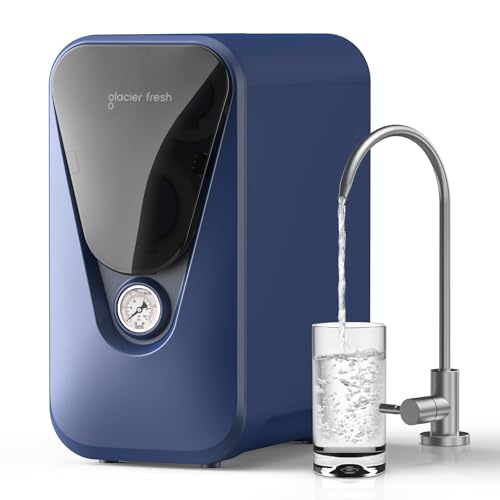
The GFU03 combines a tankless, all-in-one under-sink design with an electric-free operating concept. Its listed dimensions are 13.58 by 8.27 by 16.54 inches, and the product information says the integrated design can save cabinet space compared with a separate tank. The system carries an 800 GPD rated capacity and a stated eight-second cup fill time, although the listing also says output depends on inlet pressure and recommends at least 40 PSI.
Water efficiency is the main reason to look closely at this model. The product information states a 3:1 pure-to-drain ratio and describes one cup of wastewater for every three cups of purified water. That ratio should be read in the direction supplied rather than converted into a broader recovery claim. The system also includes a real-time pressure gauge and pull-out filters, but installation requires drilling a faucet hole if one is not already available. Filter rinsing for 10 to 20 minutes after installation or replacement is specified.
Pros
- 800 GPD rated capacity is stated.
- Electric-free operation is identified.
- Published specifications state a 3:1 pure-to-drain ratio.
- Includes a real-time water pressure gauge.
- Pull-out filter cartridges are described as quick to replace.
Cons
- Requires a faucet hole measuring 1/2 to 1 inch if one is not already available.
- The listing recommends at least 40 PSI and says lower pressure reduces flow.
This system suits shoppers who want a high stated capacity, no electrical connection, and a clearly published pure-to-drain ratio. The Waterdrop G3P600 offers display-based monitoring and its own stated 2:1 ratio, while the GFU03 has the stronger supplied water-efficiency claim. Check cabinet dimensions, faucet-hole requirements, and household pressure before choosing it.
To buy this product, click here.
Buying Guide
Tank or Tankless Architecture
A tank-based system stores treated water for dispensing and generally needs room for the tank beneath the cabinet. The iSpring RCC7AK-BN, RCC7-BN, APEC ROES-50, VIVA21, RCC7P-AK, and RCC7AK-UV use this general format. Tankless models such as the Waterdrop G3P600, Waterdrop G2P600, and GLACIER FRESH GFU03 reduce the need for an external tank, but they may bring different power, pressure, or installation requirements.
Rated Capacity and Flow Claims
GPD is a rated production-capacity figure, not a promise that a household will receive that volume every day. The 50 GPD APEC system and 75 GPD iSpring systems sit in a different capacity class from the 600 and 800 GPD tankless models. The Waterdrop and GLACIER FRESH listings also provide cup-fill figures, but those should remain separate from GPD because flow depends on operating conditions.
Certification Scope
Certification details deserve more attention than a large stage count. The iSpring RCC7AK-BN, RCC7-BN, RCC7AK-UV, and Waterdrop G3P600 listings identify NSF/ANSI 58 claims, while the VIVA21 information identifies WQA Gold Seal certification for specified standards. Waterdrop G2P600 is identified with NSF/ANSI 372 for lead-free materials. These standards and organizations are not interchangeable, and certification for one function does not prove every contaminant claim.
Drain Ratios and Water Use
Wastewater information is uneven across these systems. The Waterdrop G3P600 and G2P600 list a 2:1 ratio, while the GLACIER FRESH GFU03 lists a 3:1 pure-to-drain ratio. Read the direction carefully because ratios can be presented in different ways. The other systems do not have a clearly stated ratio in the supplied information, so their water use should not be ranked from stage count, pump presence, or GPD alone.
Pressure, Electricity, and Faucet Installation
The iSpring RCC7P-AK includes an electric booster pump for the stated low-pressure use case. The GLACIER FRESH GFU03 lists a recommended minimum pressure of 40 PSI and includes a pressure gauge. The Waterdrop G3P600 requires under-sink electricity, while several traditional iSpring systems are described as operating without a power source. Also check whether the cabinet already has a suitable faucet opening. The GFU03 specifically requires drilling a 1/2-to-1-inch hole when needed.
Maintenance and Replacement Planning
Look for filter access that suits your habits. Waterdrop’s G2P600 uses twist-and-pull filters, the GFU03 uses pull-out cartridges, and several iSpring systems provide transparent first-stage housings for visual inspection. APEC gives a 6-to-24-month replacement recommendation based on incoming water quality, while iSpring identifies replacement sets with different stated service periods for some models. These figures should be treated as published guidance, not a universal schedule for every home.
Best Under-Sink Reverse Osmosis Systems FAQ
Are tankless under-sink RO systems better than tank systems?
Neither architecture is automatically better. Tankless systems can reduce external tank clutter and may provide higher stated capacity or faster dispensing, but some require electricity and may need particular cabinet dimensions. Tank systems can operate without power and provide stored water, though the tank occupies cabinet space. Match the architecture to the available cabinet, outlet, water pressure, and daily use.
Does a higher GPD rating mean better filtration?
No. GPD describes rated production capacity. It does not establish contaminant reduction, certification, water taste, wastewater performance, or guaranteed household output. A 600 GPD system may suit high-demand dispensing, while a 50 or 75 GPD system may still be a reasonable fit for a smaller point-of-use setup.
What does NSF/ANSI 58 mean for an under-sink RO system?
NSF/ANSI 58 is a standard associated with reverse osmosis drinking-water treatment systems. The certification scope still matters. A listing that identifies certification for the complete system should not be treated as identical to one that mentions only a certified component, a different standard, or general testing language.
Do RO systems remove every contaminant?
No system should be treated as universally effective for every substance based on the RO label alone. Product-specific claims, certification, feed-water conditions, and filter configuration matter. The iSpring RCC7AK-BN and RCC7AK-UV listings provide named reduction claims, while other products identify broader categories or different certification details. Review the exact contaminant evidence for the model under consideration.
Is remineralized water automatically alkaline or healthier?
No. A remineralization stage may add minerals after RO treatment, and several products describe their output as alkaline or balanced. The supplied information does not establish a universal final pH or a health benefit. Treat mineral addback as a taste and configuration preference rather than a medical feature.
Do tankless RO systems produce no wastewater?
No. Tankless construction does not prove zero wastewater. The Waterdrop G3P600 and G2P600 list 2:1 ratios, and the GLACIER FRESH GFU03 lists a 3:1 pure-to-drain ratio. Other systems in this roundup do not clearly specify a ratio. Read the product’s stated measurement carefully before comparing water efficiency.
Will every under-sink RO system work with a refrigerator or ice maker?
Compatibility is not established for every model here. Refrigerator or ice-maker connections can depend on pressure, tubing, distance, storage configuration, and the manufacturer’s instructions. Confirm exact compatibility before routing treated water to another appliance.
Final Verdict
The iSpring RCC7AK-BN is the strongest overall choice because its 75 GPD rating, alkaline remineralization stage, top-mounted faucet design, transparent first-stage housing, and stated whole-system NSF/ANSI 58 certification create a well-rounded under-sink package. Its published contaminant claims are more detailed than the information supplied for several competing models, although buyers still need to plan for a storage tank and should not expect a stated wastewater advantage that the listing does not provide.
Choose the Waterdrop G3P600 if tankless capacity, display monitoring, and a stated 2:1 ratio matter most. The APEC ROES-50 keeps the traditional setup straightforward, the iSpring RCC7P-AK adds a booster pump for the stated low-pressure use case, and the iSpring RCC7AK-UV adds UV to alkaline filtration. For shoppers focused on electric-free operation and a published 3:1 pure-to-drain ratio, the GLACIER FRESH GFU03 is the specialized alternative. The final decision should follow cabinet dimensions, available power, inlet pressure, certification scope, and the exact replacement-filter plan.
