
Reverse osmosis buyers are often comparing two very different jobs. One household may need a dependable under-sink drinking-water system with a storage tank, while another may need a compact countertop unit or an RO/DI setup for an aquarium. Treating those systems as interchangeable is a quick route to disappointment. A high GPD figure does not prove whole-house suitability, and a TDS display does not identify every contaminant in the water.
The useful distinctions are practical: system type, stated capacity, filtration configuration, certification evidence, water-use efficiency, installation requirements, and filter maintenance. Some buyers will prioritize NSF/ANSI 58 certification and remineralization. Others will care more about a tankless cabinet footprint, a countertop format, an aquarium-ready DI stage, or a high stated production rating. Based on the supplied specifications, the iSpring RCC7AK-BN is the strongest overall choice for household drinking water because it combines a 75 GPD rating, a remineralization stage, and stated NSF/ANSI 58 certification for the complete system.
The products below include traditional tank-based under-sink systems, tankless models, a countertop option, and an RO/DI unit. That variety matters because the best fit depends on where the system will operate and what the treated water is for. Certification language, drain ratios, and contaminant claims are attributed carefully, since a published claim for one model should never be transferred to another.
Quick Answer
- Best Overall: iSpring RCC7AK-BN for under-sink drinking water with a 75 GPD rating, remineralization, and stated NSF/ANSI 58 certification.
- Best Tankless Option: Waterdrop G3P600 for buyers seeking a 600 GPD rated system, tankless storage, a smart faucet, and a stated 2:1 low-drain ratio.
- Best Countertop Option: DREO Countertop RO Water Filter for shoppers who want a countertop format with no plumbing installation stated in the product title.
- Best RO/DI Option: Aquatic Life RO Buddie for aquarium, fountain, and similar applications that specifically benefit from a DI finishing stage.
Best RO/DI Systems Comparison Table
| Product | Best For | System Type | Rated Capacity | Notable Evidence or Feature |
|---|---|---|---|---|
| iSpring RCC7AK-BN | Household drinking water with remineralization | Under-sink, 6-stage | 75 GPD | Stated NSF/ANSI 58 certification, AK remineralization stage |
| Waterdrop G3P600 | Tankless under-sink use | Tankless, 8-stage | 600 GPD | Stated NSF/ANSI 58, 42, and 372 evidence, 2:1 low-drain ratio |
| Waterdrop G3P800 | High stated capacity and monitoring | Tankless, 10-stage | 800 GPD | Stated IAPMO certification to NSF/ANSI 42, 53, 58, and 372, 3:1 pure-to-drain claim |
| APEC Water RO-90 | Higher-capacity tank-based household use | Under-sink, 5-stage | 90 GPD | Stated WQA Gold Seal certification and large-capacity filters |
| Express Water ROALK10D | Alkaline filtration and expandability | Under-sink, 10-stage | 100 GPD | Alkaline stage, leak-stop detector, upgrade path |
| iSpring RCC7-BN | Traditional under-sink drinking water | Under-sink, 5-stage | 75 GPD | Stated NSF/ANSI 58 certification, no power source required |
| APEC Water ROES-50 | Conventional 5-stage filtration | Under-sink, 5-stage | 50 GPD | Tank, faucet, installation kit, and replacement filter set included |
| DREO Countertop RO Water Filter | Countertop installation | Countertop, 7-in-1 | Not clearly specified | 3:1 pure-to-drain claim, TDS and filter-life displays |
| Aquatic Life RO Buddie | Aquariums and RO/DI applications | RO/DI, 4-stage | 50 GPD | Color-changing DI resin and aquarium-focused design |
The reviews below put each system’s configuration and limitations into a more useful buying context.
1. iSpring RCC7AK-BN — Best Overall

The RCC7AK-BN is the most balanced household pick in this group because its configuration speaks directly to the common under-sink drinking-water brief. It is a six-stage system rated at 75 GPD, and the supplied information identifies an AK stage for mineral addback after reverse osmosis. That gives it a clearer point of difference from the standard five-stage systems here. Buyers who dislike the idea of water leaving the RO membrane without a remineralization stage may find this arrangement more appealing, although the available information does not establish a specific resulting pH or mineral concentration.
Certification evidence is another reason this model ranks first. The product information states that the complete system is certified to NSF/ANSI 58, and it lists reduction claims for TDS, PFAS, chlorine, fluoride, lead, arsenic-related substances, and other contaminants. Those claims belong to this exact model and should not be used as a shortcut for judging every RO system. The transparent first-stage housing also gives owners a quick visual check of sediment buildup, while the top-mounted faucet fastener may make faucet installation less awkward under a crowded cabinet.
Pros
- 75 GPD rated capacity for household point-of-use filtration.
- Includes an AK remineralization stage according to the product information.
- Complete system certification to NSF/ANSI 58 is stated.
- Transparent first-stage housing helps with visual filter inspection.
- Top-mounted faucet fastener and quick-fitting connections are included in the installation design.
Cons
- The supplied information does not clearly specify a wastewater or recovery ratio.
- It is an under-sink system, so buyers must have suitable cabinet and plumbing space.
This is the strongest starting point for a household that wants a conventional under-sink system with stated certification and mineral addback. Buyers who prefer a tankless design, integrated monitoring, or a countertop format should look at the Waterdrop and DREO alternatives instead. The trade-off is a more traditional installation and the absence of a clearly stated drain ratio.
To buy this product, click here.
2. Waterdrop G3P600 — Best Tankless Option

The G3P600 takes a different route from the traditional tank-based systems. Its tankless format and stated 600 GPD capacity are aimed at buyers who want high rated production without placing a storage tank beneath the sink. The product information gives a cabinet footprint of 18.12 by 5.67 by 17.72 inches and says under-sink electricity is required, so the space-saving design comes with a power requirement that should be checked before purchase.
This model also brings more feedback to the faucet than the simpler systems. The smart faucet includes a TDS monitor and filter-life tracker, while the supplied specifications state an 8-ounce fill time of eight seconds under the stated conditions. A 2:1 low-drain ratio is also claimed, described in the listing as one cup of wastewater for every two cups of filtered water. The product information identifies NSF/ANSI 58 certification for TDS reduction, NSF 42 testing or certification language for chlorine, taste, and odor reduction, and NSF/ANSI 372 certification for lead-free material. Those standards address different subjects, so they should be read separately.
Pros
- Tankless under-sink architecture avoids a separate storage tank.
- 600 GPD rated capacity is stated.
- Smart faucet includes TDS and filter-life information.
- The listing states a 2:1 low-drain ratio.
- NSF/ANSI 58, NSF 42, and NSF/ANSI 372 evidence is identified for specific functions.
Cons
- Under-sink electricity is required.
- The published footprint must be checked against the available cabinet space.
Choose this system when tankless storage, monitoring, and a stated low-drain ratio matter more than a nonpowered tank-based design. The APEC and iSpring systems are simpler alternatives for buyers who do not want to plan around an electrical connection. Its main trade-off is that the impressive GPD figure remains a rated capacity, not a guarantee of identical output in every home.
To buy this product, click here.
3. Waterdrop G3P800 — Best High-Capacity Option
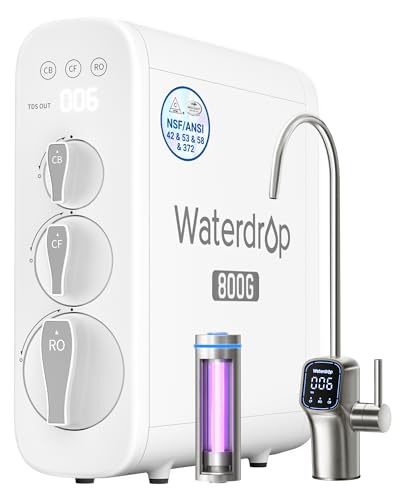
The G3P800 is the most capacity-focused system in this roundup, with an 800 GPD rating and a tankless under-sink configuration. The listing also states that it can fill a cup in five seconds and produce one cup of wastewater for every three cups of filtered water. Those figures may appeal to households that repeatedly fill bottles, prepare food, or draw water throughout the day, but they should be treated as published operating claims rather than a promise of identical real-world performance under every water condition.
Its filtration and monitoring package is extensive on paper. The product information describes a 10-stage configuration and identifies IAPMO R&T certification against NSF/ANSI 58 for TDS reduction, NSF 42 and 53 for chlorine, taste, and odor claims, and NSF/ANSI 372 for lead-free materials. The faucet provides a TDS reading and an LED indicator that activates as water flows. This is useful status information, but a TDS display is not a sensor for PFAS, lead, bacteria, or every other named contaminant. Buyers should also plan for the system’s under-sink installation and electrical requirement, neither of which is erased by the tankless architecture.
Pros
- 800 GPD rated capacity is the highest stated figure in this selection.
- The listing states a 3:1 pure-to-drain ratio.
- Tankless design provides continuous production without a listed storage tank.
- Smart faucet displays TDS information and includes an LED function.
- Specific NSF/ANSI 42, 53, 58, and 372 certification claims are identified.
Cons
- The high rated capacity does not establish whole-house suitability.
- The published information does not clearly state every installation requirement beyond the under-sink format.
This model suits buyers who place a premium on rated capacity, tankless operation, and a stated 3:1 ratio. The G3P600 offers a similar architecture at a lower stated capacity, while a conventional APEC system may suit shoppers who prefer a tank and no listed electronic monitoring. The G3P800’s central trade-off is the larger investment in a system whose key performance figures remain dependent on operating conditions.
To buy this product, click here.
4. APEC Water RO-90 — Best Tank-Based Capacity

The RO-90 is a conventional five-stage under-sink system with a stated 90 GPD capacity. That places it above the 50 and 75 GPD tank-based alternatives in rated production, while keeping the architecture familiar: a storage tank, a dedicated faucet, tubing, and an installation kit are part of the described package. Its large-capacity filters are presented as having twice the impurity-removing capacity of smaller all-in-one filters, a claim that speaks more to the stated filter format than to a universal maintenance schedule.
Certification information is a notable part of this model’s profile. The product details identify WQA Gold Seal certification for the system’s stated contaminant-reduction claims and separately mention NSF-certified filters. WQA and NSF are different organizations, and filter certification should not automatically be read as certification of every aspect of the complete system. Still, the supplied evidence gives this model a clearer certification story than products whose listings provide only broad testing language. The published maximum feed-water pressure is 85 psi, though a minimum inlet pressure is not identified.
Pros
- 90 GPD rated capacity is stated.
- Includes a storage tank, faucet, tubing, and installation kit.
- Large-capacity filter design is described in the product information.
- WQA Gold Seal certification is stated for the listed reduction claims.
- The product information identifies a maximum feed-water pressure of 85 psi.
Cons
- The published information does not clearly specify a pure-to-drain or recovery ratio.
- A storage tank requires cabinet planning that tankless systems may avoid.
The RO-90 is a sensible match for buyers who want higher rated capacity in a traditional tank-based layout and who value the supplied WQA certification claim. A Waterdrop tankless model is more suitable for monitoring and compact storage, while the APEC ROES-50 is a lower-capacity conventional alternative. The main compromise here is familiar hardware with less information about water efficiency.
To buy this product, click here.
5. Express Water ROALK10D — Best Expandable Alkaline System

The ROALK10D takes the familiar under-sink format and adds a 10-stage configuration, an alkaline stage, and a stated 100 GPD rating. The listing says its mineral stage adds calcium, potassium, magnesium, and other minerals, but it does not provide a resulting pH or a measured mineral concentration. That makes this model relevant to buyers specifically seeking mineral addback, without supporting broader claims about health or the quality of the finished water.
Practical ownership features are another part of the appeal. The product information describes quick-connect fittings, automatic tank filling, an emergency leak-stop detector, and a system that can be upgraded with additional filtration attachments such as UV and DI options. The presence of an upgrade path does not mean those attachments are included or that the base system performs those functions. The listing also states reduction claims for lead, chlorine, fluoride, nitrates, calcium, arsenic, bacteria, and other substances, but it does not identify a specific NSF/ANSI 58 certification for the complete system in the supplied information.
Pros
- 100 GPD rated capacity is stated.
- Includes an alkaline mineral stage.
- Emergency leak-stop detector is described.
- Quick-connect fittings and automatic tank filling are identified.
- The system is described as upgradeable with additional filtration attachments.
Cons
- The supplied information does not identify a specific NSF/ANSI 58 certification for the complete system.
- The listing does not clearly specify a recovery or pure-to-drain ratio.
This is a good fit for shoppers who want mineral addback, a high stated capacity, and the possibility of adding filtration components later. The iSpring RCC7AK-BN offers stronger stated complete-system NSF/ANSI 58 evidence, while the Waterdrop models provide more detailed tankless monitoring and ratio information. Express Water’s trade-off is flexibility paired with less clearly defined certification evidence in the supplied specifications.
To buy this product, click here.
6. iSpring RCC7-BN — Best Nonpowered Traditional System

The RCC7-BN is the straightforward sibling to the remineralizing RCC7AK-BN. It uses a five-stage under-sink configuration and carries a stated 75 GPD rating, while the supplied information says it requires no power source. That combination keeps the system focused on conventional point-of-use filtration rather than electronic displays or tankless pumping. For a buyer who wants a familiar setup with a brushed nickel faucet and no stated electrical requirement, the simplicity is meaningful.
The product information states NSF/ANSI 58 certification and lists reductions for PFAS, chlorine, fluoride, lead, arsenic, asbestos, calcium, sodium, and other contaminants. It also describes a transparent first-stage housing, a check valve, food-grade tubing, and a fine GAC polishing stage. The listing says the system reduces TDS by 80 to 90 percent, but TDS reduction should remain separate from contaminant-specific performance. Unlike the RCC7AK-BN, this model does not include the listed AK remineralization stage, so the two iSpring systems serve different preferences despite their similar family name.
Pros
- 75 GPD rated capacity is stated.
- NSF/ANSI 58 certification is identified.
- No power source is required according to the product information.
- Transparent first-stage housing supports visual inspection.
- Includes a check valve, food-grade tubing, and a fine GAC stage.
Cons
- This model does not include the AK remineralization stage listed for the RCC7AK-BN.
- The published specifications do not clearly identify a wastewater ratio.
Pick the RCC7-BN if conventional, nonpowered operation and stated NSF/ANSI 58 certification matter more than mineral addback. The RCC7AK-BN is the better match for buyers who specifically want a remineralization stage, while a Waterdrop tankless system offers more monitoring. Its central limitation is the lack of the convenience features and water-efficiency details found on the newer tankless alternatives.
To buy this product, click here.
7. APEC Water ROES-50 — Best Conventional 5-Stage Option

The ROES-50 keeps the design familiar and easy to categorize: five stages, a storage tank, a brushed nickel faucet, an installation kit, and a 50 GPD rating. That capacity is lower than the 75, 90, and 100 GPD tank-based systems in this selection, but GPD alone does not determine filtration quality. The simpler architecture may appeal to a buyer who wants a conventional under-sink system without a smart faucet, electricity requirement, or tankless control panel.
Its supplied filtration claims cover arsenic, chlorine, lead, fluoride, heavy metals, PFAS, microplastics, and more than 1,000 impurities. Those are product-listing claims, not independent measurements presented here, and the available information does not identify a complete-system NSF/ANSI 58 certification for this exact model. Filter replacement guidance is described broadly as six to 24 months depending on incoming water quality. That range reinforces the need to treat replacement timing as water-dependent rather than as a fixed promise.
Pros
- 50 GPD rated capacity is stated.
- Includes a storage tank and brushed nickel faucet.
- Installation kit and instructions are included.
- Quick-connection fittings and colored tubing are described.
- The listing provides a six- to 24-month replacement recommendation range based on incoming water quality.
Cons
- The supplied information does not establish complete-system NSF/ANSI 58 certification.
- The published specifications do not clearly identify a recovery or wastewater ratio.
The ROES-50 fits buyers who prefer an uncomplicated five-stage tank system and do not need the higher rated capacity or electronic features of the leading alternatives. The iSpring RCC7-BN offers the same broad under-sink category with stated NSF/ANSI 58 certification, while the Waterdrop G3P600 is better suited to tankless operation. The trade-off here is a conventional format with less certification detail in the available product information.
To buy this product, click here.
8. DREO Countertop RO Water Filter — Best Countertop Option

The DREO is the clearest choice for shoppers who need a countertop form rather than an under-sink installation. Its product title identifies an install-free countertop RO system with two autofill pitchers, self-cleaning functionality, TDS and filter-life displays, and a stated 3:1 pure-to-drain ratio. The available information does not provide a GPD rating, reservoir capacities, or detailed dispensing specifications, so buyers should focus on its format and controls rather than compare it directly with the 600 and 800 GPD figures of the tankless Waterdrop systems.
The listing describes a seven-in-one configuration and says the unit was tested by SGS to meet NSF/ANSI 58 standards. That wording should be preserved carefully. It does not provide the same complete-system certification description supplied for some other products in this roundup. The listing also makes broad reduction claims covering PFOA, PFOS, chlorine, fluoride, and other possible contaminants. Those claims may be relevant to shoppers focused on those named substances, but the available details do not provide a contaminant-by-contaminant certification scope or reduction table.
Pros
- Countertop format avoids the under-sink system type used by most other picks.
- The product title identifies an install-free design.
- Two autofill pitchers are included according to the listing.
- TDS and filter-life displays are described.
- A 3:1 pure-to-drain ratio is stated.
Cons
- The supplied information does not clearly specify a GPD production rating.
- The listing describes testing to meet NSF/ANSI 58 standards rather than clearly identifying the same complete-system certification wording used elsewhere.
This model makes the most sense for renters, offices, or kitchens where modifying plumbing is undesirable and a countertop footprint is acceptable. Under-sink systems provide a more permanent installation and may offer clearer capacity or certification information, but they require a different setup. DREO’s main trade-off is convenience in exchange for fewer published technical details about capacity and certification scope.
To buy this product, click here.
9. Aquatic Life RO Buddie — Best RO/DI Option
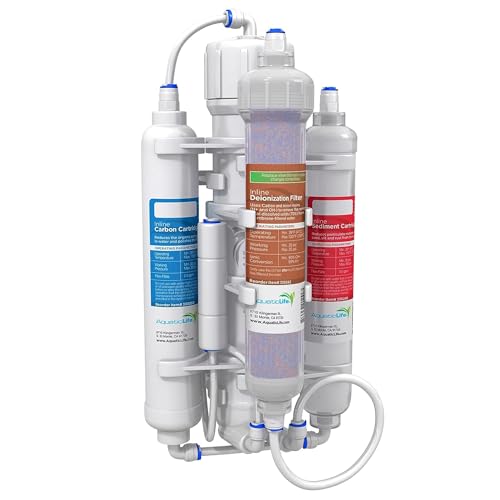
The RO Buddie belongs in a separate category from household drinking-water systems. It is a four-stage RO/DI unit with a stated 50 GPD rating, and the product information specifically positions it for fish tanks, fountains, humidifiers, and related uses. Its sediment stage is described as capturing dirt such as sand and silt, followed by a carbon block intended to reduce chlorine and odors. The listing expressly says the carbon block will not remove chloramines, a limitation that matters for source-water planning.
After the RO membrane, water passes through a color-changing deionizing resin. The resin changes from blue to tan as it becomes depleted, giving the owner a visible replacement cue instead of requiring guesswork based on a calendar alone. This RO/DI arrangement is the reason to choose the unit, not a reason to treat it as a direct substitute for an under-sink drinking-water system. The supplied information does not identify household faucet hardware, drinking-water certification, or a wastewater ratio, and the product is presented around aquarium and fountain use.
Pros
- RO/DI configuration includes a final deionizing resin stage.
- 50 GPD rated capacity is stated.
- Product information specifically identifies aquarium and fountain applications.
- Sediment filtration is described for sand, silt, and similar debris.
- Color-changing DI resin provides a visible replacement indicator.
Cons
- The carbon stage is specifically described as not removing chloramines.
- It is not presented as a household drinking-water system with a dedicated faucet or drinking-water certification.
Aquarium owners and other RO/DI users should look here first among the nine selections because the DI stage changes the application entirely. Household drinking-water buyers should choose one of the under-sink or countertop systems instead, since RO/DI equipment has a different purpose. The central trade-off is specialized output for aquatic and fountain use rather than the convenience features associated with a domestic drinking-water installation.
To buy this product, click here.
Buying Guide
Start With the Water’s Intended Use
A drinking-water system and an aquarium RO/DI unit should not be judged by the same checklist. Under-sink systems in this roundup include a faucet, tank, or tankless dispensing arrangement aimed at household use. The Aquatic Life RO Buddie adds DI resin and is specifically described for aquariums and fountains. That distinction affects the appropriate output, accessories, and certification expectations before capacity enters the discussion.
Read Certification Language Precisely
Certification claims vary considerably. The iSpring RCC7AK-BN and RCC7-BN listings state NSF/ANSI 58 certification for the systems, while the Waterdrop models identify different standards for different functions. The APEC RO-90 listing names WQA Gold Seal certification and separately refers to NSF-certified filters. DREO’s supplied wording refers to SGS testing to meet NSF/ANSI 58 standards. These statements should remain separate rather than being condensed into a vague claim that every model is equally certified.
Use GPD as a Rated Capacity, Not a Quality Score
GPD means gallons per day, so it describes a rated production figure rather than a guarantee of household output under every set of operating conditions. The listed choices range from 50 GPD for the APEC ROES-50 and Aquatic Life RO Buddie to 800 GPD for the Waterdrop G3P800. A larger number may matter for repeated demand, but it does not prove stronger contaminant reduction, better certification, or whole-house suitability.
Compare Tank, Tankless, and Countertop Formats
Tank-based systems such as the iSpring and APEC models store treated water and do not require the same tankless architecture as the Waterdrop units. Tankless systems can save the space occupied by a separate tank, but the G3P600 listing requires under-sink electricity, and the G3P800 is also an electronic tankless model. DREO takes a different path with a countertop format identified as install-free. Check cabinet dimensions, available outlets, plumbing access, and the place where treated water will be dispensed.
Look at Recovery and Drain Information
Water-use claims are presented in different ways. Waterdrop describes the G3P600 as producing one cup of wastewater for every two cups of pure water and the G3P800 as producing one cup of wastewater for every three cups of filtered water. DREO lists a 3:1 pure-to-drain claim. The other products do not provide a clearly stated ratio in the supplied information. Do not invert these descriptions or turn them into an unsupported recovery percentage.
Plan for Filters and Maintenance
Maintenance details are model-specific. The iSpring systems provide a transparent first-stage housing, while the Waterdrop tankless models include filter-life tracking. APEC ROES-50 lists a broad six- to 24-month replacement recommendation range based on incoming water quality. The Aquatic Life RO Buddie’s color-changing DI resin gives a visual indication of resin depletion. Replacement components should be checked by exact model rather than assumed compatible across a brand family.
Separate TDS Monitoring From Contaminant Testing
A TDS monitor can show a total dissolved-solids reading, as on the Waterdrop and DREO systems, but it cannot identify every individual substance. A lower TDS reading does not independently establish PFAS, lead, arsenic, bacteria, or microplastics performance. Use the model-specific certification and contaminant information supplied for the system, and do not treat a display as a universal water-safety test.
Best RO/DI Systems FAQ
What Is the Best RO/DI System in This Roundup?
The iSpring RCC7AK-BN is the strongest overall household recommendation because it combines a 75 GPD rating, a stated NSF/ANSI 58 certification for the complete system, and an AK remineralization stage. It is an under-sink drinking-water system, so it is not the right answer for an aquarium application. For aquarium or fountain use, the Aquatic Life RO Buddie is the more relevant choice because its supplied configuration includes RO and DI stages.
Are RO and RO/DI Systems the Same?
No. Reverse osmosis is one treatment stage, while RO/DI adds deionization after the RO membrane. The Aquatic Life RO Buddie uses a color-changing DI resin as its final stage and is presented for aquariums, fountains, and similar uses. Household drinking-water systems in this roundup are configured around a faucet and domestic point-of-use filtration instead.
Is a Higher GPD Rating Always Better?
No. A GPD figure is a rated production-capacity measure, not a universal score for filtration quality. The Waterdrop G3P800 has the highest stated rating at 800 GPD, while the iSpring RCC7AK-BN is rated at 75 GPD and has stronger relevance for buyers who prioritize stated complete-system NSF/ANSI 58 certification and remineralization. Capacity should be matched with daily demand, installation format, and the evidence that matters to the buyer.
Does a TDS Monitor Show Whether Water Is Safe?
No. A TDS monitor reports total dissolved solids, but it does not identify every individual contaminant. The Waterdrop G3P600, Waterdrop G3P800, and DREO systems include TDS-related monitoring or display information, yet those readings should not be treated as direct tests for PFAS, lead, arsenic, bacteria, or microplastics. Model-specific certification and contaminant claims remain separate questions.
Which System Is Best for a Countertop?
The DREO Countertop RO Water Filter is the only clearly countertop-focused choice in this selection. Its listing identifies an install-free design, two autofill pitchers, TDS and filter-life displays, and a 3:1 pure-to-drain claim. The supplied information does not clearly state a GPD rating, so shoppers who need a known production-capacity figure may prefer an under-sink model with a published GPD specification.
Do Tankless RO Systems Produce No Wastewater?
No. Tankless architecture does not mean zero wastewater. The Waterdrop G3P600 listing states a 2:1 low-drain ratio, and the G3P800 listing states a 3:1 pure-to-drain ratio. Those figures describe the products as presented, but they should not be generalized to every tankless RO system. The supplied information for the iSpring and APEC tank-based models does not clearly provide comparable ratios.
Does Remineralization Guarantee Alkaline Water?
No specific pH should be assumed without supporting information. The iSpring RCC7AK-BN and Express Water ROALK10D include mineral or alkaline stages according to their listings, but the supplied data does not establish a universal resulting pH or mineral concentration. Remineralization is a configuration feature, not proof of a medical benefit or a particular finished-water chemistry.
Can the Aquatic Life RO Buddie Be Used as a Household Drinking-Water System?
The supplied product information presents the RO Buddie for aquariums, fountains, humidifiers, and similar applications. It includes an RO/DI configuration and does not identify a household drinking-water faucet or drinking-water certification in the provided details. A domestic drinking-water buyer should select a system specifically described for that use rather than treating aquarium-focused equipment as an interchangeable substitute.
Final Verdict
The iSpring RCC7AK-BN is the strongest overall pick for household drinking water in this group. Its 75 GPD rating is practical for a point-of-use system, its AK stage provides the mineral-addback feature some buyers want, and the supplied information states NSF/ANSI 58 certification for the complete system. It also offers useful maintenance visibility through the transparent first-stage housing. Buyers should still verify cabinet space and accept that the available specifications do not clearly state a wastewater ratio.
Different priorities point elsewhere. The Waterdrop G3P600 is the better tankless alternative for monitoring and a stated 2:1 low-drain ratio, while the G3P800 targets higher rated capacity and a stated 3:1 pure-to-drain ratio. The APEC RO-90 suits buyers who prefer a tank-based system with a 90 GPD rating and stated WQA Gold Seal evidence. DREO is the practical countertop route, and Aquatic Life RO Buddie is the specialized RO/DI choice. Match the system to its intended use, installation setting, certification evidence, and maintenance requirements rather than choosing by stage count or GPD alone.
