
A whole-house reverse osmosis search can quickly become confusing because many listings combine different technologies under one title. A true high-capacity RO unit, a whole-home softener with a separate drinking-water RO system, and an under-sink filter are very different purchases. The distinction matters if you expect purified water at multiple outlets, protection from hard minerals, or enough production for a busy household.
The strongest candidate here is the iSpring CRO1000 because its supplied specifications identify a 1,000 GPD tankless RO system intended for homes, offices, restaurants, and other higher-demand settings. Several Aquasure bundles take a different approach. They treat household water with a softener and pre-filter, then provide a 75 GPD RO system for drinking water. That arrangement may suit a home with hard water, but it should not be described as whole-house RO at every faucet. Buyers should also check feed-water pressure, installation space, pretreatment needs, filter schedules, and whether the listing gives clear recovery or certification information.
The products below therefore cover the closest matches in the supplied selection, with clear labels for systems that are whole-home bundles, commercial-capacity RO units, and point-of-use alternatives. Different households will prioritize capacity, hardness treatment, lower wastewater, mineral addback, certification evidence, or a simpler installation, so the best fit depends on the water-use pattern rather than the biggest number on the product page.
Quick Answer
- Best Overall: iSpring CRO1000 for a high-capacity RO installation intended for residential and light commercial use.
- Best Whole-Home Bundle: Aquasure 72,000-Grain Bundle for homes needing softening, pre-filtration, and a separate RO drinking-water system.
- Best for Hard-Water Households: Aquasure 64,000-Grain Bundle for larger homes with the supplied 64,000-grain softener rating.
- Best Low-Waste Point-of-Use Alternative: iSpring RCS5T with a stated 1.5:1 pure-to-drain ratio and 500 GPD rated membrane.
Best Whole House Reverse Osmosis Systems Comparison Table
| Product | Best For | System Type | Rated Capacity | Notable Detail |
|---|---|---|---|---|
| iSpring CRO1000 | High-demand residential or light commercial use | Tankless commercial RO | 1,000 GPD, 0.7 GPM | Pressure gauges, mobile frame |
| Aquasure 72,000-Grain Bundle | Large homes needing softening and RO drinking water | Whole-home treatment plus RO | 75 GPD RO, 72,000-grain listing | Digital metered control |
| Aquasure 64,000-Grain Bundle | Four to six or more bathrooms | Whole-home softener plus RO | 75 GPD RO, 64,000 grains | Automatic digital control |
| Aquasure 48,000-Grain Bundle | Three- to four-bathroom homes | Whole-home softener plus RO | 75 GPD RO, 48,000 grains | Metered regeneration |
| iSpring RCS5T | Light commercial use and lower stated waste | Tankless commercial RO | 500 GPD | 1.5:1 pure-to-drain ratio |
| Aquasure 32,000-Grain Bundle | Smaller homes with hard water | Whole-home softener plus RO | 75 GPD RO, 32,000 grains | Rated for one to three bathrooms |
| iSpring RCB3P | High-output under-sink or light commercial use | Tankless under-sink RO | 300 GPD | Built-in booster pump |
| Express Water 10-Stage | Under-sink mineral addback | Tank-based under-sink RO | 50 GPD | Alkaline stage and leak detector |
| APEC ROES-50 | Simple point-of-use drinking water | Tank-based under-sink RO | 50 GPD | Five-stage system with included tank |
The detailed reviews clarify which products genuinely approach whole-home treatment and which are better reserved for a dedicated drinking-water outlet.
1. iSpring CRO1000 — Best Overall

The iSpring CRO1000 is the clearest match for buyers searching for a genuinely high-capacity reverse osmosis system for a house. Its supplied specifications list a tankless commercial design, a 1,000 GPD rated capacity, and a 0.7 GPM flow rate. That combination gives it a different role from the Aquasure bundles, where the RO section is listed at 75 GPD and is paired with whole-home softening rather than described as RO treatment at every outlet.
Its four-stage configuration uses a 20-inch sediment filter, two 20-inch carbon block filters, and a 1,000 GPD RO membrane in a stainless-steel housing. Built-in inlet and outlet gauges help the owner watch pressure, while the freestanding frame with wheels and locking brakes gives the installation a commercial-equipment character. The listing recommends an optional booster pump below 80 psi and identifies filter replacement ranges that vary with water quality, so this is a serious installation rather than a casual under-sink project.
Pros
- Supplied specifications list a 1,000 GPD rated capacity.
- Tankless design is intended for on-demand production.
- Includes a 0.7 GPM stated flow rate.
- Uses sediment, dual carbon, and RO membrane stages.
- Built-in pressure gauges and a mobile locking frame aid system management.
Cons
- The listing recommends an optional booster pump below 80 psi.
- Its commercial frame and large filters require more dedicated space than a typical under-sink unit.
This model is the strongest fit for a property, office, restaurant, or other site that needs substantially more RO capacity than a 50 or 75 GPD drinking-water system. Buyers seeking softened water throughout the house may still need separate pretreatment, and shoppers wanting a compact cabinet installation may prefer a smaller point-of-use system.
To buy this product, click here.
2. Aquasure Whole House Water Filtration Bundle, 72,000 Grains — Best Whole-Home Bundle

This Aquasure package approaches the whole-home problem through several treatment steps rather than relying on RO for every outlet. The supplied information identifies a water softener, a sediment/GAC/zinc pre-filter, and a 75 GPD four-stage RO system. That setup may appeal to a homeowner dealing with hard minerals, chlorine, odors, sediment, and a separate desire for purified drinking water.
The automatic digital metered control head is a practical feature for a system that includes softening. Its backlit display allows programmable auto-flush intervals, and the listing describes automatic regeneration and backwash. The pre-filter claims cover soil, silt, sand, rust, heavy metals, VOCs, odors, and taste, while the RO section is intended for filtered drinking water. The product information also lists a fiberglass-lined tank, bypass valve, and prefilled resin, but the listing contains an apparent grain-rating inconsistency, so buyers should verify the exact configuration before ordering.
Pros
- Combines whole-home softening with a 75 GPD RO drinking-water system.
- Includes sediment, GAC, and zinc pre-filtration according to the listing.
- Automatic digital control supports programmed regeneration and backwash.
- Four-stage RO section is identified for drinking-water use.
- Supplied information lists five-year extended warranty eligibility after activation.
Cons
- The product title and feature text present different grain-capacity figures.
- The RO section is listed at 75 GPD and is not established as whole-house RO treatment at every outlet.
This package suits a larger property where hard-water control is as important as drinking-water filtration. A buyer seeking RO water from showers, laundry, and every household outlet should look closely at the distinction between the softener and the separate 75 GPD RO unit before choosing it.
To buy this product, click here.
3. Aquasure 64,000-Grain Bundle — Best for Larger Hard-Water Homes

The 64,000-grain Aquasure bundle is sized in the supplied product information for homes with four to five bathrooms and as many as six household members. Its primary whole-home function is softening, while the included 75 GPD RO system provides a separate purified-water source. That division makes sense for a house where scale control is needed across plumbing and RO water is mainly intended for drinking or food preparation.
The automatic Aquatrol control head handles metered operation, and the package is described as using high-strength materials with safety features intended to protect the home during system downtime. The listing also mentions a five-year manufacturer warranty and lifetime technical support. Capacity ratings should be read as the supplied softener specification, not as a claim that the RO membrane can supply 64,000 grains or treat every household fixture.
Pros
- Rated at 64,000 grains for the softening portion.
- Listed for homes with four to five bathrooms and up to six family members.
- Includes a separate 75 GPD RO drinking-water system.
- Automatic digital metering reduces the need for manual regeneration.
- Supplied information lists lifetime technical support.
Cons
- The 64,000-grain figure applies to the softener, not the RO section.
- The listing does not establish whole-house RO output at all fixtures.
Choose this bundle for a larger hard-water household that wants softened service throughout the property and RO water at a dedicated drinking outlet. The CRO1000 is a better match for genuinely high-volume RO production, while this Aquasure model puts more emphasis on capacity for hardness treatment.
To buy this product, click here.
4. Aquasure 48,000-Grain Bundle — Best for Mid-Size Homes

This Aquasure configuration is aimed at homes with three to four bathrooms and up to four family members. The package pairs a 48,000-grain softener with a 75 GPD RO system, creating a practical split between household water conditioning and a dedicated purified-water supply. A household dealing with scale around fixtures may value that arrangement more than a stand-alone under-sink RO filter.
The automatic digital control head is intended to meter softener use, while the supplied information describes premium materials and safety features for operation during system downtime. The package is therefore broader than a drinking-water RO unit, but the RO component remains a 75 GPD point-of-use system according to the product details. Buyers should plan the installation around both the softener equipment and the RO outlet rather than treating the package as a single whole-house RO membrane system.
Pros
- 48,000-grain softener rating is suited to the listed three- to four-bathroom range.
- Includes a 75 GPD RO drinking-water system.
- Automatic digital metered control supports scheduled operation.
- Addresses hardness treatment and drinking-water filtration in one package.
- Supplied information lists up to five-year manufacturer warranty coverage.
Cons
- The RO section is not identified as a whole-house, every-outlet RO system.
- The package needs space and plumbing for multiple treatment components.
This is a sensible middle-ground bundle for a conventional family home with hard water and a desire for RO water at one drinking station. It is less appropriate for a property that needs high-volume RO for several outlets at once, where the iSpring CRO1000 has a much higher stated capacity.
To buy this product, click here.
5. iSpring RCS5T — Best Lower-Waste Commercial Option
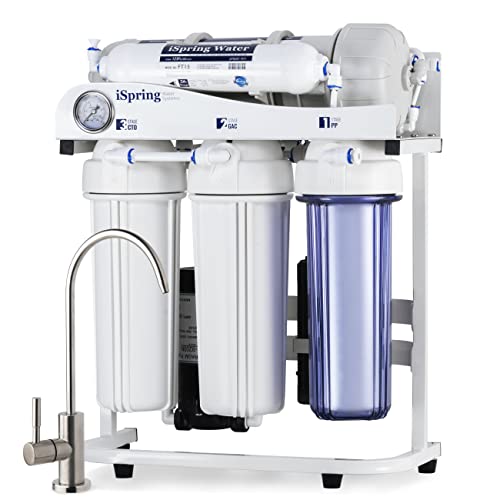
The iSpring RCS5T is a tankless commercial RO system with a stated 500 GPD membrane and a built-in booster pump. Its five-stage arrangement includes sediment and carbon filtration, an RO membrane, and a final carbon stage. The supplied information names PFAS, including PFOA and PFOS, among the claims for the early stages, while also mentioning heavy metals and pesticide residues for the RO membrane. Those are published product claims, not independent test results.
A stated 1.5:1 pure-to-drain ratio gives this model a clearer water-use specification than several alternatives in the selection. The ratio should be read exactly as presented because the supplied material does not fully define its direction beyond the phrase “pure to drain.” The pressure gauge, swivel faucet, transparent first-stage housing, and replacement guidance make it more practical for an office, salon, lab, or small food-service setting than for whole-house treatment at every fixture.
Pros
- Lists a 500 GPD rated membrane capacity.
- Includes a built-in booster pump.
- Publishes a 1.5:1 pure-to-drain ratio.
- Uses five listed filtration stages.
- Includes a pressure gauge and transparent first-stage housing.
Cons
- The listing does not establish whole-house treatment for every household outlet.
- The supplied ratio wording does not explain the measurement method in full.
This system fits buyers who need more output than a standard under-sink unit and who care about a stated drain ratio. It should be treated as a commercial or dedicated high-output RO installation, not as a substitute for a whole-home softener or a verified whole-house RO design.
To buy this product, click here.
6. Aquasure 32,000-Grain Bundle — Best for Smaller Hard-Water Homes

The smallest Aquasure bundle in this group is listed for one to two bathrooms and up to three family members. It combines a 32,000-grain softener with a 75 GPD RO drinking-water system, giving a smaller home a way to address hard minerals throughout the plumbing while reserving RO treatment for drinking water.
Its automatic digital metered control head is intended to manage the softener, and the supplied information describes high-strength construction, built-in safety features, and support for the life of the system. The 75 GPD RO rating is useful context, but it should not be confused with whole-house RO capacity. A homeowner comparing this package with the CRO1000 is choosing between a smaller integrated household-conditioning setup and a far higher-capacity commercial RO platform.
Pros
- 32,000-grain softener rating suits the listed smaller-home range.
- Includes a 75 GPD RO drinking-water system.
- Automatic digital metered control is included.
- Combines hardness treatment with point-of-use RO.
- Supplied information lists lifetime technical support.
Cons
- The RO section is not established as whole-house RO treatment.
- It may be undersized for homes beyond the listed one- to three-bathroom range.
This package makes the most sense for a smaller property where hard-water control is the main whole-home concern and purified water is needed at a dedicated outlet. Buyers seeking RO water throughout the entire plumbing system should look for a system with explicit whole-house RO sizing and feed-water guidance.
To buy this product, click here.
7. iSpring RCB3P — Best High-Output Under-Sink Alternative

The RCB3P is clearly identified as an under-sink tankless RO system, so it is a comparison alternative rather than a true whole-house recommendation. Its supplied 300 GPD rating and built-in booster pump give it considerably more stated capacity than a conventional 50 GPD under-sink model. The stainless-steel frame and metal hanging bracket also create a more equipment-focused installation than a compact cartridge-only design.
The listing describes reduction of over 1,000 contaminants and names PFAS, PFOA, PFOS, lead, fluoride, arsenic, calcium, and sodium among the claims. It also states a 1.5:1 pure-to-drain ratio and says the system is compatible with 11- or 20-gallon iSpring storage tanks, although a tank is not included. Those details matter for a buyer planning a high-demand dedicated outlet, but they do not establish that the system can supply every fixture in a house.
Pros
- Lists a 300 GPD rated production capacity.
- Includes a built-in booster pump.
- Publishes a 1.5:1 pure-to-drain ratio.
- Uses a stainless-steel frame and metal hanging bracket.
- Compatible with specified 11- or 20-gallon tanks, which are sold separately.
Cons
- It is an under-sink system, not a whole-house installation.
- The storage tank is not included.
Consider this model for a large household drinking-water demand that can be served from one under-sink location, especially where the supplied booster-pump feature is useful. A whole-home treatment plan still requires a separately sized system and should not be inferred from the 300 GPD number.
To buy this product, click here.
8. Express Water 10-Stage Reverse Osmosis Alkaline System — Best for Mineral Addback

This Express Water model is a 50 GPD under-sink system with a tank, faucet, alkaline stage, and leak detector. Its place in this roundup is as a point-of-use alternative for buyers who want mineral addback after RO treatment, not as a whole-house RO unit. The supplied information also describes an expandable design with quick-connect fittings for optional UV, alkaline, or deionization attachments.
The product information names lead, chlorine, fluoride, PFAS/PFOA, calcium, arsenic, mercury, microplastics, and chromium among its reduction claims. Those statements should be understood as listing claims rather than independent measurements, and the supplied material does not identify a specific NSF certification. The alkaline stage is described as adding minerals, but no exact mineral concentration or resulting pH is provided.
Pros
- Lists a 50 GPD under-sink RO capacity.
- Includes an alkaline mineral-addback stage.
- Includes a storage tank, faucet, and leak detector.
- Requires no electricity according to the supplied information.
- Quick-connect fittings support optional system additions.
Cons
- It is not a whole-house RO system.
- The supplied information does not identify a specific NSF certification.
This system suits a buyer focused on drinking water, mineral addback, and future customization under the sink. A homeowner seeking treated water at showers, laundry connections, and multiple fixtures needs a different system category, while a certification-focused buyer should verify the exact documentation before purchase.
To buy this product, click here.
9. APEC ROES-50 — Best Basic Drinking-Water Alternative

The APEC ROES-50 is a conventional five-stage, 50 GPD under-sink RO system with a storage tank, faucet, installation kit, and one filter set. It is far smaller in intended use than the iSpring CRO1000, yet it remains relevant as a lower-capacity alternative for a home that wants RO water at one kitchen outlet rather than throughout the plumbing.
The supplied information names arsenic, chlorine, lead, fluoride, heavy metals, PFAS, and microplastics among its claims and says filters may be replaced over a six- to 24-month range based on incoming water quality. The listing also describes quick connections and colored tubing for installation. Those details may help a buyer planning a standard under-sink setup, but the product information does not establish whole-house suitability, high-volume output, or a specific recovery ratio.
Pros
- Lists a 50 GPD rated capacity.
- Uses a five-stage filtration configuration.
- Includes a tank, faucet, installation kit, and filter set.
- Supplied information identifies quick connections and colored tubing.
- Lists a filter replacement range tied to incoming water quality.
Cons
- It is an under-sink system rather than whole-house RO.
- The supplied information does not specify a recovery or pure-to-drain ratio.
The ROES-50 is a reasonable comparison point for buyers who may have started with a whole-house search but actually need a dedicated drinking-water filter. It lacks the capacity and whole-home architecture required for broad household distribution, yet its included tank and installation components keep the setup focused and straightforward.
To buy this product, click here.
Buying Guide
Separate Whole-Home Treatment From Drinking-Water RO
A bundle can include a whole-home softener and a separate RO drinking system without providing RO water at every outlet. Aquasure’s products illustrate this structure clearly. The softener addresses the household water line, while the listed 75 GPD RO unit serves drinking-water needs. The iSpring CRO1000 is a closer match for high-capacity RO production, but its installation requirements and feed-pressure needs deserve careful planning.
Check Capacity Without Treating GPD as a Guarantee
GPD is a rated production figure, not a promise that a household will receive that exact amount under every condition. The CRO1000 lists 1,000 GPD, the RCS5T lists 500 GPD, and the RCB3P lists 300 GPD, while the Aquasure bundles list 75 GPD RO sections. These figures help show relative scale, but they do not establish whole-house suitability by themselves.
Look for Pressure and Recovery Information
Feed pressure can influence RO operation. The CRO1000 listing recommends an optional booster pump below 80 psi, and the RCS5T and RCB3P include booster pumps according to their product information. The RCS5T and RCB3P also list a 1.5:1 pure-to-drain ratio. Do not assume a tankless design automatically produces less wastewater unless the product information provides a relevant ratio or recovery claim.
Plan Pretreatment for Hard or Dirty Water
Hardness, sediment, rust, chlorine, and other source-water conditions can affect the equipment selected before the RO membrane. The Aquasure bundles place softening and pre-filtration before their drinking-water RO systems. The CRO1000 uses a sediment filter and two carbon block filters. A product listing may identify a filter configuration without providing every feed-water limit, so unusual source water may require additional assessment before installation.
Read Certification Language Precisely
The supplied products use different types of performance language. The iSpring RCC7AK-UV, which was not selected because it is an under-sink system, includes explicit NSF/ANSI 58 and 372 claims in its listing, while other products use manufacturer reduction statements or testing language. Certification of one model, one component, or one standard should not be transferred to another product.
Budget Space for Maintenance
Large commercial-style systems use larger filters, frames, gauges, and plumbing connections. The CRO1000 listing gives replacement ranges of three to six months for the first filter, six to 12 months for the carbon filters, and two to three years for the membrane, depending on water quality. The Aquasure 72,000-grain listing describes six- to 12-month RO filter replacement. Actual service needs should follow the product instructions and source-water conditions.
Best Whole House Reverse Osmosis Systems FAQ
Is the iSpring CRO1000 a true whole-house reverse osmosis system?
It is the closest high-capacity match in this selection. The product information identifies it for houses, restaurants, small businesses, and light industrial use, with a 1,000 GPD tankless RO design. The listing does not remove the need to verify storage, distribution, pretreatment, pressure, and installation requirements for a specific property.
Do the Aquasure bundles provide RO water at every faucet?
The supplied descriptions identify a whole-home softener or pre-filtration equipment plus a 75 GPD RO drinking system. That wording does not establish RO treatment at every faucet. These packages are better understood as whole-home water conditioning with dedicated RO drinking water.
Is a higher GPD rating always better?
No. GPD describes rated production capacity, not universal filtration quality or guaranteed household output. A 1,000 GPD system may suit higher demand, while a 50 GPD unit may be adequate for one drinking-water outlet. Pressure, storage, recovery, installation, and source water also affect suitability.
Does tankless mean zero wastewater?
No. Tankless architecture describes the lack of a conventional storage tank. It does not prove zero wastewater or a particular recovery rate. The RCS5T and RCB3P publish a 1.5:1 pure-to-drain ratio, while the CRO1000 listing does not provide the same ratio in the supplied information.
Do I need a water softener before whole-house RO?
The answer depends on the source water and the selected system. The Aquasure bundles combine softening with RO drinking water, showing one approach for homes concerned about hardness. The supplied information does not provide a universal pretreatment rule for every product, so buyers should follow the system documentation and assess their source water.
Can an under-sink RO system replace a whole-house RO system?
No. Under-sink systems such as the APEC ROES-50, Express Water model, and iSpring RCB3P are intended for a dedicated point of use. A higher GPD rating on an under-sink unit does not automatically make it suitable for supplying showers, laundry, bathrooms, and other whole-home outlets.
Does an alkaline stage make RO water healthier?
The supplied product information describes mineral addback for the Express Water system and the selected Aquasure bundles do not establish a health outcome from RO water. Mineral addback and alkaline labeling should be treated as configuration details, not medical benefits. The supplied data does not provide a resulting pH or mineral concentration for the Express Water unit.
Final Verdict
The iSpring CRO1000 is the strongest overall fit for a buyer specifically seeking a high-capacity RO platform associated with residential and light commercial use. Its stated 1,000 GPD capacity, tankless configuration, pressure gauges, large filter format, and mobile frame separate it from ordinary under-sink systems. It still requires careful planning because a high-capacity membrane does not by itself answer questions about storage, distribution, pressure, pretreatment, or wastewater.
For homes where hard-water control matters across the plumbing, the Aquasure bundles offer a different and potentially more practical path. The 72,000-grain configuration suits the largest listed household range, the 64,000-grain model fits a sizable home, and the 48,000- or 32,000-grain versions scale down from there. The RCS5T is the better alternative for a stated pure-to-drain ratio, while the APEC ROES-50 and Express Water system make sense only when point-of-use drinking water is the real requirement. Match the system to the actual outlets, source water, capacity demand, and maintenance plan rather than treating every RO listing as interchangeable.
