
NSF certification matters most when a reverse osmosis system will supply drinking and cooking water every day. A familiar stage count or a dramatic contaminant-removal headline does not tell the whole story. The useful question is whether the complete system, rather than one cartridge or membrane, has a clearly identified certification and whether its installation, capacity, and maintenance fit your home.
The candidates here are mostly under-sink systems, but their practical differences are substantial. Some use storage tanks and require no electricity, while others are tankless and need an outlet. Some add minerals, one adds an LED UV stage, and a few publish specific recovery or monitoring information. Certification wording also varies. Several products identify NSF/ANSI 58, while the VIVA21 cites WQA certification to NSF/ANSI standards and the Waterdrop G3P800 identifies IAPMO certification. Those distinctions deserve more attention than a bigger stage number.
The iSpring RCC7AK-BN is the strongest overall fit because it combines a stated NSF/ANSI 58 certification for the complete system, 75 GPD rated capacity, alkaline remineralization, and a practical under-sink design. Buyers focused on maximum capacity, UV protection, tankless space savings, or a lower-complexity five-stage setup will find better matches elsewhere in the list.
Quick Answer
- Best Overall: iSpring RCC7AK-BN for complete-system NSF/ANSI 58 certification, 75 GPD capacity, and remineralization.
- Best Premium Capacity: Waterdrop G3P800 for a tankless design, 800 GPD rated capacity, and stated IAPMO certification across several NSF/ANSI standards.
- Best With UV: iSpring RCC7AK-UV for a seven-stage configuration with alkaline remineralization and an LED UV stage.
- Best Conventional Value: iSpring RCC7-BN for a 75 GPD, five-stage, no-electricity under-sink system with NSF/ANSI 58 certification.
Best NSF Certified Reverse Osmosis Systems Comparison Table
| Product | Best For | System Type | Rated Capacity | Certification Evidence | Standout Feature |
|---|---|---|---|---|---|
| iSpring RCC7AK-BN | Most households | Tank-based under-sink | 75 GPD | NSF/ANSI 58 | Alkaline remineralization |
| Waterdrop G3P800 | High demand | Tankless under-sink | 800 GPD | IAPMO, NSF/ANSI 42, 53, 58, 372 | 3:1 stated pure-to-drain ratio |
| iSpring RCC7AK-UV | UV and mineral addback | Tank-based under-sink | Not clearly specified | NSF/ANSI 58 and 372 | LED UV stage |
| iSpring RCC7-BN | Simple certified filtration | Tank-based under-sink | 75 GPD | NSF/ANSI 58 | No electricity required |
| VIVA21 V21RS5S01 | Leak-conscious buyers | Tank-based under-sink | Not clearly specified | WQA Gold Seal, NSF/ANSI 58 and 372 | Included leak detector |
| Waterdrop G3P600 | Tankless convenience | Tankless under-sink | 600 GPD | NSF/ANSI 42, 58, and 372 | TDS and filter-life display |
| Express Water NSF Certified 5-Stage | Included replacement filters | Tank-based under-sink | 50 GPD | NSF certification stated | Extra filter set and leak detector |
| FS-TFC 5-Stage RO System | Lower ongoing filter expense | Tank-based under-sink | 100 GPD | NSF certification stated | Four extra replacement filters |
| APEC Water ROES-50 | Established five-stage format | Tank-based under-sink | 50 GPD | Not clearly specified | Colored tubing and included tank |
The reviews below separate certification evidence from general filtration claims, then show which system makes sense for each installation and ownership priority.
1. iSpring RCC7AK-BN — Best Overall

The RCC7AK-BN brings together the features many buyers are trying to find in one under-sink system. Its published specifications identify NSF/ANSI 58 certification for the complete RO system, rather than presenting certification as a cartridge-level detail. The 75 GPD rating gives it a useful middle position between basic residential systems and high-output tankless models, while the six-stage layout adds an AK remineralization stage after reverse osmosis treatment.
That mineral stage may appeal to people who dislike the flat taste sometimes associated with heavily filtered water, although the product information should not be read as a medical claim or a guarantee of a particular pH. The transparent first-stage housing offers a quick visual check, and the top-mounted faucet fastener can simplify work above the counter. This is still a tank-based under-sink installation, so cabinet room and plumbing access matter before ordering.
Pros
- Complete-system NSF/ANSI 58 certification is identified in the product information.
- 75 GPD rated capacity suits ordinary household drinking and cooking demand.
- Includes an AK remineralization stage for mineral addback.
- Transparent first-stage housing helps make sediment buildup visible.
- Replacement filter sets are listed for six-month, one-year, two-year, and three-year schedules.
Cons
- The listing does not clearly specify a pure-to-drain or recovery ratio.
- Its tank-based under-sink layout needs cabinet space and a standard installation connection.
Households seeking a conventional certified RO system with remineralization have the clearest reason to choose this model. Buyers who want tankless storage savings, integrated TDS monitoring, or a stated high-recovery ratio should look at the Waterdrop systems instead.
To buy this product, click here.
2. Waterdrop G3P800 — Best Premium Capacity
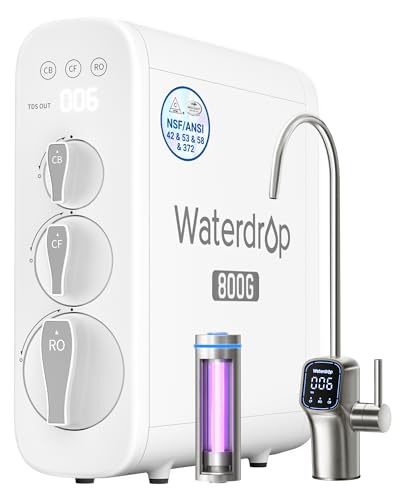
The G3P800 is aimed at buyers who need a faster, higher-capacity tankless system and have an electrical outlet available under the sink. Its stated 800 GPD rating is the highest in this group, and the product information reports a cup of water in about five seconds. That figure comes from the listing, so actual output can still depend on installation and operating conditions, but it gives the model a clear capacity-focused identity.
Certification information is unusually detailed here. The supplied specifications identify IAPMO certification to NSF/ANSI 42, 53, 58, and 372, with different standards tied to different reduction or material claims. The smart faucet displays TDS and filter-life information, while the stated 3:1 pure-to-drain ratio gives water-efficiency shoppers a concrete comparison point. The tradeoff is a powered tankless architecture and a higher-complexity installation than a basic tank model.
Pros
- 800 GPD rated capacity is the highest figure among these selections.
- Product information identifies IAPMO certification to NSF/ANSI 42, 53, 58, and 372.
- Tankless design avoids a separate storage tank under the sink.
- Smart faucet provides TDS and filter-life information.
- The listing states a 3:1 pure-to-drain ratio and five-second cup-filling rate.
Cons
- Requires under-sink electricity, unlike the conventional tank systems in this guide.
- The published footprint is 18.12 by 5.67 by 17.72 inches, so cabinet measurements matter.
This is the better fit for high-demand households that value tankless operation, monitoring, and stated water-use efficiency. A buyer who wants a simpler no-electricity installation may find the iSpring RCC7AK-BN or RCC7-BN easier to live with.
To buy this product, click here.
3. iSpring RCC7AK-UV — Best With UV

The RCC7AK-UV adds two features that separate it from a standard five-stage tank system: an AK remineralization stage and an LED UV stage. The product information describes the UV component as mercury-free, maintenance-free, and activated by water flow. That extra layer may interest buyers who specifically want UV functionality, but it should not be treated as a universal guarantee of microbiological safety or as a substitute for checking source-water conditions.
Its certification claims are also clearly identified. The system is described as NSF certified to NSF/ANSI 58 and 372, with supplied reduction information for several substances and TDS. The transparent first-stage housing and listed replacement sets make maintenance easier to plan, while the top-mounted faucet fastener can help during faucet installation. The listing does not provide a GPD figure in the supplied information, so capacity comparisons should remain cautious.
Pros
- Includes both alkaline remineralization and an LED UV stage.
- Product information identifies whole-system NSF/ANSI 58 and 372 certification.
- Flow-activated UV operation is stated in the specifications.
- Transparent first-stage housing allows visual inspection of sediment buildup.
- Replacement filter sets are identified for multiple maintenance intervals.
Cons
- The supplied product information does not clearly state a GPD capacity.
- UV functionality adds another feature layer that may be unnecessary for buyers seeking a basic RO setup.
Choose this model when UV is a central buying requirement and the added remineralization stage is welcome. If certification and 75 GPD capacity matter more than UV, the RCC7AK-BN gives a simpler comparison within the same general family.
To buy this product, click here.
4. iSpring RCC7-BN — Best Conventional Value

The RCC7-BN keeps the architecture straightforward: a five-stage, tank-based under-sink RO system with a stated 75 GPD rating and no power requirement. For a household replacing bottled water at the drinking tap, that arrangement avoids the outlet requirement associated with tankless systems. The supplied information identifies NSF/ANSI 58 certification and lists reduction claims for substances including PFAS, chlorine, fluoride, lead, arsenic, and asbestos.
A transparent first-stage housing lets owners see sediment buildup, and the check valve and leak-resistant design details address practical ownership concerns. The included brushed nickel faucet and lead-free materials claim keep the package focused on a standard kitchen installation. There is no remineralization stage listed, so buyers who specifically want mineral addback should move to the RCC7AK models instead.
Pros
- 75 GPD rated capacity is clearly stated.
- NSF/ANSI 58 certification is identified for the system.
- Operates without a power source.
- Includes a transparent first-stage housing for visual checks.
- Uses a five-stage configuration with a final GAC polishing stage.
Cons
- No remineralization stage is identified in the supplied configuration.
- The published information does not clearly specify a recovery or wastewater ratio.
This is the sensible pick for buyers who want a familiar tank system, a stated 75 GPD capacity, and certification evidence without paying for UV or mineral addback. Those seeking a slimmer tankless cabinet layout should compare it with the G3P600, while alkaline-focused buyers should look at the RCC7AK-BN.
To buy this product, click here.
5. VIVA21 V21RS5S01 — Best With Included Leak Detection
The VIVA21 takes a practical five-stage approach and includes the major pieces needed for a standard under-sink installation: faucet, tank, tubing, filtration unit, installation kit, and leak detector. Its most distinctive ownership feature is that leak detector, which can shut off water flow when it detects unwanted moisture. That does not remove the need to inspect connections after installation, but it gives leak-conscious buyers a specific feature to weigh.
The certification wording is different from the iSpring systems. The product information cites WQA Gold Seal certification for the V21RS5S01 to NSF/ANSI 58 and NSF/ANSI/CAN 372. Keeping the organization and standards distinct matters, since WQA certification is not the same statement as NSF certification. Capacity, recovery ratio, and detailed contaminant percentages are not clearly supplied, so this model ranks on its included protection and conventional configuration rather than output claims.
Pros
- WQA Gold Seal certification is identified for NSF/ANSI 58 and NSF/ANSI/CAN 372.
- Includes a leak detector with the under-sink kit.
- Five-stage filtration includes sediment, carbon, RO, and post-carbon functions.
- Includes a tank, faucet, tubing, and installation hardware.
- Automatic shutoff and leak-resistant fittings are listed features.
Cons
- The supplied information does not clearly identify a GPD capacity.
- No specific wastewater ratio or contaminant-reduction percentages are provided.
The VIVA21 fits buyers who place more weight on included leak protection and WQA certification evidence than on a high capacity number. For buyers who need detailed NSF certification wording or a stated 75 GPD rating, the iSpring RCC7-BN offers clearer information.
To buy this product, click here.
6. Waterdrop G3P600 — Best Tankless Midrange Option

The G3P600 gives the tankless category a lower-capacity alternative to the G3P800 while retaining useful monitoring features. Its stated 600 GPD rating, smart display faucet, and tank-free cabinet layout suit buyers who want direct-flow convenience without a separate storage tank. The listing also reports an eight-second fill time for an eight-ounce cup, plus a 2:1 ratio described as one cup of wastewater for every two cups of filtered water.
Certification claims cover NSF/ANSI 58 for TDS reduction, NSF/ANSI 372 for lead-free materials, and NSF 42 for chlorine, taste, and odor reduction. Those standards should be read according to their stated scope, rather than as proof of every contaminant claim in the listing. The system requires under-sink electricity, and the published dimensions are 18.12 by 5.67 by 17.72 inches, so the compact width does not eliminate the need to measure the cabinet.
Pros
- 600 GPD rated capacity is clearly stated.
- Certification information identifies NSF/ANSI 42, 58, and 372 claims.
- Tankless format preserves cabinet space otherwise used by a storage tank.
- Smart faucet displays TDS and filter-life information.
- The listing states a 2:1 wastewater ratio and eight-second cup-filling time.
Cons
- Requires an under-sink electrical connection.
- Its published dimensions still require careful cabinet measurement.
This model suits buyers who want tankless operation, monitoring, and a stated water-use ratio without stepping up to the G3P800’s larger capacity. A no-electricity household installation is better served by a tank-based system such as the RCC7-BN.
To buy this product, click here.
7. Express Water NSF Certified 5-Stage — Best Filter Bundle

This Express Water system is a conventional 50 GPD under-sink RO unit with a 3.2-gallon tank, chrome faucet, leak detector, and an additional filter set. The included extras give it a different ownership angle from systems that focus on high flow or tankless storage savings. The product information states that the system needs no electricity, which can simplify placement when the cabinet has no nearby outlet.
The listing identifies the system as NSF certified and names reduction claims involving lead, chlorine, fluoride, PFAS/PFOA, arsenic, and other substances. It does not identify a specific NSF/ANSI standard in the supplied information, so buyers who require precise certification scope should seek that confirmation before purchase. The 50 GPD rating is modest beside the Waterdrop systems, but the tank and included replacement set are useful for a buyer focused on conventional operation and maintenance supplies.
Pros
- NSF certification is stated in the product information.
- Includes a 3.2-gallon tank and chrome faucet.
- Operates without electricity.
- Includes a leak detector and extra filter set.
- Uses a five-stage under-sink configuration.
Cons
- The supplied information does not identify a specific NSF/ANSI standard.
- Its stated 50 GPD capacity is lower than the 75 GPD and tankless alternatives here.
Buyers who want included replacement filters and a no-electricity tank system have a clear reason to consider this Express Water model. Those who place certification scope ahead of bundle contents should favor a product with a named NSF/ANSI standard, such as the RCC7-BN.
To buy this product, click here.
8. FS-TFC 5-Stage RO System — Best Included Filter Supply

The FS-TFC system aims at buyers who want a high stated capacity and replacement filters included in the box. Its product information identifies a 100 GPD rating, an 18-liter-per-hour full-flow figure under stated test conditions, and a 1:1 drain ratio. Those are different measurements, so the GPD number should not be treated as a guaranteed household output or as interchangeable with the stated flow rate.
The listing describes the system as NSF certified and names reductions involving chlorine, fluoride, arsenic, lead, nitrates, VOCs, and heavy metals. It also includes four extra replacement filters and describes a tool-free installation process. Since the supplied information does not identify a specific NSF/ANSI standard or certification scope, buyers who need precise documentation should verify that detail. The product is a conventional under-sink RO system rather than a tankless design.
Pros
- 100 GPD rated capacity is clearly stated.
- The listing identifies an 18-liter-per-hour full-flow figure under stated conditions.
- Includes four extra replacement filters.
- Product information states a 1:1 drain ratio.
- Includes a two-year extended warranty after registration, according to the listing.
Cons
- The supplied information does not identify a specific NSF/ANSI certification standard.
- The 100 GPD rating and stated flow figure should not be treated as guaranteed output in every installation.
This model is worth a look for buyers who value replacement supplies and a higher stated capacity in a traditional tank system. Buyers who want a named NSF/ANSI standard, smart monitoring, or a tankless cabinet layout have stronger alternatives above.
To buy this product, click here.
9. APEC Water ROES-50 — Best Established Five-Stage Alternative

The APEC ROES-50 is a straightforward 50 GPD, five-stage under-sink system supplied with a storage tank, brushed nickel faucet, installation kit, and colored tubing. The color-coded tubing can make it easier to follow connections during setup, while the conventional tank design avoids the electrical requirement associated with the Waterdrop tankless options. Its filtration claims cover arsenic, chlorine, lead, fluoride, heavy metals, and more than 1,000 impurities.
This product belongs in the comparison as a practical alternative, but its certification status needs careful wording. The supplied product information does not clearly identify an NSF/ANSI certification for the complete RO system. That makes it a weaker match for a buyer who requires verified NSF certification than the first eight options with explicit certification language. The listing recommends filter replacement at six- to 24-month intervals based on incoming water quality, so source water should influence the maintenance plan.
Pros
- 50 GPD rated capacity is clearly stated.
- Includes a storage tank, faucet, installation kit, and instructions.
- Colored tubing may help organize installation connections.
- Five-stage filtration is listed for arsenic, chlorine, lead, fluoride, and heavy metals.
- Published filter guidance spans six to 24 months based on incoming water quality.
Cons
- The supplied information does not clearly identify NSF/ANSI certification for the complete system.
- Its 50 GPD rating is lower than the 75 GPD and tankless options in this guide.
The ROES-50 makes sense for a buyer who values a familiar five-stage package and clear installation components more than a documented NSF certification claim. For a strict NSF-certified shortlist, the iSpring, Waterdrop, VIVA21, Express Water, or FS-TFC models provide more direct certification language.
To buy this product, click here.
Buying Guide
Read the Certification Language Precisely
NSF/ANSI 58 is the key standard identified across several complete-system listings here, but the wording still matters. A statement that a system is certified to NSF/ANSI 58 is different from a statement that a membrane was tested to a standard or that individual components carry certification. The iSpring RCC7AK-BN and RCC7-BN provide especially direct system-level wording, while the VIVA21 identifies WQA Gold Seal certification to NSF/ANSI 58 and 372. The Waterdrop G3P800 names IAPMO certification and several standards, each with its own stated scope.
Separate TDS Claims From Contaminant Claims
TDS measures dissolved solids as a broad category. It does not identify a particular substance, and a TDS display cannot confirm whether water contains PFAS, lead, arsenic, bacteria, or microplastics. A system may have a stated TDS reduction certification alongside separate contaminant claims, but one should not be substituted for the other. Look for the exact contaminant and the exact testing or certification language that supports it.
Choose Tank or Tankless Architecture
Tank-based systems such as the iSpring RCC7-BN and APEC ROES-50 store filtered water and generally do not require electricity. They also occupy cabinet space with a tank. Tankless models such as the Waterdrop G3P600 and G3P800 save that tank space, provide direct-flow operation, and include electronic features, but they require an electrical connection. Neither architecture automatically produces better water. The useful choice depends on cabinet layout, outlet access, demand, and comfort with a more electronic installation.
Use GPD as a Rated Capacity, Not a Promise
GPD means gallons per day under the manufacturer’s stated conditions. It is useful for comparing the listed capacity of a 50 GPD, 75 GPD, 100 GPD, 600 GPD, or 800 GPD system, but it does not guarantee that every home will receive that output. Water pressure, temperature, and installation conditions can affect production. A higher GPD rating also does not prove better contaminant reduction or stronger certification.
Check Recovery and Drain Information
Wastewater claims deserve careful reading because ratios can be presented in different directions. The Waterdrop G3P800 lists a 3:1 pure-to-drain ratio, while the G3P600 lists a 2:1 ratio. The FS-TFC lists a 1:1 drain ratio. These statements should be compared using the wording supplied by each manufacturer, rather than converted casually into a recovery percentage. Systems without a published ratio should not be labeled water-efficient simply because they are tankless or high capacity.
Plan Filter Ownership Before Installation
Replacement schedules vary with source water and usage, so a stated interval is a planning reference rather than a universal rule. The iSpring systems list replacement sets for several time periods, the Express Water model includes an extra set, and the FS-TFC includes four additional filters. Transparent housings can help reveal sediment buildup, while smart filter-life displays provide a different kind of reminder. Check that replacement cartridges are available for the exact model rather than assuming a related system uses the same parts.
Best NSF Certified Reverse Osmosis Systems FAQ
What Does NSF/ANSI 58 Mean for an RO System?
NSF/ANSI 58 is a standard associated with reverse osmosis drinking-water treatment systems. The exact performance claims and certification scope still matter. A product listing that identifies complete-system certification provides different evidence from one that mentions an individual component or general testing. Check the model and standard named in the product information before treating a certification claim as applicable to the whole system.
Is WQA Certification the Same as NSF Certification?
No. WQA and NSF are separate organizations, so their certification statements should remain distinct. The VIVA21 product information identifies WQA Gold Seal certification to NSF/ANSI 58 and NSF/ANSI/CAN 372. That is useful certification information, but it should not be rewritten as NSF certification.
Does A Higher GPD Rating Mean Better Filtration?
No. GPD describes rated production capacity, not universal filtration quality. An 800 GPD system may suit a high-demand household, while a 75 GPD tank system may provide adequate capacity for another home. Certification evidence, contaminant claims, installation requirements, and replacement needs deserve separate attention.
Are Tankless RO Systems Better Than Tank Systems?
Neither design is automatically better. Tankless systems save storage-tank space and may offer fast flow or monitoring features, but they generally require electricity. Tank systems can provide stored filtered water without an outlet, although the tank occupies cabinet room. Choose based on the available space, electrical access, demand, and preferred maintenance arrangement.
Does Remineralization Make RO Water Healthier?
No health benefit should be assumed from a remineralization stage. In these products, remineralization is a configuration feature that adds minerals after RO treatment. The iSpring RCC7AK-BN and RCC7AK-UV identify an AK stage, but the supplied information does not establish a medical benefit or a guaranteed pH result.
Does An LED UV Stage Guarantee Safe Water?
No. The iSpring RCC7AK-UV includes a flow-activated LED UV stage, but that feature should not be treated as a universal guarantee of microbiological safety. UV performance depends on the specific system, water conditions, and supported claims. Buyers with a microbiological concern should review the exact certification and application information for the model.
Can A TDS Monitor Detect Lead Or PFAS?
No. A TDS monitor reports a broad dissolved-solids reading. It does not identify individual contaminants such as lead, PFAS, arsenic, bacteria, or microplastics. The Waterdrop G3P600 and G3P800 include TDS displays as monitoring features, but those displays do not replace contaminant-specific testing or certification evidence.
Do All RO Systems Produce The Same Amount Of Wastewater?
No. Wastewater performance varies by system and operating conditions. Some listings provide a ratio, such as the Waterdrop G3P600’s stated 2:1 ratio or the G3P800’s stated 3:1 ratio, while other systems in this guide do not clearly specify one. Avoid calculating a recovery percentage unless the ratio’s direction and meaning are clear.
Final Verdict
The iSpring RCC7AK-BN is the most balanced recommendation for this group. Its complete-system NSF/ANSI 58 certification claim, 75 GPD rating, AK remineralization stage, transparent first-stage housing, and no stated need for electricity cover the priorities of many under-sink buyers without pushing them into a tankless installation. It also gives certification-focused shoppers clearer wording than models whose listings use a broad “NSF certified” phrase without naming the standard.
Different priorities point elsewhere. The Waterdrop G3P800 is the premium capacity choice for buyers who want tankless operation, monitoring, and a stated 3:1 pure-to-drain ratio. The iSpring RCC7AK-UV adds an LED UV stage, while the RCC7-BN keeps the configuration simpler. The VIVA21 adds a leak detector and WQA certification evidence, and the Express Water and FS-TFC systems include extra filters. Match the final choice to the exact certification scope, cabinet layout, electrical access, rated capacity, and maintenance supplies you can support.
