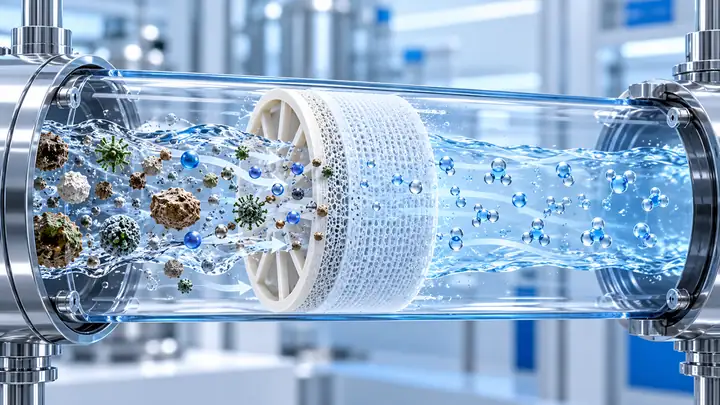
Reverse osmosis is a water-treatment process that uses pressure to move water through a semipermeable membrane. The membrane preferentially allows water to pass while rejecting much of the dissolved material in the feed water, including many salts, minerals, metals, and other contaminants. A residential RO system usually combines this membrane with sediment and carbon filters, a storage tank or direct-flow design, and controls that manage wastewater and pressure.
The short answer to “What is reverse osmosis and how does it work?” is this: feed water enters the system, pretreatment protects the membrane, pressure drives water across the membrane, and the membrane separates the flow into product water and a concentrated reject stream. The product water goes to a faucet, appliance, or storage tank. The reject water carries much of the material held back by the membrane toward the drain.
What Reverse Osmosis Means
Osmosis occurs when water moves through a semipermeable membrane from a less concentrated solution toward a more concentrated solution. This natural movement tends to balance the concentration on both sides of the membrane.
Reverse osmosis applies external pressure to the more concentrated side. When sufficient pressure is applied, water moves in the opposite direction of the natural osmotic process. Water passes through the membrane, while much of the dissolved material remains on the feed-water side and leaves with the concentrate, also called reject water or drain water.
An RO membrane is selective rather than an absolute barrier. Its performance depends on membrane construction, feed-water pressure, temperature, water chemistry, system design, and maintenance. A residential system should therefore be evaluated by its actual specifications and verified claims rather than by the term “RO” alone.
How a Residential RO System Works
Most under-sink RO systems treat water in several stages. The exact order and number of filters vary by system, but the functions commonly follow this pattern.
1. Sediment Filtration
A sediment filter traps suspended particles such as sand, silt, rust, and other visible or microscopic debris. This stage helps protect carbon filters, valves, tubing, and the RO membrane from physical fouling.
2. Activated Carbon Filtration
Carbon filters adsorb chlorine and many organic compounds that can affect taste and odor. They also protect many thin-film composite RO membranes from chlorine damage. Some water supplies contain chloramine instead of, or in addition to, free chlorine. The system must use carbon treatment appropriate for the disinfectant present in the feed water.
3. Reverse Osmosis Membrane Treatment
After pretreatment, the home’s water pressure or a booster pump provides the pressure needed for membrane separation. The membrane produces two streams:
- Permeate or product water: The portion that passes through the membrane.
- Concentrate or reject water: The portion that carries retained dissolved material away from the membrane.
The membrane is the primary dissolved-solids reduction stage. It can reduce many substances, but performance varies by contaminant, membrane condition, water chemistry, pressure, and system design. A claim about RO technology does not automatically prove that every residential system reduces a particular contaminant.
4. Storage or Direct-Flow Delivery
Traditional under-sink systems send product water to a pressurized storage tank. The tank stores water as the membrane produces it and provides a supply that can be dispensed when the faucet is opened. Tankless systems generally use a pump and higher-capacity membrane configuration to produce water on demand, often with electronic controls managing operation.
5. Postfiltration and Optional Treatment
A post-carbon filter may polish the water before it reaches the faucet, particularly after storage in a tank. Some systems also include a remineralization cartridge. This stage can add selected minerals back to the water, but remineralization does not automatically establish a particular pH, mineral concentration, or health benefit.
What Happens Inside the RO Membrane
Feed water contacts the membrane under pressure. Water moves through the membrane’s selective layer, while much of the dissolved material remains in the concentrate stream. The system keeps water moving across the membrane surface so that concentrated material can be carried toward the drain rather than simply accumulating at the membrane.
Three conditions strongly affect membrane operation:
- Pressure: Effective feed pressure influences both water production and membrane performance. Insufficient pressure can substantially reduce output.
- Temperature: Cold water passes through an RO membrane more slowly than warmer water. A membrane’s rated output is based on specified test conditions, so actual production may be lower when feed water is cold.
- Feed-water chemistry: TDS, hardness, iron, manganese, sediment, chlorine, chloramine, and other constituents can affect membrane performance, pretreatment requirements, or service life.
Pressure that is too low may result in slow production and poor overall system performance. A booster pump can help in some installations, but the pump, electrical supply, pressure controls, and RO system must be compatible with one another.
RO System Components and Their Jobs
| Component | Primary Function |
|---|---|
| Sediment filter | Reduces suspended particles and protects downstream components. |
| Activated carbon filter | Reduces chlorine and some organic compounds while protecting many RO membranes. |
| RO membrane | Provides the primary separation stage for reducing many dissolved substances. |
| Flow restrictor | Controls concentrate flow and helps maintain the operating conditions required across the membrane. |
| Automatic shutoff valve | Stops or limits feed-water flow when a compatible tank-based system reaches its shutoff condition. |
| Storage tank | Stores product water for dispensing in many conventional RO systems. |
| Postfilter | Provides final treatment before dispensing, commonly for taste and odor. |
| Remineralization cartridge | Adds selected minerals back to the water when included in the system design. |
| Booster pump | Raises feed pressure when the available supply pressure is inadequate for the system. |
| Permeate pump | Uses hydraulic energy from the concentrate stream to reduce backpressure from the storage tank in compatible systems. |
The flow restrictor, automatic shutoff valve, check valve, and drain connection work together differently across RO designs. A conventional tank-based system should not be assumed to operate like a tankless, countertop, or high-capacity system.
What the RO System Sends to the Drain
Reverse osmosis requires a concentrate stream because dissolved material rejected by the membrane needs a path out of the system. Flow across the membrane also helps carry concentrated material away from the membrane surface.
Manufacturers may describe water use with terms such as recovery rate, drain ratio, or pure-to-drain ratio. These terms must be read carefully because the direction of a ratio matters. For example, a stated 2:1 pure-to-drain ratio means two parts product water for one part drain water. It does not mean two parts drain water for one part product water.
Recovery rate and rejection rate describe different results. Recovery rate refers to the proportion of feed water that becomes product water. Rejection rate describes the membrane’s reduction of dissolved material and can be estimated by comparing feed-water and product-water TDS.
A basic TDS-based calculation is:
Rejection rate (%) = [(Feed TDS – Product TDS) ÷ Feed TDS] × 100
For example, feed water measuring 300 ppm TDS and product water measuring 30 ppm TDS produces an estimated TDS rejection rate of 90 percent. This calculation describes the change in measured TDS. It does not prove that the membrane rejects every individual contaminant at the same percentage.
A TDS meter can therefore be useful for monitoring changes in dissolved-solids reduction over time, but TDS is not a complete water-safety measurement. A TDS reading does not identify individual substances such as lead, PFAS, arsenic, bacteria, viruses, pesticides, or microplastics.
What GPD Means in Reverse Osmosis
GPD means gallons per day. A membrane or system rated at a particular GPD has a stated production capacity under specified test conditions. Actual household output can differ because of water pressure, temperature, feed-water TDS, membrane condition, fouling, and system configuration.
GPD is not the same as faucet flow rate. A tank-based system may produce water gradually over several hours and then dispense stored water at a much faster rate. A tankless system may use a pump and higher-capacity membrane arrangement to support direct-flow dispensing. Neither design should be judged by its GPD rating alone.
GPD also does not indicate contaminant-removal performance by itself. A higher-capacity membrane may produce more water under its rated conditions, but that number alone does not establish better filtration, higher contaminant rejection, lower wastewater, or stronger certification.
What Reverse Osmosis Can and Cannot Do
RO membranes can reduce many dissolved substances, including various salts and minerals. Depending on the membrane, complete system, feed-water conditions, and verified performance data, an RO system may also reduce contaminants such as certain metals, nitrate, fluoride, arsenic, and other dissolved substances.
Other treatment stages have different jobs. Carbon pretreatment can reduce chlorine and certain organic compounds while protecting chlorine-sensitive RO membranes. Sediment filtration removes suspended particles before they reach the membrane. A postfilter may provide additional taste and odor treatment after the membrane.
Reverse osmosis should not be treated as a universal solution for every water-quality problem. A standard residential RO system does not automatically guarantee reduction of every contaminant or make microbiologically unsafe water safe. If a private well or another source may contain bacteria, viruses, or other biological hazards, appropriate source-water testing and treatment are important.
Specific contaminant claims should be checked against the exact system’s performance data or certification record. General RO membrane capability and verified performance of a particular complete system are separate questions.
NSF/ANSI 58 and RO System Certification
NSF/ANSI 58 is a standard for point-of-use reverse osmosis drinking-water treatment systems. It includes requirements covering areas such as material safety, structural integrity, TDS reduction, efficiency and recovery ratings, and contaminant-reduction claims.
TDS reduction is a required performance claim under NSF/ANSI 58, while claims for specific contaminants such as lead, arsenic, nitrate/nitrite, and fluoride are optional. Certification to the standard therefore does not mean that every certified RO system has been certified for every contaminant covered by the standard.
“Tested to NSF/ANSI 58,” “uses NSF-certified components,” and “certified to NSF/ANSI 58” describe different levels of evidence and should not be treated as interchangeable. Likewise, certification of a membrane, cartridge, or other component does not automatically establish certification of the complete RO system.
For a specific treatment need, verify the exact model, the certifying organization, the applicable standard, and the individual contaminant-reduction claim. This matters particularly when a manufacturer or retailer uses broad language about what reverse osmosis technology can reduce without providing an equivalent certified claim for the complete product.
Where Reverse Osmosis Systems Are Used
Under-Sink Systems
Under-sink RO systems are commonly used to provide drinking and cooking water at a dedicated faucet. Traditional designs often include a storage tank, drain connection, feed-water valve, and separate faucet. A refrigerator or ice maker may also be supplied by the RO system when the system specifications and plumbing arrangement support the connection.
Countertop Systems
Countertop RO units can avoid some of the permanent plumbing associated with under-sink installation. Designs vary substantially. Some use a refillable feed-water reservoir and collect wastewater internally, while others connect to a faucet or water line. Electrical requirements, dispensing arrangements, filter configurations, and wastewater handling therefore depend on the model.
Tankless Systems
Tankless RO systems eliminate the conventional storage tank and generally produce water as it is requested. Many use electricity, a booster pump, higher-capacity membranes, and electronic controls. They can reduce the amount of cabinet space occupied by the system, but their actual production, dispensing rate, wastewater performance, and pressure requirements depend on the specific design.
Whole-House Systems
Whole-house RO treats water at a much larger scale than a point-of-use drinking-water system. A practical installation may require substantial pretreatment, product-water storage, repressurization, and wastewater planning. Hardness, iron, manganese, sediment, pH, feed pressure, and other water conditions can affect the design. Whole-house RO should therefore be treated as a different engineering application rather than simply a larger under-sink system.
RO/DI Systems
RO/DI systems add deionization resin after reverse osmosis to further reduce ionic material remaining in the RO product water. This configuration is used for applications requiring very low ionic content, including some aquarium, laboratory, and specialty processes. Water produced for a technical application should not automatically be treated as interchangeable with a residential drinking-water system merely because both use reverse osmosis.
Maintenance and Performance Checks
Routine RO maintenance commonly includes replacing sediment and carbon filters at the intervals specified for the system, monitoring membrane performance, and replacing postfilters or remineralization cartridges when required. Actual service life depends on water use, feed-water quality, pressure, sediment, hardness, disinfectant exposure, membrane condition, and system design.
A tank-based system may also require inspection of tubing, fittings, the automatic shutoff valve, drain connection, check valve, and storage tank. Tank air precharge can affect dispensing performance, but pressure should be checked under the conditions specified by the manufacturer. A pressure reading from a full tank should not be treated as equivalent to the specified empty-tank precharge measurement.
Changes in product-water TDS can provide another clue about system performance. A temporary increase in the first water produced after a membrane has been idle can occur because of TDS creep and does not automatically indicate membrane failure. Persistent high product-water TDS, declining production, unusual drain flow, leaks, or a storage tank that fails to fill deserve further investigation.
How the Pieces Fit Together
Reverse osmosis works as a system rather than as a membrane alone. Pretreatment protects the membrane, pressure drives the separation process, the membrane produces permeate and concentrate streams, and storage or direct-flow components deliver the treated water. Pressure, temperature, feed-water chemistry, maintenance, and system design all affect the result.
That is also why two products labeled “reverse osmosis systems” can perform quite differently. Membrane capacity, pretreatment, recovery, storage or direct-flow design, pressure management, certification, and maintenance requirements all influence how a system behaves. For a specific contaminant or treatment goal, the exact system’s verified performance data and certification record matter more than the presence of an RO membrane by itself.
