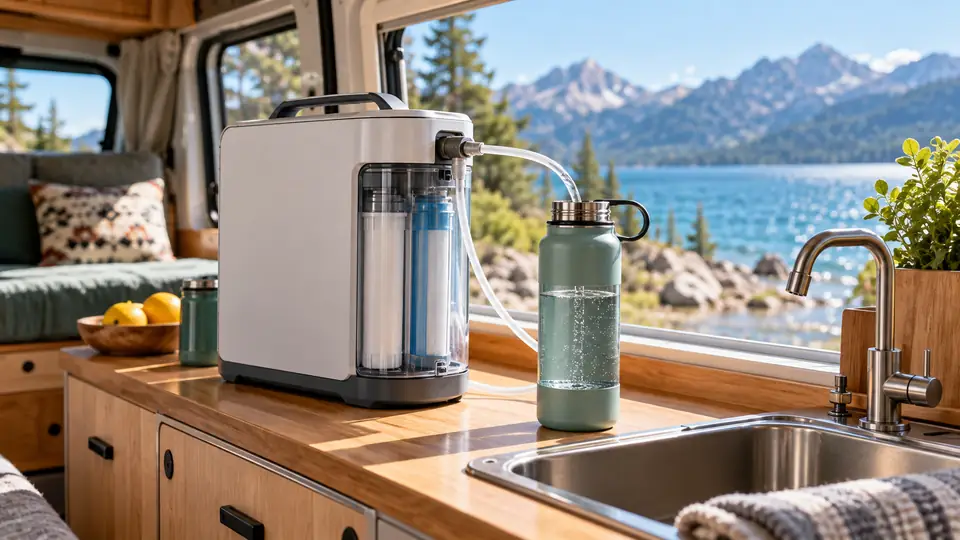
A portable reverse osmosis system can be a lifesaver when a permanent under-sink installation is impractical. Renters, RV owners, apartment residents, travelers, and aquarium keepers often need serious filtration without drilling cabinets or arranging plumbing work. Countertop units, faucet-connected systems, and compact electric purifiers solve that problem in very different ways, though, and the word “portable” does not tell you how a system handles wastewater, filter changes, power, or daily demand.
The common mistake is choosing by stage count or a large-sounding GPD number alone. A countertop dispenser may be convenient but require electricity and reservoir refills. A faucet-connected unit may offer a more familiar RO layout but still need a suitable faucet connection. An RO/DI system can be useful for aquariums while being a poor match for drinking water. Certification language also needs careful reading, since “tested to” a standard is different from certification of the complete system. For most household buyers, the DREO countertop system is the strongest starting point because it combines a no-plumbing format with monitoring, self-cleaning, two autofill pitchers, and a stated 3:1 pure-to-drain ratio.
Different buyers will prioritize different details. A renter may value quick countertop setup, an outdoor traveler may need battery operation and UV, while an aquarium owner may care more about DI resin and a color-changing indicator than a carafe. The selections below therefore include countertop, faucet-connected, under-sink, outdoor, and aquarium-focused designs. Look closely at the intended use before treating any of them as interchangeable.
Quick Answer
- Best Overall: DREO Reverse Osmosis Water Filter Countertop for countertop use with monitoring and a stated 3:1 pure-to-drain ratio.
- Best Premium Countertop Option: Bluevua RO100ROPOT With UV for buyers who want UV, remineralization, a glass carafe, and filter-life monitoring.
- Best for Outdoor Use: Purewell Portable Electric RO Water Filter System for fresh or brackish water during camping, RV trips, and outages.
- Best for Aquariums: Aquatic Life RO Buddie for buyers who specifically need an RO/DI setup rather than a drinking-water dispenser.
Best Portable Reverse Osmosis Systems Comparison Table
| Product | Best For | System Type | Rated Capacity | Notable Feature |
|---|---|---|---|---|
| DREO Reverse Osmosis Water Filter Countertop | General countertop use | Countertop electric RO | Not clearly specified | 3:1 pure-to-drain claim, TDS and filter-life display |
| Bluevua RO100ROPOT With UV | Premium countertop filtration | Countertop electric RO | Not clearly specified | UV, remineralization, glass carafe |
| Bluevua RO100ROPOT | Countertop use with mineral addback | Countertop electric RO | Not clearly specified | Five-stage filtration and glass carafe |
| Universal 5-Stage RO With DI | Faucet-connected portable use | Faucet-connected RO/DI | 75 GPD | DI postfilter and approximately 3 gallons per hour |
| Geekpure 3 Stage Portable RO | Budget DIY and travel setups | Tankless portable RO | 100 GPD | 40 to 100 psi stated feed range |
| iSpring RCC7AK-BN | Permanent under-sink installation | Under-sink RO | 75 GPD | NSF/ANSI 58 certification claim and remineralization |
| Purewell Portable Electric RO With UV | Camping and emergency use | Battery-capable portable RO | 2.1-liter bottle in stated three-minute claim | UV, carry bag, emergency lighting |
| Aquatic Life RO Buddie | Aquariums and fountains | RO/DI filtration unit | 50 GPD | Color-changing DI resin |
| Purewell Portable Electric RO With UV, Alternate Listing | Portable fresh or brackish-water filtration | Battery-capable portable RO | 2.1-liter bottle in stated three-minute claim | Dual UV lamp and Type-C reverse charging |
The reviews below put each system in its proper context, especially where portability overlaps with countertop convenience, aquarium filtration, or permanent installation.
1. DREO Reverse Osmosis Water Filter Countertop — Best Overall

DREO is the most balanced pick for a renter or apartment resident who wants countertop RO without committing to a faucet connection. The product information describes a seven-in-one filtration system, two autofill pitchers, self-cleaning operation, and displays for TDS and filter life. That combination matters in daily use because the machine is intended to make the routine visible. Instead of guessing whether a cartridge needs attention, the user has a built-in status display to consult.
The published information also states a 3:1 pure-to-drain ratio and identifies testing by SGS against NSF/ANSI 58 standards. Those claims should be read exactly as presented, rather than treated as certification of every aspect of the system. The DREO is a sensible fit for someone who wants a plug-in countertop appliance for drinking and cooking water. It is less suitable for a household seeking direct plumbing, a large stored supply, or a permanent under-sink installation.
Pros
- Countertop format does not require the supplied information to be interpreted as an under-sink installation.
- Includes TDS and filter-life monitoring.
- Product information states a 3:1 pure-to-drain ratio.
- Includes two autofill pitchers.
- Self-cleaning operation is identified in the product description.
Cons
- The published information does not clearly specify rated GPD production.
- It requires access to electrical power for countertop operation.
This model fits buyers who want the least plumbing involvement among the general household choices here. Select a different system if you need an under-sink faucet, battery operation, or aquarium-specific DI filtration. Its central advantage is the blend of countertop convenience and monitoring, while its trade-off is reliance on an appliance-style reservoir system.
To buy this product, click here.
2. Bluevua RO100ROPOT Countertop Reverse Osmosis Water Filter System With UV — Best Premium Countertop Option
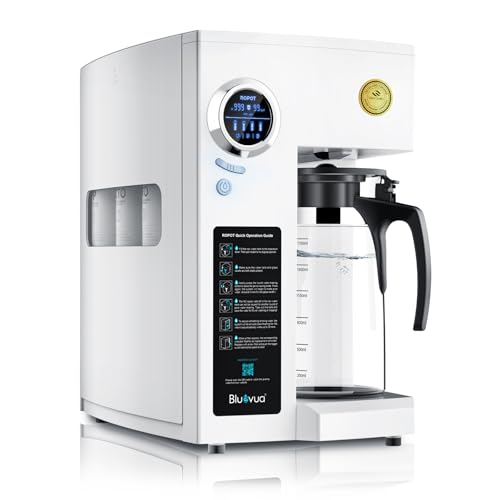
This Bluevua version is aimed at buyers who want a fuller countertop feature set. Its supplied specifications identify six filtration stages, a UV light, a remineralization filter, a borosilicate glass carafe, and a filter-life monitor. The product information also states that the system is tested by SGS and certified by WQA against NSF/ANSI/CAN 372 for lead-free materials. That is a specific certification statement, not a reason to claim certification for every contaminant or the complete filtration performance.
The 2:1 pure-to-drain ratio is presented as a water-saving feature, while leftover water can be used for other household tasks according to the description. A glass carafe may appeal to people who prefer that material, though it also means handling a breakable component rather than a purely plastic reservoir. This is a strong premium countertop match for a home office, apartment, or small kitchen where UV and mineral addback matter more than the lowest ownership cost.
Pros
- Includes UV and a remineralization filter according to the product information.
- Uses a borosilicate glass carafe.
- Product specifications state a 2:1 pure-to-drain ratio.
- Provides a filter-life monitor.
- Enters an automatic power-saving standby mode when inactive.
Cons
- The supplied certification information identifies NSF/ANSI/CAN 372 for lead-free status, not full NSF/ANSI 58 certification.
- Electrical operation and a countertop reservoir are required.
Choose this system if the glass carafe, UV stage, and remineralization feature justify a more elaborate countertop setup. The standard Bluevua RO100ROPOT below may make more sense if UV is unnecessary. Buyers who want a permanently plumbed supply should look toward the iSpring instead.
To buy this product, click here.
3. Bluevua RO100ROPOT Countertop Reverse Osmosis Water Filter System — Best With Remineralization

The standard RO100ROPOT keeps the countertop format while simplifying the configuration compared with the UV version. Its supplied details describe five filtration stages, including remineralization, plus a glass carafe, filter-life monitoring, and automatic standby. For an apartment resident who wants a countertop unit that feels more like a dedicated appliance than a loose collection of housings and tubing, that layout is easy to understand.
The stated 2:1 pure-to-drain ratio gives this model a clear water-use talking point, though the product information does not provide a rated GPD figure. Its published contaminant language is broad, so buyers should avoid treating the general “99.9%” statement as proof of identical reduction for every possible substance. The main distinction from the UV model is straightforward: this version supplies remineralization and a glass carafe without the separately identified UV stage.
Pros
- Countertop operation does not require the supplied installation of an under-sink system.
- Includes a remineralization filter.
- Uses a five-stage filtration configuration.
- Includes a glass carafe and filter-life monitor.
- Product information states a 2:1 pure-to-drain ratio.
Cons
- The supplied information does not identify a UV stage for this model.
- Rated production capacity is not clearly specified.
This model suits someone who wants the Bluevua countertop format and mineral addback but has no need for the UV version’s extra stage. It is a weaker fit for outdoor use because the product information describes countertop electrical operation rather than battery portability. The decision is mainly between its simpler configuration and the UV model’s broader feature set.
To buy this product, click here.
4. Countertop Portable Universal 5-Stage Reverse Osmosis RO With DI — Best Faucet-Connected Option
This system takes a different path from the appliance-style countertop units. The product description says it attaches to a kitchen faucet without a plumber and includes five stages with a DI mixed-bed postfilter. It also identifies a 75 GPD membrane and approximately three gallons of pure water per hour. That makes the unit relevant to buyers who want a portable faucet-connected setup, including some apartment, RV, travel, and aquarium situations.
The DI stage is a meaningful distinction, but it also changes the ownership conversation. DI resin is a consumable that needs attention, and the product information does not provide a filter-life schedule for this exact system. The listing supplies contaminant reduction ranges for many substances, yet those figures should remain attributed to the published product information. This is a more hands-on choice than a self-contained countertop dispenser, with faucet compatibility becoming a practical first checkpoint.
Pros
- Product information states faucet attachment without a plumber.
- Includes a five-stage RO and DI configuration.
- Uses a stated 75 GPD RO membrane.
- Published output is approximately three gallons per hour.
- Suitable applications listed include home, RV, travel, and aquarium use.
Cons
- Requires a compatible faucet connection rather than simple reservoir filling.
- The supplied information does not clearly state a filter-replacement interval.
Consider this system if you prefer a conventional faucet connection and need DI capability for a specialized use. It is less convenient than the DREO or Bluevua for a renter who cannot use the faucet adapter, and it does not offer the same clearly listed electronic monitoring features. Its appeal rests on the stated capacity and RO/DI configuration.
To buy this product, click here.
5. Geekpure 3 Stage Portable Reverse Osmosis Water Filter System — Best Budget DIY Option

Geekpure is the stripped-down choice for buyers comfortable with tubing, fittings, flushing, and a little setup work. The product information identifies a three-stage system with sediment, carbon, and RO filtration, a 100 GPD rating, quick-push fittings, and a tankless design without a faucet. It is described for residential, apartment, RV, boat, vacation, and aquarium use, giving it a broad portable footprint despite the absence of a self-contained dispensing enclosure.
The listing states a 1:2 pure-to-waste ratio, but the direction of that ratio should be read from the source rather than casually converted into a recovery percentage. It also identifies a 40 to 100 psi feed-water range, maximum TDS of 1,000 ppm, and an expected filter life of six to twelve months depending on use and feed water. New filters require a stated 30-minute flush. These details make the Geekpure practical for a hands-on owner, but less appealing for anyone seeking push-button countertop convenience.
Pros
- Published rated capacity is 100 GPD.
- Includes sediment, carbon, and RO stages.
- Product information states a 40 to 100 psi feed-water range.
- Tankless layout is suitable for portable installations.
- Replacement filter and DI upgrade references are provided in the product information.
Cons
- It does not include a faucet and cannot operate automatically on and off according to the listing.
- New filters require a 30-minute flush before use.
This is a good match for an owner who values low entry cost and flexible DIY placement over polished dispensing. The DREO is a better everyday countertop appliance, while the Geekpure makes more sense for an RV, boat, aquarium, or utility area where tubing is acceptable. Plan for filter handling and confirm that the available water pressure fits the stated range.
To buy this product, click here.
6. iSpring RCC7AK-BN — Best Under-Sink Alternative

The iSpring RCC7AK-BN is the least portable design in this roundup, but it belongs here as a useful alternative for buyers who begin by searching for portability and realize they actually want a permanent drinking-water station. The supplied information identifies an under-sink six-stage system, 75 GPD rating, a top-mounted faucet fastener, quick-fitting connections, and a transparent first-stage housing. Those details point toward a fixed installation rather than a countertop appliance that moves between locations.
Its product information explicitly states NSF/ANSI 58 certification for the complete RO system and lists reduction claims for TDS, PFAS, chlorine, fluoride, lead, and other substances. Those are model-specific claims supplied for this product, not assumptions transferred from the RO category. The AK stage is described as a natural mineral remineralization stage, but the presence of remineralization should not be turned into a medical claim or a guaranteed pH outcome.
Pros
- Published rated capacity is 75 GPD.
- Product information states NSF/ANSI 58 certification for the complete system.
- Includes a remineralization stage.
- Top-mounted faucet fastening is identified as part of the design.
- Replacement filter sets are listed for six-month, one-year, two-year, and three-year intervals.
Cons
- It is an under-sink system rather than a portable countertop purifier.
- Installation requires a fixed faucet and cabinet-based setup.
Select the iSpring when permanence and certification evidence matter more than moving the unit between locations. A renter who cannot modify plumbing should choose one of the countertop models instead. For a homeowner willing to install a dedicated system, this option offers a clearer long-term layout than the loose portable systems.
To buy this product, click here.
7. Purewell Portable Electric RO Water Filter System With UV — Best for Outdoor Use

Purewell shifts portable RO away from the counter and toward camping, RV travel, emergency storage, and power-outage use. The product information describes a 0.0001-micron RO membrane, dual UV lamps, a 54-watt fast charger, a carry bag, emergency lighting, and a stated ability to run for 6.5 hours. It also says the system can fill a 2.1-liter bottle in three minutes. These details make it much more field-oriented than the Bluevua or DREO units.
The listing states that the system is intended for fresh or brackish water and specifically excludes ocean seawater. It also describes a 2:1 ratio, a 10-second self-cleaning cycle at startup, TDS monitoring, and Type-C reverse charging for devices. UV is an added treatment feature, but it should not be interpreted as a universal guarantee that any questionable water source is safe. Source-water selection and the stated application limits still matter.
Pros
- Includes a dual UV lamp system.
- Product information states 6.5 hours of battery operation.
- Includes a carry bag and emergency light modes.
- Offers TDS monitoring and an automatic 10-second self-cleaning cycle.
- Listing identifies fresh and brackish water use, while excluding ocean seawater.
Cons
- Battery operation adds charging and maintenance requirements that countertop users may not need.
- The product information does not establish that UV makes every untreated source safe to drink.
This is the better fit for someone carrying filtration beyond a normal kitchen, especially during RV trips or outages. A household that simply wants countertop drinking water will likely find DREO easier to live with. The main trade-off is portability with electronics, charging, and source-water limits.
To buy this product, click here.
8. Aquatic Life RO Buddie 4-Stage Aquarium Water Filter System — Best for Aquariums
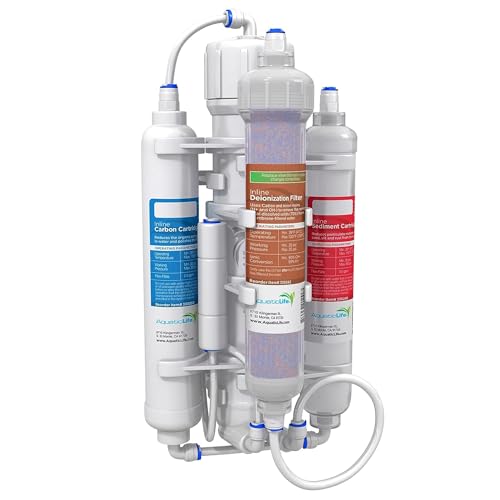
The Aquatic Life RO Buddie is a specialized portable RO/DI unit for fish tanks, fountains, humidifiers, and similar applications. The product information identifies four stages, a 50 GPD rating, a sediment filter, a carbon block, an RO membrane, and a final DI resin stage. That configuration is materially different from a countertop drinking-water purifier. The color-changing DI resin is especially useful for an aquarium owner who needs a visible indication that the polishing stage is becoming exhausted.
The listing says the carbon block helps reduce chlorine and odors but will not remove chloramines. It also describes the RO membrane as reducing most TDS and the DI resin as removing remaining TDS. Those statements explain why this system belongs in an aquarium-focused category, while also showing why it should not be casually treated as a household dispenser. It does not include the carafe, monitoring interface, and self-contained dispensing workflow found on the countertop models.
Pros
- Designed for aquarium, fountain, and humidifier applications.
- Includes four filtration stages with RO and DI.
- Published rated capacity is 50 GPD.
- Color-changing DI resin provides a visible replacement cue.
- The listing clearly identifies that the carbon stage does not remove chloramines.
Cons
- It is an RO/DI filtration unit rather than a household countertop drinking-water dispenser.
- The supplied information does not identify a household faucet or carafe setup.
Aquarium owners should look here before choosing a drinking-water unit, particularly if DI polishing is central to the application. For ordinary drinking water, the DREO, Bluevua, or iSpring is more appropriately configured. The defining trade-off is specialization: the RO Buddie gives aquarium users the right type of filtration, but sacrifices appliance-style convenience.
To buy this product, click here.
9. Purewell Portable Electric RO Water Filter System With UV, Alternate Listing — Best Backup Portable Configuration

This Purewell listing presents the same named K8680/P01 configuration and the same broad feature set as the preceding Purewell entry. The supplied product information identifies the RO membrane, dual UV lamps, TDS display, battery operation, self-cleaning, a 2:1 ratio, and fresh or brackish-water use. Since the descriptions overlap closely, shoppers should compare the exact listing, included materials, and replacement-filter references before treating this ASIN as a separate hardware choice.
Its practical value is still clear for portable use. A carry bag, emergency light mode, Type-C reverse charging, and the stated 2.1-liter bottle-fill claim create a package aimed at travel rather than a fixed counter. The listing also names the PP pre-filter and RO element replacement ASINs, which is useful for planning ownership. As with the first Purewell entry, UV should be viewed as a defined component, not a blanket promise about every water source.
Pros
- Supplied information identifies RO filtration plus dual UV lamps.
- Includes TDS monitoring and self-cleaning startup.
- Battery operation and Type-C reverse charging are listed.
- Includes emergency lighting and a carry bag.
- Replacement pre-filter and RO element references are provided.
Cons
- The supplied description closely overlaps the other Purewell listing, so buyers should verify the exact ASIN and package.
- It is unsuitable for ocean seawater according to the product information.
This listing is worth examining when the exact package or seller availability makes it preferable to the other Purewell entry. It should not be selected because the repeated feature set proves superior performance. Buyers seeking a genuinely different design should move to DREO, Bluevua, Geekpure, or the aquarium-specific Aquatic Life unit.
To buy this product, click here.
Buying Guide
Start With the Meaning of Portable
Portable can mean a self-contained countertop dispenser, a faucet-connected filter that can be moved, a lightweight RO housing, or a battery-capable outdoor purifier. DREO and Bluevua are appliance-style countertop systems. Geekpure and the universal five-stage unit require more hands-on plumbing or tubing. Purewell is aimed at travel and emergency use. Decide which meaning matches your situation before comparing stage counts.
Separate Drinking Water From RO/DI
RO/DI systems such as the Aquatic Life RO Buddie use deionization after reverse osmosis and are aimed at aquariums, fountains, or similar uses. That is a different job from producing water through a countertop carafe. Aquarium owners should prioritize DI resin behavior and the intended application. Household buyers should avoid assuming that an aquarium unit provides the same dispensing experience or installation format as a drinking-water purifier.
Read Certification Language Precisely
The supplied products use several types of evidence. The iSpring information states NSF/ANSI 58 certification for the complete system. The DREO description refers to SGS testing against NSF/ANSI 58 standards. Bluevua identifies WQA certification against NSF/ANSI/CAN 372 for lead-free status and SGS testing. Those statements are different. A standard reference or testing claim should not be expanded into a claim that every contaminant is certified at a particular reduction level.
Do Not Use GPD as a Complete Performance Score
GPD is a rated production-capacity figure. It does not automatically describe faucet flow, actual output in every home, contaminant reduction, or wastewater performance. Geekpure lists 100 GPD, while the universal system lists 75 GPD and approximately three gallons per hour. Those numbers describe different aspects of use, so they should not be treated as interchangeable.
Check Wastewater Wording
DREO states a 3:1 pure-to-drain ratio, while the Bluevua models state 2:1 and Geekpure states 1:2. Because product descriptions may present ratios in different directions, avoid converting them into recovery percentages without a clear definition. A system described as water-saving may still produce drain water, and tankless or electric operation does not automatically mean zero wastewater.
Plan for Filters and Power
Countertop electric units need an outlet and reservoir management. Purewell adds charging and battery considerations. Geekpure requires filter flushing and provides a stated six-to-twelve-month life range that depends on use and feed water. Bluevua identifies a twelve-to-twenty-four-month range in its description, while iSpring lists replacement sets by interval. Treat “up to” or broad ranges as planning information, not a promise that every household will follow the same schedule.
Match the Source Water and Connection
Faucet-connected systems need a suitable faucet. Under-sink systems need a fixed installation. Geekpure lists a 40 to 100 psi feed-water range and a maximum TDS of 1,000 ppm, while Purewell identifies fresh and brackish water but excludes ocean seawater. Those details are more useful than a generic portability label. Confirm the water source, pressure, available power, and connection method before purchase.
Best Portable Reverse Osmosis Systems FAQ
What is the best portable reverse osmosis system for most homes?
The DREO countertop system is the strongest general fit in this selection because it combines countertop operation, two autofill pitchers, TDS and filter-life monitoring, self-cleaning, and a stated 3:1 pure-to-drain ratio. Its product information does not provide a rated GPD figure, so buyers with unusually high demand should examine a different configuration.
Do portable RO systems require plumbing?
Some do and some do not. DREO and Bluevua are described as countertop systems that require electrical power rather than a permanent plumbing installation. The universal five-stage unit attaches to a faucet, while Geekpure is a tankless system with tubing and no included faucet. Always check the exact installation description instead of assuming that portable means completely installation-free.
Are countertop RO systems better than under-sink systems?
They serve different situations. Countertop units are more suitable for renters or users who want a movable appliance. The iSpring RCC7AK-BN is an under-sink system with a stated 75 GPD rating and NSF/ANSI 58 certification claim for the complete system. It is a better match for a fixed household installation, while a countertop system avoids that permanent setup.
Does a TDS display prove that water is safe?
No. A TDS monitor reports total dissolved solids and can help track changes in the system’s output. It does not identify specific substances such as PFAS, lead, arsenic, bacteria, or microplastics. Product-specific contaminant claims and certification evidence should be evaluated separately.
Can an aquarium RO/DI system be used as a drinking-water system?
The Aquatic Life RO Buddie is described for aquariums, fountains, humidifiers, and similar uses. It includes a DI stage and a color-changing resin indicator, which are useful for that category. The supplied information does not describe it as a countertop drinking-water dispenser with a carafe, so household buyers should choose a system explicitly configured for drinking water.
Are portable reverse osmosis systems suitable for camping?
The Purewell portable electric system is the clearest match in this selection because its information identifies battery operation, a carry bag, emergency lighting, UV, and fresh or brackish-water use. It specifically excludes ocean seawater. Outdoor users should also follow the stated source-water limitations and avoid treating UV as a universal guarantee for untreated water.
What does a pure-to-drain ratio mean?
It describes the relationship between water collected as product water and water sent to drain, but the direction must be read carefully from the product’s own wording. DREO lists 3:1, Bluevua lists 2:1, and Geekpure lists 1:2. Those descriptions should not be inverted or converted into a recovery percentage unless the source clearly defines the terms.
Does remineralization make RO water alkaline?
Remineralization and alkalinity should not be treated as identical. Bluevua identifies a remineralization filter, and iSpring describes an AK mineral stage with balanced pH language. The supplied information does not justify assigning a universal final pH or making a health claim. Choose this feature for the configuration it provides, then follow the manufacturer’s stated maintenance instructions.
Final Verdict
DREO is the best overall portable reverse osmosis system here for ordinary countertop use. Its no-plumbing appliance format, monitoring, self-cleaning, two autofill pitchers, and stated 3:1 pure-to-drain ratio create a practical balance for renters and households that want a dedicated filtration station without an under-sink project. It does require electricity, and the supplied information does not establish a rated GPD figure, so it should not be treated as a universal answer for heavy daily demand.
Bluevua’s UV model is the premium countertop alternative for buyers who value UV, remineralization, a glass carafe, and filter monitoring. Geekpure offers the most hands-on budget route, the iSpring is the strongest fixed-installation alternative, and Purewell is the clearest outdoor choice. Aquarium owners should move directly to Aquatic Life RO Buddie because its RO/DI design matches that specialized application. The final decision should follow the actual use case, water source, installation limits, power access, certification evidence, and maintenance routine rather than a stage count alone.
