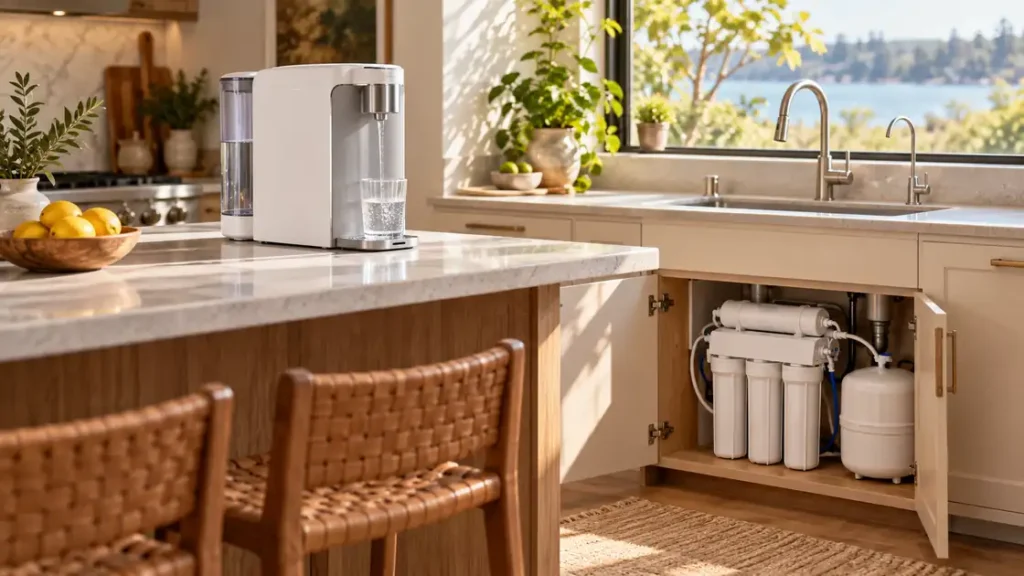
Countertop and under-sink reverse osmosis (RO) systems use the same basic treatment process, but they fit into a kitchen differently. A countertop unit sits in view and may draw water from a refillable reservoir or a faucet connection. An under-sink unit connects to the plumbing, sends reject water to a drain, and usually dispenses through a dedicated faucet. That difference shapes installation, daily use, available space, and maintenance.
Neither layout guarantees better filtration. The reduction claims and operating requirements belong to the specific system, not to its location on or below the counter.
Countertop vs Under-Sink RO at a Glance
| Feature | Countertop RO | Under-Sink RO |
|---|---|---|
| Water supply | Often a refillable reservoir; some models connect to a compatible faucet | Typically a direct connection to the cold-water supply |
| Reject water | Often collected in a container or sent to the sink, depending on design | Typically routed to the drain |
| Installation | Usually little or no permanent plumbing for reservoir models | Requires supply, drain, and dispensing connections |
| Dispensing | From the appliance or a connected faucet, depending on model | Usually from a dedicated faucet |
| Storage | May have a removable feed reservoir and a treated-water container | May have a storage tank or produce water on demand |
| Space used | Counter space and sometimes room above the unit for refilling | Cabinet space beneath the sink |
| Electricity | Depends on whether the unit uses a pump or powered controls | Depends on design; many conventional tank systems do not need an outlet |
How Each Configuration Works in Daily Use
Countertop Systems
A reservoir-fed countertop system requires you to add source water and empty its reject-water container as directed by the manufacturer. It can be practical where a permanent plumbing connection is unavailable, but those repeated tasks matter if several people use RO water throughout the day. Check the reservoir capacities and how the unit signals that a container needs attention.
Faucet-connected countertop systems work differently. They draw from a compatible faucet and may discharge reject water into the sink. Faucet shape, threads, pull-down sprayers, and the manufacturer’s connection requirements can limit compatibility. “Countertop” therefore does not automatically mean “no connection needed.”
Under-Sink Systems
An under-sink system generally draws water from the cold-water line without manual refilling. Its reject water flows through a drain connection, while treated water reaches a dedicated faucet. Installation needs suitable cabinet space and access to the supply and drain. It may also require a faucet opening, subject to the sink, countertop, and local plumbing requirements.
Under-sink systems can be tank-based or tankless. A tank-based system stores treated water for dispensing; production resumes as the tank empties. A tankless system makes water on demand and may use an electric pump. The presence of a tank affects dispensing and space requirements, but it is a separate distinction from countertop versus under-sink placement.
Installation, Portability, and Space
A refillable countertop unit usually avoids changes to the sink plumbing. That makes it easier to move or put away, provided there is a suitable outlet if the unit needs power. Measure the full operating footprint, including clearance to lift out reservoirs and replace filters. An appliance that fits beneath a cabinet may still be awkward to refill there.
An under-sink system keeps the counter clear but occupies cabinet space that may already hold a disposal, plumbing, or cleaning supplies. Tubing, filters, and any storage tank also need to remain accessible for service. Before installation, check the system manual for supply-pressure limits, electrical needs, faucet requirements, and permitted drain arrangement.
Shut off the water supply before opening a pressurized connection, follow the manufacturer’s instructions, and check all new connections for leaks. A qualified plumber can help where the cabinet layout or local requirements make the connection uncertain. For a rental, confirm which changes the property owner permits before altering the plumbing or countertop.
Production, Dispensing, and Water Efficiency
The speed of filling a glass is not the same as the rate at which an RO membrane produces water. A tank can deliver stored water quickly while the membrane replenishes it more slowly. A countertop appliance may have treated water ready in a container but require another treatment cycle after that water is used. A direct-flow under-sink system depends more visibly on its on-demand production and dispensing design.
Manufacturers may state production in GPD (gallons per day). That rating is measured under specified conditions, not a guarantee of household output or faucet flow. Feed-water pressure, temperature, dissolved-solids level, and membrane condition can change actual production. Compare usable treated-water capacity and refill or recovery time alongside any GPD figure.
Both configurations separate incoming water into treated water and a reject-water stream. A countertop unit may collect that stream for you to empty; an under-sink unit usually sends it to the drain. Collection makes the water visible, but it does not establish that the system uses more water. For an efficiency comparison, look for clearly stated test conditions and check the direction of any ratio. “Two parts treated water to one part drain water” means something different from “two parts drain water to one part treated water.”
Filtration Claims Depend on the Exact System
Both formats can contain sediment and carbon prefilters, an RO membrane, and post-treatment stages. The number and arrangement of stages vary. A larger housing or a longer stage list does not, by itself, establish better reduction of a particular contaminant.
For a specific treatment concern, read the exact model’s performance data sheet and any applicable certification listing. NSF/ANSI 58 is a standard for reverse osmosis drinking-water treatment systems, but certification to the standard does not mean a system has every possible contaminant-reduction claim. Check that the claim you need applies to the complete system and exact model. A certified component, or a statement that a product was tested to a standard, is not the same as complete-system certification.
A TDS meter can help track changes in dissolved-solids readings, but it cannot identify every contaminant or establish that water is safe. If treatment is intended to address a known water-quality issue, start with an appropriate water test and match the result to verified system claims.
Maintenance and Ongoing Work
Both layouts need filter changes, membrane replacement when indicated, and cleaning or sanitization according to the manufacturer’s instructions. The schedule depends on the model, water quality, and usage. Cartridge shapes and stage names do not establish replacement-part compatibility; use the specified parts for the exact system.
The everyday tasks differ. A reservoir countertop system adds filling and emptying containers to the routine. Its containers and wetted surfaces also need the care specified in its manual. An under-sink system removes those container tasks but calls for periodic inspection of tubing, fittings, and the cabinet area for leaks. Tank-based systems have maintenance requirements that do not apply to systems without a tank.
Compare the complete maintenance instructions before judging convenience. A cartridge that is easy to reach may still need frequent attention under challenging feed-water conditions, while a hidden unit may be straightforward to service if there is adequate cabinet clearance.
Which Layout Fits Which Situation?
- A countertop system may fit better where plumbing changes are restricted, portability matters, or cabinet space is unavailable. Confirm whether the particular unit needs a compatible faucet, an electrical outlet, or manual reservoir handling.
- An under-sink system may fit better where a permanent connection and dedicated faucet are practical, counter space is limited, or manual refilling would be inconvenient. Confirm that the cabinet has room for installation and future service.
- For either type, evaluate the exact system’s verified reduction claims, feed-water requirements, water use, dispensing behavior, and replacement-part availability separately from its location.
Countertop versus under-sink is primarily a choice about connections and daily workflow. Countertop units can reduce installation demands but may put refilling and reject-water disposal in your hands. Under-sink units move those tasks into the plumbing while requiring space, installation, and leak checks beneath the sink. Filtration performance still has to be established for the individual system.
