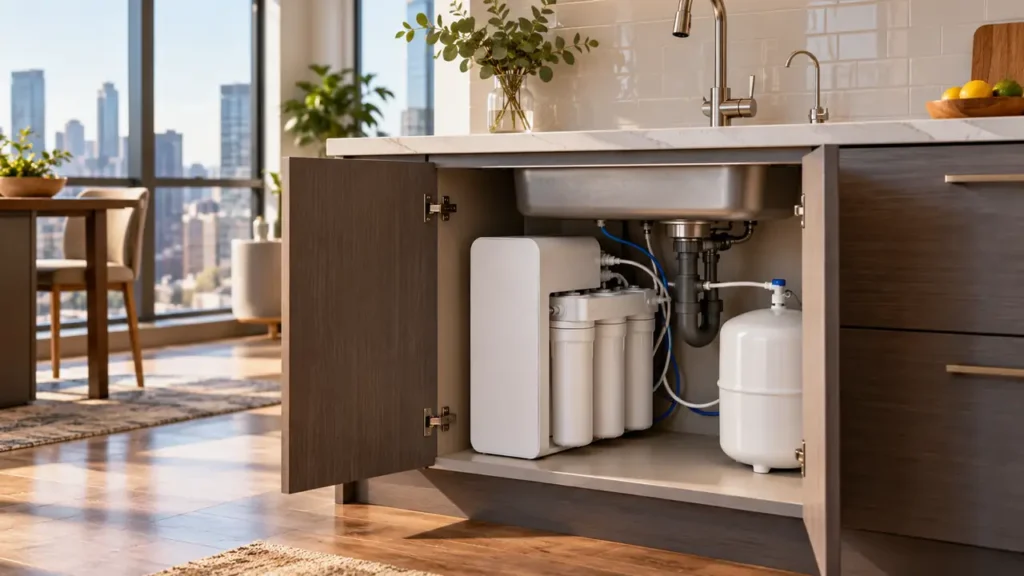
Apartment water treatment brings a peculiar mix of constraints. You may want reverse osmosis filtration for drinking and cooking, yet a lease can rule out drilling, drain connections, or permanent faucet changes. A countertop unit can solve that problem, but it needs somewhere to sit, a nearby outlet, and enough reservoir capacity for daily use. Under-sink models preserve counter space, although they generally require more involved installation and cabinet room.
Common mistakes include treating every countertop system as installation-free, assuming a high GPD rating guarantees faster water in every apartment, and comparing stage counts as though more stages automatically mean better results. The useful questions are narrower: Does the system require plumbing? What does the listing actually say about filtration, wastewater, monitoring, and replacement intervals? Does it fit your cabinet or counter? Different apartment dwellers will value portability, certification evidence, water efficiency, or higher daily capacity differently. For the broadest apartment fit, the DREO countertop system is the leading option here because its supplied features combine install-free operation, monitoring, two pitchers, and a stated 3:1 pure-to-drain ratio.
A countertop RO system is usually the least disruptive route for renters, while an under-sink model may suit an owner or long-term tenant who wants the counter kept clear. This guide includes both categories, separating published claims from assumptions so a compact studio, shared apartment, or larger rental kitchen can be judged on its actual limitations.
Quick Answer
- Best Overall: DREO Reverse Osmosis Water Filter Countertop for install-free apartment use with two autofill pitchers and monitoring.
- Best Certification Evidence: AquaTru Glass Carafe Countertop RO System for buyers who want supplied IAPMO certification information and a glass carafe.
- Best Premium Countertop Option: Bluevua RO100ROPOT-UV for countertop filtration with UV, remineralization, a glass carafe, and a filter-life monitor.
- Best Under-Sink Option: Waterdrop G3P600 for apartment owners or renters permitted to use an under-sink electrical system and seeking a tankless design.
Best Reverse Osmosis Systems for Apartments Comparison Table
| Product | Best For | System Type | Published Capacity or Ratio | Installation |
|---|---|---|---|---|
| DREO Reverse Osmosis Water Filter Countertop | Most renters | Countertop | 3:1 pure-to-drain | Install-free |
| AquaTru Glass Carafe | Certification-focused buyers | Countertop | 4-stage filtration | No plumbing or drilling |
| Bluevua RO100ROPOT-UV | Premium countertop filtration | Countertop | 2:1 pure-to-drain | No plumbing |
| Bluevua RO100ROPOT | Countertop remineralization | Countertop | 2:1 pure-to-drain | No plumbing |
| Express Water Countertop RO System | Simple faucet-connected setup | Countertop | 0.5 to 1 gallon per hour | Threaded removable aerator required |
| Waterdrop G3P600 | High stated capacity | Tankless under-sink | 600 GPD; 2:1 stated ratio | Under-sink electricity required |
| iSpring RCC7AK-BN | Under-sink remineralization | Under-sink | 75 GPD | DIY-oriented installation |
| APEC Water ROES-50 | Traditional under-sink setup | Under-sink | 50 GPD | Installation kit included |
| VIVA21 5-Stage Reverse Osmosis System | Leak-detector bundle | Under-sink | Not clearly specified | Under-sink installation |
The reviews below focus on apartment-relevant differences such as permanent installation, counter use, cabinet space, stated water handling, and maintenance information.
1. DREO Reverse Osmosis Water Filter Countertop — Best Overall

DREO is the most apartment-friendly package in this group because the supplied information removes the plumbing hurdle entirely. Its countertop format, install-free description, self-cleaning function, and two autofill pitchers suit a renter who cannot modify a faucet or connect a drain line. The listing also identifies TDS and filter-life monitoring, which gives the owner a visible way to follow the machine’s status rather than relying only on a calendar reminder.
The stated 3:1 pure-to-drain ratio is a notable apartment detail, especially where wastewater handling is awkward or where a user wants to limit discarded water. The product information also describes seven-stage RO filtration and SGS testing against NSF/ANSI 58 standards, while listing claims involving PFOA, PFOS, chlorine, and fluoride. Those claims should be read as published product information, not as a universal guarantee for every water condition. The two pitchers may be handy for a shared apartment, although they also require storage and regular filling.
Pros
- Countertop design is identified as install-free.
- Includes two autofill pitchers.
- Provides TDS and filter-life monitoring.
- Lists a 3:1 pure-to-drain ratio.
- Product information identifies seven-stage filtration and SGS testing against NSF/ANSI 58 standards.
Cons
- Counter space and a nearby electrical outlet are still required.
- The supplied information does not clearly state a daily production rating or replacement schedule.
Apartment renters who want the least disruptive setup should start here. Buyers who prefer a glass carafe, IAPMO certification information, or a specific filter-life schedule may find AquaTru or Bluevua easier to compare, while people with very limited counter space may need an under-sink model instead.
To buy this product, click here.
2. AquaTru Glass Carafe — Best Certification Evidence

AquaTru takes a straightforward route for apartment use. The system plugs into a standard outlet, uses a removable glass carafe with a lid, and requires no plumbing, drilling, or installation according to the supplied product information. That arrangement is useful for a renter who wants to move the purifier later or avoid a conversation with a landlord about faucet hardware.
The four-stage configuration includes pre-filtration, carbon filtration, an RO filter, and VOC carbon filtration. The product information specifically names PFOA, PFOS, lead, microplastics, fluoride, chromium-6, and arsenic among its reduction claims, and identifies testing and certification to NSF standards by IAPMO. It also gives filter-life figures of six months or 300 gallons for the pre/carbon filter, one year or 600 gallons for the RO filter, and one year or 300 gallons for the VOC carbon filter. Those details make future upkeep easier to plan, though the listing does not clearly state a pure-to-drain ratio.
Pros
- Requires no plumbing or drilling according to the product information.
- Uses a removable glass carafe with a lid.
- Four-stage filtration includes an RO filter and VOC carbon stage.
- Supplied claims specifically identify PFOA, PFOS, lead, microplastics, fluoride, chromium-6, and arsenic.
- Filter-life figures are published for the main cartridges.
Cons
- The product information does not clearly identify a wastewater or recovery ratio.
- A carafe-based design requires filling and emptying the reservoir manually.
This is a strong match for renters who place certification information and named contaminant claims above maximum output. A buyer who wants built-in TDS display, remineralization, or a stated water ratio may prefer one of the Bluevua systems or DREO.
To buy this product, click here.
3. Bluevua RO100ROPOT-UV Countertop Reverse Osmosis Water Filter System — Best Premium Countertop Option
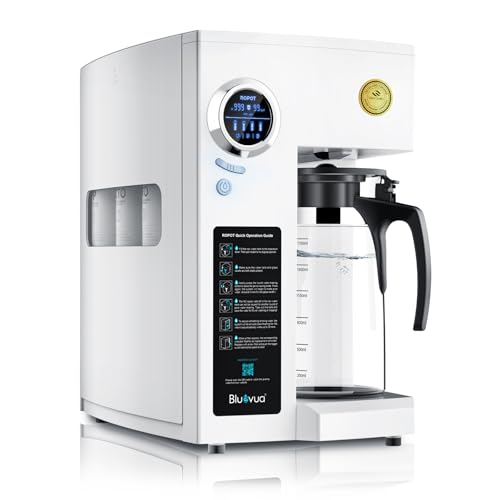
The Bluevua RO100ROPOT-UV is aimed at apartment buyers who want a fuller countertop feature set and are comfortable paying more for it. It combines a six-stage configuration with UV, an RO membrane identified in the listing as 0.0001μm, and a remineralization filter. The supplied information also describes a borosilicate glass carafe, so the unit avoids a conventional plastic serving vessel while retaining the portability of a countertop purifier.
Its stated 2:1 pure-to-drain ratio gives apartment owners a clear water-handling figure to compare, although ratios should be interpreted exactly as published rather than converted into an assumed recovery percentage. A monitor displays water quality and filter service life, and the listing states filter duration between 12 and 24 months. Certification information is specific but limited: the product is described as WQA certified against NSF/ANSI/CAN 372 for lead-free materials and tested by SGS. That is different from claiming complete-system certification to NSF/ANSI 58.
Pros
- Countertop operation requires no plumbing according to the listing.
- Includes UV and remineralization stages.
- Uses a borosilicate glass carafe.
- Lists a 2:1 pure-to-drain ratio.
- Includes water-quality and filter-service monitoring.
Cons
- The product information does not identify complete-system NSF/ANSI 58 certification.
- The added features may be unnecessary for a renter seeking the simplest countertop setup.
Choose this model when UV, a glass carafe, monitoring, and remineralization all matter in the same apartment. If your priority is low initial complexity or a clearer certification claim, AquaTru may be easier to evaluate; if you want a similar countertop format without UV, the standard Bluevua version is the closer alternative.
To buy this product, click here.
4. Bluevua RO100ROPOT Countertop Reverse Osmosis Water Filter System — Best Countertop Remineralization

The standard Bluevua RO100ROPOT keeps the apartment-friendly structure of the UV model while using a five-stage configuration that includes remineralization. It needs no plumbing according to the product information, uses a glass carafe, and enters a power-saving standby mode when inactive. For someone renting a small place, that means the system can remain a self-contained appliance rather than becoming part of the apartment’s plumbing.
The published 2:1 pure-to-drain ratio gives it a useful comparison point against the Express Water countertop model, whose listing states a 1:3 ratio. Bluevua also identifies a filter monitor and a stated service range of 12 to 24 months. The supplied information describes reduction of 99.9% of possible contaminants, but it does not provide the same detailed certification wording as the AquaTru listing. The remineralization stage may appeal to buyers who want mineral addback, but no specific mineral concentration or resulting pH should be assumed.
Pros
- Countertop system requires no plumbing according to the listing.
- Includes a remineralization filter.
- Uses a high-borosilicate glass carafe.
- Lists a 2:1 pure-to-drain ratio.
- Provides filter-life and water-quality monitoring.
Cons
- The supplied information does not identify UV functionality on this model.
- The listing does not clearly provide a contaminant-by-contaminant certification scope.
This model fits renters who want countertop convenience and remineralization without the UV stage of the related version. Pick the UV model if that feature is central to your decision, or choose DREO if two pitchers and a stated 3:1 ratio matter more than a glass carafe.
To buy this product, click here.
5. Express Water Countertop Reverse Osmosis Water Filtration System — Best Faucet-Connected Option
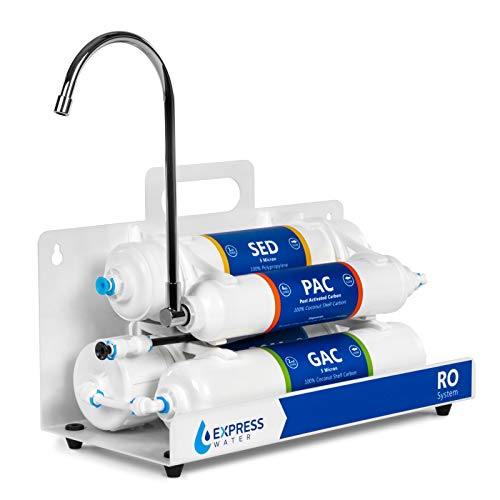
Express Water takes a different apartment approach. This is a preassembled, faucet-connected countertop RO system rather than a self-contained reservoir appliance. The supplied information says it fits faucets with a threaded removable aerator and is incompatible with sprayer faucets. That detail deserves attention before purchase, because a renter with a pull-out or integrated sprayer may discover that the installation path ends before the first filter cycle.
The four-stage configuration includes sediment, granular carbon, RO membrane, and post-activated carbon filtration. Its published production rate is 0.5 to 1 gallon per hour, and the listing states a 1:3 pure-to-drain ratio. Those figures make it easier to plan for a single occupant or moderate drinking-water demand, but less appealing for someone who wants quick filling for several people. Quick-connect cartridges and a one-year limited warranty are also listed.
Pros
- Arrives preassembled according to the product information.
- Uses four listed filtration stages.
- States a 0.5 to 1 gallon-per-hour filtration rate.
- Lists quick-connect replacement cartridges.
- Includes a one-year limited warranty according to the listing.
Cons
- Requires a threaded removable faucet aerator.
- The stated 1:3 pure-to-drain ratio indicates a less favorable water-use profile than some listed countertop alternatives.
This system makes sense for a renter whose faucet is compatible and who wants a relatively direct countertop connection. It is a poor fit for sprayer faucets or buyers who cannot accept a slower stated production rate and a less favorable published drain ratio.
To buy this product, click here.
6. Waterdrop G3P600 Tankless Reverse Osmosis Water Filter System — Best High-Capacity Under-Sink Option

Waterdrop G3P600 belongs in this apartment guide for a different kind of renter or owner. It is a tankless under-sink system with a stated 600 GPD rating, a smart display faucet, and a published eight-ounce fill time of eight seconds. The listing gives dimensions of 18.12 by 5.67 by 17.72 inches and says under-sink electricity is required. That makes cabinet measurement and landlord permission more important than they are with a countertop unit.
The supplied specifications identify NSF/ANSI 58 certification for TDS reduction, NSF/ANSI 372 certification for lead-free material, and NSF 42 testing or certification claims for chlorine, taste, and odor. They also list SGS testing for a range of substances, including PFAS, fluoride, arsenic salt, and others. A 2:1 low-drain ratio is stated, as are filter-life tracking and tool-free filter changes. The 600 GPD number is a rated capacity, not a promise that every apartment’s pressure and conditions will produce that output.
Pros
- Tankless design is intended to save under-sink space.
- Lists a 600 GPD rated capacity.
- Includes a smart faucet with TDS and filter-life displays.
- States a 2:1 low-drain ratio.
- Lists NSF/ANSI 58 and NSF/ANSI 372 certification information.
Cons
- Requires electricity beneath the sink.
- The supplied dimensions may be difficult to accommodate in compact apartment cabinets.
Apartment owners and long-term tenants who can make an under-sink installation should look closely at this system for higher stated demand. Renters who need a reversible setup should skip the plumbing and electrical work and choose a countertop model instead.
To buy this product, click here.
7. iSpring RCC7AK-BN — Best Under-Sink Remineralization

The iSpring RCC7AK-BN is a conventional under-sink choice for an apartment where the lease and cabinet layout permit a more permanent installation. Its published 75 GPD rating, six-stage configuration, and AK remineralization stage create a different ownership proposition from a countertop appliance. The top-mounted faucet fastener is intended to simplify faucet installation from above, while the transparent first-stage housing allows a visual check of sediment buildup.
Certification evidence is one of its clearest strengths. The product information identifies NSF/ANSI 58 certification for the complete system and supplies reduction figures for TDS, PFAS, chlorine, asbestos, barium, cadmium, chromium, copper, fluoride, lead, and selenium. Those claims remain model-specific and should not be expanded into universal contaminant promises. Replacement sets are identified by six-month, one-year, two-year, and three-year labels, giving apartment owners a clearer maintenance path than products with no stated schedule.
Pros
- Lists a 75 GPD rated capacity.
- Product information identifies complete-system NSF/ANSI 58 certification.
- Includes an AK remineralization stage.
- Uses a transparent first-stage filter housing.
- Identifies several replacement-filter intervals and sets.
Cons
- Requires under-sink installation rather than a reversible countertop setup.
- The supplied information does not clearly state a wastewater ratio.
Choose the RCC7AK-BN if mineral addback, certification evidence, and a 75 GPD rating matter more than portability. A renter who expects to move soon should lean toward AquaTru or DREO, while a buyer wanting UV should examine a model specifically identified with that feature.
To buy this product, click here.
8. APEC Water ROES-50 — Best Traditional Under-Sink System

APEC’s ROES-50 is a straightforward five-stage under-sink system with a stated 50 GPD rating. It includes a storage tank, brushed nickel faucet, installation kit, instructions, and a filter set, so the package is aimed at a standard point-of-use installation rather than apartment portability. The colored tubing and quick connections described in the product information may help an owner who prefers a clearly laid-out installation kit.
The listing names reduction claims involving arsenic, chlorine, lead, fluoride, heavy metals, PFAS, and microplastics, along with more than 1,000 impurities. It also recommends filter replacement every six to 24 months based on incoming water quality. That wide interval should be treated as a published recommendation range rather than a fixed schedule. The product information does not clearly identify an NSF/ANSI 58 certification for the complete system or a wastewater ratio, so those points should be checked before purchase if they are decisive.
Pros
- Lists a 50 GPD rated capacity.
- Includes a storage tank and brushed nickel faucet.
- Provides an installation kit and instructions.
- Uses quick connections and colored tubing.
- Identifies a six- to 24-month filter replacement range based on source water.
Cons
- The supplied information does not clearly identify complete-system NSF/ANSI 58 certification.
- The listing does not clearly state a wastewater or recovery ratio.
ROES-50 suits an apartment owner seeking a familiar tank-based under-sink arrangement and a listed 50 GPD capacity. It is less suitable for someone who cannot modify plumbing or wants a self-contained counter appliance with no storage tank beneath the sink.
To buy this product, click here.
9. VIVA21 5-Stage Reverse Osmosis System — Best With Leak Detection
VIVA21 is a compact under-sink package aimed at buyers who want the key pieces supplied together. The product information lists a five-stage system, faucet, tank, tubing, installation kit, automatic shutoff, leak-resistant fittings, and a leak detector. For an apartment owner handling a kitchen renovation, that bundled approach can reduce the chance of discovering that a small but necessary component is missing halfway through installation.
Its certification information is described through WQA Gold Seal certification for NSF/ANSI 58 reverse osmosis performance and NSF/ANSI/CAN 372 lead content. The supplied data says the filtration path includes sediment, carbon, RO membrane, and post-carbon filtration, but it does not provide a GPD rating, pure-to-drain ratio, or contaminant-by-contaminant reduction schedule. That leaves more unanswered questions for buyers comparing daily output or water efficiency, yet the leak detector and stated parts support may carry real weight under an apartment sink.
Pros
- Includes a tank, faucet, tubing, and installation kit.
- Includes a leak detector.
- Lists automatic shutoff and leak-resistant fittings.
- Uses five listed filtration stages.
- Product information identifies WQA Gold Seal certification for NSF/ANSI 58 and NSF/ANSI/CAN 372.
Cons
- The supplied information does not state a GPD rating.
- The listing does not clearly identify a pure-to-drain or recovery ratio.
VIVA21 is a reasonable under-sink pick for an apartment owner who gives leak awareness and a complete kit priority. Buyers who need a known capacity should choose Waterdrop, iSpring, or APEC, while renters seeking a temporary arrangement should avoid under-sink installation altogether.
To buy this product, click here.
Buying Guide
Start With Lease Permission And Installation
Apartment suitability begins with what you are allowed to change. DREO, AquaTru, and both Bluevua countertop models are presented as requiring no plumbing, while Express Water connects to a compatible faucet aerator. Under-sink models involve a different level of commitment because they use a faucet, tubing, drain connections, or cabinet space. A countertop system still needs room and, for these selections, generally an electrical outlet. A no-plumbing design reduces disruption, but it does not mean the appliance disappears into a drawer.
Choose Countertop Or Under-Sink Deliberately
Countertop RO is usually the safer direction for a short lease, a shared kitchen, or a renter who expects to move. Reservoirs and carafes require manual attention, and the machine occupies visible space. Under-sink systems keep the counter clearer and can suit a long-term apartment owner, but the cabinet must accommodate the system, storage tank, tubing, and replacement work. Waterdrop is the unusual under-sink pick here because it is tankless, although its published dimensions and electricity requirement still need checking against the cabinet.
Read Capacity And Flow As Separate Measurements
GPD means gallons per day, while a countertop hourly rate or a stated cup-filling time describes a different aspect of use. Waterdrop lists 600 GPD and an eight-ounce fill time of eight seconds, iSpring lists 75 GPD, and APEC lists 50 GPD. Those figures help compare published specifications, but they do not guarantee the same output in every apartment. Incoming conditions and installation details can affect actual production. Express Water’s stated 0.5 to 1 gallon per hour is more directly relevant to its countertop workflow.
Compare Wastewater Claims Carefully
The products use different wording for water handling. DREO lists a 3:1 pure-to-drain ratio, Bluevua lists 2:1, Express Water lists 1:3, and Waterdrop lists 2:1. Do not reverse those ratios or turn them into a recovery percentage unless the source clearly defines the direction. AquaTru, iSpring, APEC, and VIVA21 do not clearly identify a ratio in the supplied information. If wastewater is a major apartment concern, give greater weight to systems with a clearly stated figure and plan how the drain water will be handled.
Separate Certification From General RO Language
Certification claims vary across these models. iSpring RCC7AK-BN is described as NSF/ANSI 58 certified for the complete system. Waterdrop lists NSF/ANSI 58 for TDS reduction and NSF/ANSI 372 for lead-free material. AquaTru identifies testing and certification to NSF standards by IAPMO, while VIVA21 identifies WQA Gold Seal certification for NSF/ANSI 58 and NSF/ANSI/CAN 372. Bluevua’s UV model identifies WQA certification against NSF/ANSI/CAN 372 for lead-free materials and SGS testing. These statements have different scopes, so a product should not be labeled broadly “fully NSF certified” unless the supplied information supports that wording.
Plan For Filters And Counter Space
Replacement planning matters more in an apartment because storage may be limited and a failed filter can be inconvenient. AquaTru publishes separate service figures for its pre/carbon, RO, and VOC carbon filters. DREO provides filter-life monitoring, while Bluevua identifies a 12- to 24-month service range and Waterdrop includes filter-life tracking. iSpring identifies replacement sets by service period. A clear schedule is useful, but published maximums or ranges are not guarantees for every source-water condition.
Best Reverse Osmosis Systems For Apartments FAQ
Are Countertop RO Systems Better For Apartment Renters?
They are often easier to use in a rental because the selected countertop models do not require permanent under-sink plumbing. AquaTru, Bluevua, and DREO are described as no-plumbing or install-free systems. Express Water still needs a compatible threaded faucet aerator, so its countertop format does not remove every installation issue.
Which Apartment RO System Requires No Plumbing?
DREO, AquaTru, and both Bluevua models are identified in the supplied information as countertop systems requiring no plumbing. They still need counter space, water filling, and electrical power. Express Water is different because it connects to a removable faucet aerator.
Can An Under-Sink RO System Work In An Apartment?
It can work where the lease permits the required plumbing and faucet changes and where the cabinet has enough room. Waterdrop also requires under-sink electricity. Check the lease, cabinet dimensions, outlet location, and connection requirements before choosing an under-sink model.
What Does A 3:1 Or 2:1 RO Ratio Mean?
Those labels describe a product’s stated relationship between purified water and drain water, but the direction must be read from the individual listing. DREO states 3:1 pure to drain, while Bluevua and Waterdrop identify 2:1 wording. Do not convert an ambiguous ratio into a recovery percentage.
Is A Higher GPD Rating Better For An Apartment?
A higher stated GPD rating may matter for heavier daily demand, but it does not automatically mean better filtration or guaranteed output in a particular apartment. Waterdrop lists 600 GPD, iSpring lists 75 GPD, and APEC lists 50 GPD. Compare the rating with installation, pressure information, storage, and actual household use.
Do RO Systems Remove Every Contaminant?
No product should be treated as a universal contaminant guarantee. The supplied models make different claims, and some identify specific testing or certification scopes. TDS reduction is also not proof of reduction for every named contaminant. Review the exact model’s supported claims rather than transferring claims from a related system.
Do I Need Remineralization In An Apartment RO System?
Remineralization is a preference about system configuration, not a universal requirement. The iSpring RCC7AK-BN and both Bluevua models identify remineralization stages. The supplied information does not establish a specific resulting pH, mineral concentration, or health benefit, so select this feature only if mineral addback is meaningful to your buying criteria.
Final Verdict
DREO is the strongest overall fit for most apartment renters because it addresses the central problem directly: it is presented as a countertop, install-free system with two autofill pitchers, TDS and filter-life monitoring, and a stated 3:1 pure-to-drain ratio. AquaTru is the more certification-focused alternative, particularly for buyers who value its glass carafe and supplied IAPMO information. Bluevua’s UV model is the premium countertop route for shoppers who want UV, remineralization, monitoring, and a glass carafe in one appliance.
Apartment owners or long-term tenants with permission for under-sink work have more choices. Waterdrop offers the highest stated capacity and tankless architecture, while iSpring adds a 75 GPD rating, remineralization, and complete-system NSF/ANSI 58 certification information. APEC keeps the traditional under-sink format simple, and VIVA21 adds a leak detector to its bundled installation package. Match the system to your lease, available counter or cabinet space, electricity access, daily demand, and the exact certification or wastewater evidence you consider important.
