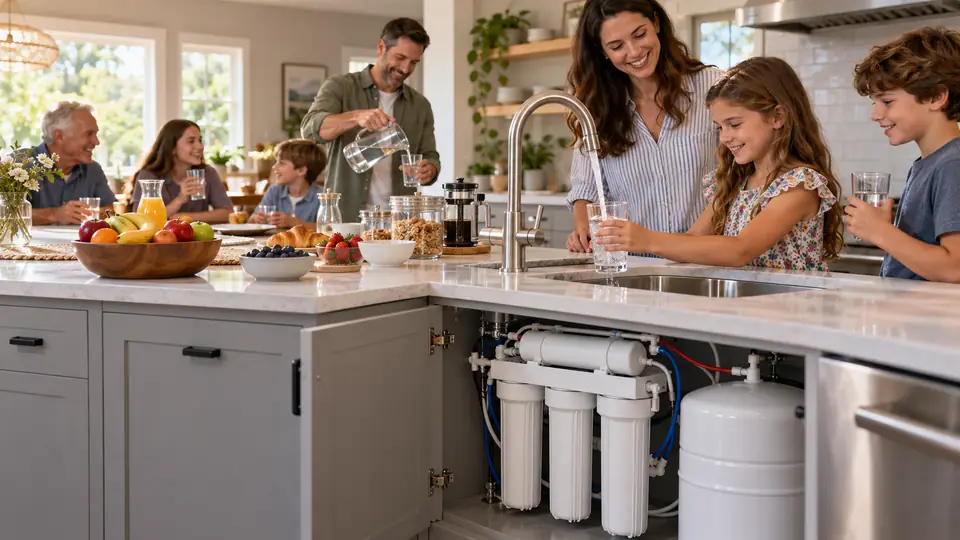
A large household can empty a storage tank surprisingly quickly. Add cooking, coffee, ice, packed lunches, and several refillable bottles, and a system that looks adequate on paper may spend much of the day recovering. That is why shoppers searching for the best reverse osmosis systems for large families should look beyond contaminant claims and stage counts. Rated capacity, dispensing speed, tankless or tank-based design, drain performance, and filter upkeep all shape how comfortably a system handles repeated demand.
A common mistake is treating GPD as a guaranteed daily output or assuming that a higher number automatically means better filtration. GPD is a rated production figure, while faucet flow and stored-water availability are separate concerns. Families also differ in priorities. One household may value an 800 GPD tankless design, another may need a booster pump for low water pressure, and a third may prefer a traditional under-sink tank with no electrical connection. Certification scope matters too, especially when a product lists testing rather than certification. Among these options, the Waterdrop G3P800 has the strongest overall capacity and water-efficiency profile for heavy daily use.
The best fit depends on the household’s source water, cabinet space, plumbing setup, and tolerance for filter management. Tankless systems can provide high rated capacity while using less under-sink space, but they require electricity. Conventional systems are often simpler in layout, although their storage and production characteristics differ. The comparison below separates those trade-offs so a busy household can focus on the specifications that affect everyday availability rather than flashy stage counts.
Quick Answer
- Best Overall: Waterdrop G3P800 for the highest stated capacity and a 3:1 pure-to-drain ratio.
- Best High-Capacity Value: Waterdrop G3P600 for 600 GPD output, tankless storage, and a stated 2:1 drain ratio.
- Best Traditional Under-Sink System: iSpring RCC7AK-BN for 75 GPD capacity, NSF/ANSI 58 certification, and remineralization.
- Best for Low Water Pressure: iSpring RCC7P-AK for its supplied electric booster pump and alkaline remineralization stage.
Best Reverse Osmosis Systems for Large Families Comparison Table
| Product | Best For | System Type | Rated Capacity | Recovery / Drain Information | Certification or Testing |
|---|---|---|---|---|---|
| Waterdrop G3P800 | Highest stated household demand | Tankless under-sink | 800 GPD | 3:1 pure to drain | IAPMO certification for NSF/ANSI 42, 53, 58, and 372 claims |
| Waterdrop G3P600 | High capacity with monitoring | Tankless under-sink | 600 GPD | 2:1 low-drain ratio | NSF/ANSI 42, 58, and 372 claims |
| iSpring RCC7AK-BN | Remineralized water with certification | Tank-based under-sink | 75 GPD | Not clearly specified | NSF/ANSI 58 certification stated |
| iSpring RCC7P-AK | Low water pressure | Pumped under-sink | Not clearly specified | Listing connects pump use with reduced wastewater | Specific certification not clearly identified |
| iSpring RCC7AK-UV | UV and remineralization features | Tank-based under-sink | Not clearly specified | Not clearly specified | NSF/ANSI 58 and 372 certification stated |
| iSpring RCC7-BN | Simple 75 GPD household setup | Tank-based under-sink | 75 GPD | Not clearly specified | NSF/ANSI 58 certification stated |
| APEC ROES-50 | Conventional 5-stage filtration | Tank-based under-sink | 50 GPD | Not clearly specified | Specific certification not clearly identified |
| DREO Countertop RO System | Countertop installation | Countertop RO | Not clearly specified | Listing states a 3:1 pure-to-drain ratio | SGS testing to NSF/ANSI 58 standards stated |
| Waterdrop G2P600 | Tankless capacity at a lower feature level | Tankless under-sink | 600 GPD | 2:1 low-drain ratio | NSF/ANSI 372 certification stated |
The individual reviews add the installation, certification, maintenance, and capacity details that are easy to miss in a quick comparison.
1. Waterdrop G3P800 — Best Overall
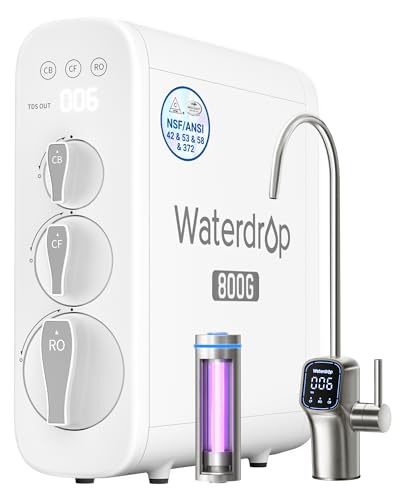
For a large household, the G3P800’s central advantage is its stated 800 GPD capacity. That figure does not guarantee a particular family’s daily output, yet it gives this tankless system the highest published capacity in the group. The listing also states that it can fill one cup in five seconds and uses a 3:1 pure-to-drain ratio, making it especially relevant for households that draw water repeatedly rather than waiting for a small storage tank to refill.
The tankless cabinet format keeps stored water out of the equation and includes a smart faucet with TDS and filter-life information. The product information identifies IAPMO certification for NSF/ANSI 42, 53, 58, and 372 claims, with separate statements about reduction of substances such as PFAS, fluoride, lead, chromium, and radium. It requires under-sink electricity, and the listed dimensions should be checked against the cabinet before purchase. That combination of high capacity, monitoring, and a stated 3:1 ratio gives this model a clear edge for heavy demand.
Pros
- Lists an 800 GPD rated capacity.
- States a 3:1 pure-to-drain ratio.
- Includes a faucet with TDS and filter-life displays.
- Uses a tankless design with a stated five-second cup fill.
- Identifies IAPMO certification claims for NSF/ANSI 42, 53, 58, and 372.
Cons
- Requires electricity under the sink.
- The cabinet must accommodate the listed 18.12 by 5.67 by 17.72-inch dimensions.
Households that refill several bottles, prepare frequent meals, or want a high-capacity tankless layout have the clearest reason to choose this system. Buyers who prefer a nonpowered tank-based setup may find the iSpring RCC7AK-BN or RCC7-BN easier to match to their plumbing preferences.
To buy this product, click here.
2. Waterdrop G3P600 — Best High-Capacity Value

The G3P600 targets the same daily-demand problem as the G3P800, but with a lower stated 600 GPD capacity. That is still substantially higher than the conventional 50 and 75 GPD figures listed for several tank-based models. The listing reports an eight-second fill for an 8-ounce cup, so the system is aimed at repeated dispensing for drinking and food preparation rather than occasional use alone.
Its tankless construction saves under-sink space according to the product information, while a smart faucet displays TDS and filter-life information. The system lists an NSF/ANSI 58 certification for TDS reduction, NSF/ANSI 372 certification for lead-free materials, and NSF 42 certification claims related to chlorine, taste, and odor. It also states a 2:1 low-drain ratio. Electricity is required, and the cabinet dimensions should be verified before installation, especially in a household already storing cleaning supplies or cookware beneath the sink.
Pros
- Lists a 600 GPD rated capacity.
- States a 2:1 low-drain ratio.
- Includes TDS and filter-life information at the faucet.
- Tankless design is listed as saving 70% of under-sink space.
- Provides stated NSF/ANSI 42, 58, and 372 certification claims.
Cons
- Requires under-sink electricity.
- The published information does not give the same five-second fill claim listed for the G3P800.
This model suits families seeking high stated capacity without moving to the 800 GPD version. The G3P800 is the stronger fit for maximum capacity and its stated 3:1 ratio, while the G3P600 may appeal to buyers who want substantial throughput with a different feature and certification package.
To buy this product, click here.
3. iSpring RCC7AK-BN — Best Traditional Remineralizing System

The RCC7AK-BN takes a more conventional route to family water production. Its published 75 GPD rating is far below the tankless Waterdrop models, but the system uses a storage-tank format and adds a sixth remineralization stage. That makes it a practical match for buyers who prefer a familiar under-sink RO layout and want mineral addback identified in the product configuration rather than a bare five-stage arrangement.
The supplied information states NSF/ANSI 58 certification for the entire system and lists specific reduction claims for TDS, PFAS, chlorine, fluoride, lead, and several other substances. A transparent first-stage housing lets owners inspect sediment buildup, while the top-mounted faucet fastener and quick-fitting connections are presented as installation conveniences. Replacement sets are identified for six-month, one-year, two-year, and three-year schedules, although real replacement needs can vary with source water and usage.
Pros
- Lists a 75 GPD rated capacity.
- Includes a sixth-stage mineral AK filter.
- States NSF/ANSI 58 certification for the complete RO system.
- Provides specific supplied reduction claims for PFAS, fluoride, lead, and TDS.
- Identifies replacement-filter sets for several service periods.
Cons
- The published information does not clearly specify a recovery or drain ratio.
- Its stated capacity is much lower than the 600 and 800 GPD tankless alternatives.
Choose this model when certification evidence, remineralization, and a nonpowered traditional system matter more than maximum rated throughput. A family that regularly needs rapid continuous dispensing may prefer a Waterdrop tankless model, while this iSpring is better suited to ordinary drinking and cooking demand supported by stored water.
To buy this product, click here.
4. iSpring RCC7P-AK — Best for Low Water Pressure

The feature that changes the RCC7P-AK’s place in a large-family comparison is its electric booster pump. The product information specifically connects the pump with consistent RO performance in homes with low water pressure and says it can reduce wastewater. That is a more targeted advantage than simply choosing a system with a larger GPD number, because weak inlet pressure can affect how an RO setup operates.
This is a six-stage under-sink system with alkaline remineralization and a transparent first-stage housing for visual filter checks. The supplied information lists reduction claims for more than 1,000 contaminants, including lead, chlorine, fluoride, arsenic, and PFAS, but it does not identify a specific certification standard in the provided details. The 100 to 240V, 50/60Hz adapter gives the pump broad electrical compatibility, although the system still adds a powered component beneath the sink.
Pros
- Includes an electric booster pump.
- Product information connects pump operation with low water pressure performance.
- Includes a sixth-stage alkaline remineralization filter.
- Lists a transparent first-stage housing for filter inspection.
- Uses a 100 to 240V, 50/60Hz pump adapter.
Cons
- A specific NSF or other certification is not clearly identified in the supplied information.
- Its rated GPD is not clearly specified in the published product details.
Families dealing with low inlet pressure have the strongest reason to choose this system. Those with normal pressure and a preference for lower electrical complexity may favor the RCC7AK-BN, while households focused on maximum stated throughput should look toward the 600 or 800 GPD tankless systems.
To buy this product, click here.
5. iSpring RCC7AK-UV — Best With UV and Remineralization

The RCC7AK-UV adds two features that are absent from the standard RCC7AK-BN: an LED UV stage and alkaline remineralization. The product information describes the UV feature as mercury-free, maintenance-free, and activated when water flows. That gives this model a distinct position for buyers who specifically want an additional UV stage, although UV should be viewed as one treatment component rather than a universal guarantee of microbiological safety.
The listing states NSF/ANSI 58 and 372 certification for the entire system and supplies reduction figures for TDS, fluoride, lead, asbestos, and other listed substances. Its layered cartridges, transparent first-stage housing, top-mounted faucet fastener, and identified replacement sets address practical ownership details. Capacity and recovery information are not clearly specified, so families with especially heavy continuous demand have less published throughput information to compare than they do with the Waterdrop models.
Pros
- Includes an LED UV stage that activates with water flow.
- Includes an alkaline mineral AK stage.
- States NSF/ANSI 58 and 372 certification for the whole system.
- Lists layered filter cartridges and a transparent first-stage housing.
- Identifies replacement-filter sets for several service periods.
Cons
- Rated capacity is not clearly specified in the supplied product information.
- A recovery or drain ratio is not clearly identified.
This model fits a household that values the combination of UV and remineralization more than a published high-capacity rating. Buyers who need clear daily-demand figures should favor a Waterdrop system, while those seeking a feature-rich traditional under-sink configuration may find the RCC7AK-UV more relevant.
To buy this product, click here.
6. iSpring RCC7-BN — Best Simple 75 GPD Setup

The RCC7-BN keeps the configuration straightforward: five-stage filtration, a 75 GPD rating, and an under-sink tank-based design. It does not add the remineralization stage found in the RCC7AK-BN, so its appeal is strongest for families that want the core iSpring arrangement without mineral addback. A lead-free designer faucet, food-grade tubing, and a final GAC stage are identified in the product information.
The listing states NSF/ANSI 58 certification and claims reduction of up to 99% of more than 1,000 contaminants, with specific examples including PFAS, chlorine, fluoride, lead, arsenic, and asbestos. Its transparent first-stage housing helps with visual inspection, and the system requires no power source according to the supplied details. A check valve and automatic shutoff are described, but the product information does not give a wastewater ratio or a storage-tank usable capacity.
Pros
- Lists a 75 GPD rated capacity.
- States NSF/ANSI 58 certification.
- Requires no power source according to the product information.
- Includes a transparent first-stage housing and check valve.
- Uses a five-stage configuration with a final GAC polishing stage.
Cons
- Does not include the remineralization stage found in the RCC7AK-BN.
- The published information does not clearly specify a recovery or drain ratio.
This is a sensible match for a family that wants a conventional, nonpowered RO system with a stated 75 GPD rating and certification information. Buyers wanting mineral addback can step up to the RCC7AK-BN, while those who frequently need immediate high-volume dispensing should look at a tankless model.
To buy this product, click here.
7. APEC ROES-50 — Best Conventional 5-Stage Option

The ROES-50 is a traditional 50 GPD under-sink system with five filtration stages, a storage tank, and a brushed nickel faucet. Its stated capacity is the lowest among the tank-based systems in this selection, so it is less compelling for nonstop dispensing. Still, a storage tank can provide a ready reserve for ordinary drinking, cooking, coffee, and ice needs, depending on how the household uses its supply.
APEC identifies reduction claims for arsenic, chlorine, lead, fluoride, heavy metals, PFAS, and microplastics, along with more than 1,000 impurities. The listing includes an installation kit, instructions, and one filter set, and it recommends filter replacement over a six-to-24-month range based on incoming water quality. A specific certification is not clearly identified in the supplied information, and no recovery ratio is provided, so buyers who prioritize certification evidence or water efficiency have stronger alternatives elsewhere in this guide.
Pros
- Lists a 50 GPD rated capacity.
- Includes five filtration stages and a storage tank.
- Supplied claims identify arsenic, lead, fluoride, PFAS, and microplastics.
- Includes a brushed nickel faucet and installation kit.
- Provides a six-to-24-month filter replacement recommendation range based on source water.
Cons
- A specific NSF, WQA, or IAPMO certification is not clearly identified in the supplied details.
- The rated capacity is lower than the 75, 600, and 800 GPD alternatives.
The ROES-50 is best for buyers who prefer a conventional five-stage layout and supplied contaminant claims without needing tankless flow. Larger households with frequent refills may find its 50 GPD rating limiting, while families with moderate demand and adequate storage space may appreciate its complete under-sink kit.
To buy this product, click here.
8. DREO Countertop RO System — Best Countertop Option

The DREO takes the family-demand question away from under-sink plumbing and places the system on the countertop. Its product information identifies two autofill pitchers, TDS and filter-life displays, self-cleaning, and an install-free format. That can be useful in a rental or a home where modifying the faucet and drain connection is undesirable, although countertop space and reservoir handling become part of the daily routine.
The listing describes seven-in-one filtration and states testing by SGS to NSF/ANSI 58 standards. It also names PFOA, PFOS, chlorine, and fluoride among the possible contaminants addressed, while claiming filtration of 99.9% of possible contaminants. A 3:1 pure-to-drain ratio is stated, but a GPD capacity and specific certification are not clearly provided in the supplied information. For a large family, the missing capacity figure matters more than the stage count, particularly if several people need water at once.
Pros
- Uses a countertop format described as install-free.
- Includes two autofill pitchers.
- Provides TDS and filter-life information.
- Lists self-cleaning functionality.
- States SGS testing to NSF/ANSI 58 standards and a 3:1 pure-to-drain ratio.
Cons
- A rated GPD capacity is not clearly specified.
- The supplied information describes testing to NSF/ANSI 58 standards rather than clearly identifying certification.
This model fits a large family only when countertop access and installation flexibility matter more than maximum continuous output. An under-sink Waterdrop system is a better match for high-volume dispensing, while DREO has a distinct advantage for households that cannot or do not want to modify under-sink plumbing.
To buy this product, click here.
9. Waterdrop G2P600 — Best Lower-Feature Tankless Option

The G2P600 offers the same stated 600 GPD capacity as the G3P600, giving it a meaningful place for families that want tankless high-volume production. Its published information also reports an eight-second fill for a 200 ml cup and a 2:1 drain ratio. Those figures are relevant to repeated daily use, although they should be read as product claims and not as a guarantee of household output under every water condition.
The seven-stage system includes filter-life indicators and twist-and-pull filters that the listing says can be changed without tools or moving the unit. It is certified to NSF/ANSI 372 for lead-free materials, but the supplied information does not identify the broader NSF/ANSI 42 and 58 certification claims listed for the G3P600. That makes the G2P600 an interesting capacity-focused alternative, while the G3P600 has the stronger stated certification package and monitoring feature set.
Pros
- Lists a 600 GPD rated capacity.
- States a 2:1 low-drain ratio.
- Reports an eight-second fill for a 200 ml cup.
- Uses tool-free twist-and-pull filter replacement.
- Includes filter-life indicators and NSF/ANSI 372 certification information.
Cons
- The supplied information does not identify the TDS and filter-life faucet display listed for the G3P600.
- Its certification information is narrower than the G3P600’s stated NSF/ANSI 42, 58, and 372 claims.
Families seeking a high stated capacity and a tankless footprint may find this model attractive when the simpler feature package is sufficient. The G3P600 is the stronger choice for buyers who specifically want broader stated certification and faucet monitoring, while traditional iSpring systems remain better suited to households avoiding tankless electrical equipment.
To buy this product, click here.
Buying Guide
Start With Daily Demand, Not Stage Count
Large families should first compare rated GPD, dispensing information, and storage architecture. The 800 GPD and 600 GPD figures on the Waterdrop models are rated capacity claims, not promises that a household will receive that exact amount every day. Water temperature, pressure, and other operating conditions can affect real output, so the rating works best as a comparison point rather than a guarantee.
Choose Tankless or Tank-Based Deliberately
Tankless systems can provide high stated capacities and avoid keeping a large storage tank beneath the sink, but the Waterdrop models in this guide require electricity. Tank-based systems such as the iSpring and APEC models use a different supply pattern, with stored water available for dispensing. Neither architecture is automatically superior. A family that wants high continuous capacity may prefer tankless, while a household seeking a conventional nonpowered installation may lean toward a tank-based system.
Read Drain Ratios Carefully
The products use different wording for water efficiency. Waterdrop lists a 3:1 pure-to-drain ratio for the G3P800 and a 2:1 low-drain ratio for the G3P600 and G2P600. DREO also states a 3:1 pure-to-drain ratio. These figures should not be inverted or converted into a recovery percentage unless the manufacturer clearly defines the measurement. Systems without a supplied ratio should not be assumed to produce less or more wastewater.
Separate Certification From Testing
Certification language deserves close attention. The iSpring RCC7AK-BN, RCC7-BN, and RCC7AK-UV listings state certification claims, while the DREO information describes SGS testing to NSF/ANSI 58 standards. Those are different forms of evidence. Waterdrop models list different standards and organizations across their product information, so compare the exact standard and certification scope rather than treating every NSF reference as interchangeable.
Match Features to the Water Problem
Remineralization, UV, and a booster pump solve different purchasing goals. A remineralization stage adds a stated mineral-addback step, but it does not establish a specific pH or health outcome. The RCC7AK-UV includes an LED UV stage, yet UV should not be treated as universal microbiological protection. The RCC7P-AK’s booster pump is the targeted choice among these products for the low-pressure situation described in its listing.
Plan for Filters and Cabinet Space
A high-capacity system still needs accessible replacement filters and enough room for its hardware. Several iSpring models identify replacement-filter sets, while the Waterdrop G2P600 and G3P600 use twist-and-pull or tool-free replacement descriptions. Check the cabinet dimensions for tankless systems, and verify that a countertop unit has a convenient location for its pitchers. Filter intervals should be treated as published guidance, not universal schedules, because source water and household use affect service needs.
Best Reverse Osmosis Systems for Large Families FAQ
Is 600 GPD enough for a large family?
A 600 GPD rating gives the Waterdrop G3P600 and G2P600 a much higher stated capacity than the 50 and 75 GPD tank-based models in this selection. It does not guarantee that a household will produce 600 gallons under its actual water conditions. Pressure, temperature, demand patterns, and installation conditions can affect real output, so use the figure to compare models rather than predict an exact household supply.
Is the 800 GPD Waterdrop system the best choice for every large household?
No. The G3P800 has the highest stated capacity here, along with a smart faucet and a listed 3:1 pure-to-drain ratio, but it requires electricity and specific cabinet space. A family that prefers a conventional tank-based system, has no convenient outlet, or values remineralization may find the iSpring RCC7AK-BN a better match.
What is the difference between a tankless and tank-based RO system?
A tank-based system stores filtered water for dispensing, while a tankless system produces water without the same type of storage tank. Tankless models in this guide list high rated capacities and require electricity. Tank-based iSpring and APEC systems use a more traditional under-sink arrangement. The better format depends on space, electrical access, demand patterns, and the features supported by the individual model.
Does a higher GPD rating mean better filtration?
No. GPD describes a rated production capacity, not universal filtration quality. A 600 or 800 GPD system may suit heavier demand, but certification, contaminant-specific claims, filter configuration, and operating requirements still matter. A 75 GPD system with clearly stated NSF/ANSI 58 certification may be more appealing to a buyer who prioritizes certification evidence over maximum output.
Which system is best for low water pressure?
The iSpring RCC7P-AK is the clearest fit among these products because its listing specifically identifies an electric booster pump and connects that pump with operation in homes with low water pressure. The supplied details do not provide a universal minimum pressure figure, so households should still verify their plumbing conditions before purchase.
Are the drain ratios directly comparable?
Only with care. The listings state 3:1 pure-to-drain for the G3P800 and DREO, and 2:1 low-drain for the G3P600 and G2P600. The product information does not establish a universal definition for every ratio, so do not reverse the figures or convert them into recovery percentages without a clearly defined measurement.
Do remineralization and alkaline stages make RO water healthier?
The supplied products describe remineralization or alkaline stages as part of their filtration configuration. Those descriptions support saying that mineral addback is included. They do not establish a medical benefit, a specific pH, or a claim that one water type is healthier. Choose the feature for its configuration and taste preference rather than an unsupported health promise.
Does an integrated TDS display identify every contaminant?
No. A TDS display reports total dissolved solids as a broad measurement. It does not individually detect PFAS, lead, arsenic, bacteria, microplastics, or every other possible contaminant. The Waterdrop smart faucets can help owners monitor the displayed TDS value and filter status, but contaminant-specific evidence must come from the product’s certification or testing information.
Final Verdict
The Waterdrop G3P800 is the strongest overall fit for a large family because it combines the highest stated 800 GPD capacity in this selection with tankless operation, a listed five-second cup fill, a smart faucet, and a 3:1 pure-to-drain ratio. Those specifications address the repeated dispensing and under-sink space concerns that often matter in a busy household. Its electricity requirement and cabinet dimensions still need to fit the installation.
The G3P600 and G2P600 offer 600 GPD tankless alternatives, with the G3P600 carrying the broader stated certification and monitoring package. For a conventional system, the 75 GPD iSpring RCC7AK-BN adds remineralization and stated NSF/ANSI 58 certification, while the RCC7P-AK is the targeted choice for the low-pressure situation described in its product information. Match the final selection to daily demand, source-water evidence, certification scope, available space, electrical access, and the maintenance routine the household can realistically follow.
