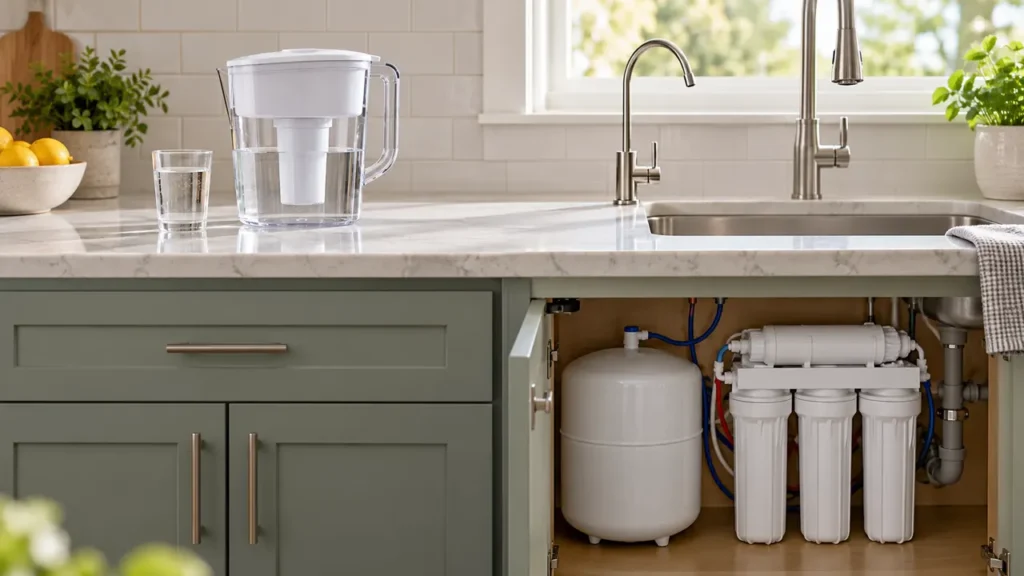
Reverse osmosis and water filtration both improve water quality, but they do not describe two completely separate categories. Reverse osmosis is itself a membrane-based water-treatment process. In everyday use, however, water filtration often refers to conventional systems that rely on sediment media, activated carbon, or other filter cartridges, while reverse osmosis adds pressure-driven separation through a semipermeable membrane.
The practical distinction is this: conventional sediment and carbon filters primarily capture particles or adsorb selected substances, while reverse osmosis adds a membrane-separation stage capable of reducing many dissolved substances. A conventional filter may be well suited to sediment, chlorine, taste, or odor. RO is often used when the treatment goal also includes dissolved-solids reduction or specific dissolved contaminants.
Reverse Osmosis vs. Water Filtration at a Glance
| Feature | Conventional Water Filtration | Reverse Osmosis |
|---|---|---|
| Primary process | Mechanical filtration, adsorption, or another media-based treatment | Pressure-driven separation through a semipermeable membrane |
| Common stages | Sediment and activated carbon filters | Sediment, carbon, RO membrane, and often a postfilter |
| Common treatment goals | Particles, chlorine, taste, odor, and selected contaminants | Dissolved solids and specific dissolved contaminants, depending on the membrane and verified system performance |
| Drain stream | Usually no continuous concentrate stream during normal filtration | Typically sends a concentrate stream to the drain |
| Electricity | Often operates without electricity | Many conventional under-sink systems operate without electricity; some tankless and countertop systems require power |
| Dissolved minerals | Sediment and carbon filters generally leave most dissolved minerals largely unchanged | Reduces many dissolved minerals and salts; some systems add a remineralization stage afterward |
| Typical configurations | Faucet-mounted, countertop, under-sink, refrigerator, and whole-house | Commonly countertop or under-sink for drinking water, with larger and specialized configurations also available |
What Water Filtration Means
Water filtration is a broad term rather than one specific treatment mechanism. Depending on the product, treatment may involve mechanical filtration, adsorption, ion exchange, membrane separation, or another process. Technologies such as ultraviolet treatment are also commonly discussed alongside home water filters even though UV disinfects water rather than physically filtering contaminants from it.
This is why a product being described simply as a water filter tells you relatively little about what it can reduce. The treatment media, system design, flow conditions, capacity, testing, and certification claims are more informative than the general label.
Sediment Filtration
Sediment filters use porous media to capture suspended material such as sand, silt, rust, dirt, and other particles. Their primary job is physical particle removal. They generally do not provide the dissolved-solids reduction associated with reverse osmosis.
Sediment filtration is also frequently used as pretreatment. Removing particles before water reaches carbon media, an RO membrane, or another treatment stage can reduce fouling and help protect downstream components.
Activated Carbon Filtration
Activated carbon works primarily through adsorption, in which certain substances attach to the carbon’s surface. Carbon filters are commonly used to reduce chlorine and improve taste and odor. Particular carbon filters may also carry verified reduction claims for other substances.
Performance depends on factors such as the type and quantity of carbon, water chemistry, flow rate, contact time, cartridge capacity, and replacement schedule. A generic statement about activated carbon should not be treated as proof that every carbon cartridge reduces the same contaminants.
Other Water-Treatment Technologies
Other systems use specialized media or treatment processes for particular water problems. Ion exchange can remove or exchange selected ions and is used in applications such as water softening. Ultrafiltration uses membrane technology but generally does not provide the same dissolved-solids separation as reverse osmosis.
Ultraviolet systems operate differently again. UV light can be used to inactivate microorganisms under appropriate operating conditions, but it does not remove dissolved salts from water. Calling all of these technologies simply “filters” can hide important differences in what they actually do.
How Reverse Osmosis Is Different
A reverse osmosis system applies pressure to feed water on one side of a semipermeable membrane. Water passes through the membrane more readily than many dissolved substances. The treated portion is called permeate or product water. A second stream carries concentrated rejected material away from the membrane and normally goes to a drain.
Residential RO systems usually combine the membrane with conventional filtration rather than replacing filtration altogether. A typical system may contain:
- Sediment prefilter: Captures particles that could restrict flow or contribute to fouling.
- Carbon prefilter: Reduces chlorine and selected organic compounds and helps protect chlorine-sensitive RO membranes.
- RO membrane: Performs the primary separation of many dissolved substances.
- Postfilter: Commonly uses carbon to treat taste and odor before dispensing.
- Remineralization stage: An optional cartridge that adds selected minerals after RO treatment.
A system may also include a storage tank, flow restrictor, automatic shutoff valve, check valve, booster pump, permeate pump, electronic controls, or other components. The exact arrangement depends on whether the system is tank-based, tankless, countertop, or designed for another application.
Which Contaminants Can Each Approach Address?
The treatment method should match the actual water problem. Sediment filtration is useful for suspended particles. Activated carbon is commonly used for chlorine and taste or odor concerns. Specialized filters may target additional substances when the cartridge has been designed and verified for those claims.
Reverse osmosis technology can reduce many dissolved substances. Depending on the exact system and verified performance, RO may also be used to address contaminants such as nitrate, fluoride, arsenic, or lead. Those examples should not be interpreted as universal claims for every RO product.
A particular system’s performance against a target contaminant should be established from that exact system’s performance data or certification claim. General membrane capability, testing of a component, and certification of a complete treatment system are different forms of evidence.
Reverse osmosis should also not be treated as a universal guarantee of microbiological safety. If source water may contain bacteria, viruses, or other microorganisms, the treatment plan needs to account for that risk specifically. Private wells deserve particular attention because their water chemistry and microbiological quality can vary substantially.
How RO Performance Is Measured
Several measurements help describe RO performance, but they answer different questions. TDS, rejection rate, recovery rate, GPD, and faucet flow should not be treated as interchangeable specifications.
TDS
TDS means total dissolved solids. A TDS meter measures the electrical conductivity of the water and uses that measurement to estimate the concentration of dissolved ionic material. Comparing feed-water and product-water TDS can be useful for monitoring RO membrane performance.
TDS is not a contaminant-specific safety test. It does not tell you which individual dissolved substances are present, nor can it independently establish the presence or absence of concerns such as PFAS, lead, arsenic, bacteria, viruses, pesticides, or microplastics.
Rejection Rate
Rejection rate describes how effectively the membrane reduces dissolved material. A basic estimate using TDS measurements is:
Rejection rate (%) = [(Feed TDS – Product TDS) ÷ Feed TDS] × 100
If feed water measures 300 ppm TDS and product water measures 30 ppm, the estimated TDS rejection rate is 90 percent. That result describes the reduction in measured TDS. It does not mean that every individual contaminant has been reduced by 90 percent.
Recovery Rate
Recovery rate answers a different question: how much of the incoming feed water becomes product water. The remainder leaves primarily as concentrate. A system can have strong membrane rejection while still sending a significant portion of its feed water to the drain.
GPD and Dispensing Rate
GPD means gallons per day. A membrane or system rated for a particular GPD has a stated production capacity under defined test conditions. Actual production can change with feed-water pressure, temperature, TDS, membrane condition, fouling, and system configuration.
GPD is not the same as faucet flow rate. A conventional tank-based system may produce water gradually and store it for faster dispensing later. A tankless system may use a booster pump and larger membrane capacity to provide direct-flow delivery. A larger GPD number therefore does not automatically mean proportionally faster water at the faucet.
Wastewater Is a Major Difference
Conventional sediment and carbon filters normally do not produce a continuous concentrate stream while filtering water. Reverse osmosis generally does because rejected dissolved material needs a path out of the system. Cross-flow across the membrane also helps carry concentrated material away from its surface.
Manufacturers describe water efficiency in several ways, including recovery rate, pure-to-drain ratio, product-to-waste ratio, and waste-to-product ratio. The direction of the ratio matters. A 2:1 pure-to-drain ratio means two parts product water for one part drain water. A 2:1 waste-to-product ratio describes a very different result.
Actual water use can vary with pressure, temperature, feed-water chemistry, membrane condition, flow control, tank backpressure, and system design. Ratios should therefore be compared only after confirming that manufacturers are expressing them in the same direction and under reasonably comparable conditions.
Installation Requirements Also Differ
Conventional filters range from simple pitcher and faucet-mounted products to under-sink and whole-house systems. Installation can be as simple as inserting a cartridge or may involve permanent plumbing, depending on the configuration.
A traditional under-sink RO system normally requires more components. Installation may include a feed-water connection, drain connection, storage tank, dedicated faucet, and tubing between treatment stages. Some systems can also supply a refrigerator or ice maker when the design, pressure, and plumbing arrangement support it.
Countertop RO systems can reduce or eliminate permanent plumbing work, although they vary in feed-water handling, wastewater collection, electrical requirements, and filter configuration. Tankless systems typically occupy less cabinet space than systems with storage tanks, but many require electricity for a booster pump and electronic controls.
Whole-house RO is a substantially different application from point-of-use drinking-water treatment. Treating all household water can require pretreatment, large membrane capacity, storage, repressurization, adequate drain capacity, and careful sizing for household demand.
Permanent plumbing work should follow the manufacturer’s instructions and applicable plumbing requirements. Water should be shut off before disconnecting pressurized plumbing, and new connections should be checked carefully for leaks before the installation is considered complete.
Maintenance Differences
Both conventional filtration and reverse osmosis require maintenance, but an RO system usually contains more treatment stages and operating components.
- Conventional filter cartridges: Replace them according to the manufacturer’s instructions and actual water conditions. A loaded sediment filter can restrict flow, while exhausted treatment media may no longer provide its intended performance.
- RO sediment and carbon prefilters: Replace them at the specified intervals so that sediment and disinfectants do not unnecessarily stress the membrane.
- RO membrane: Monitor and replace it according to manufacturer guidance and system performance. A change in product-water TDS or production may justify further diagnosis, but it does not automatically prove that the membrane has failed.
- Postfilter: Replace it according to the specified schedule to maintain its intended treatment function.
- Storage tank, tubing, and fittings: Inspect for leaks and maintain or sanitize them according to the instructions for the exact system.
Tank-based RO systems may also require a tank air-precharge check when troubleshooting poor delivery or tank-filling problems. The correct test condition and specified pressure should come from the manufacturer. A pressure reading from a tank containing water is not equivalent to the empty-tank precharge measurement used for many systems.
When Conventional Filtration May Be Enough
Reverse osmosis is not automatically necessary simply because water is being treated. If the main problem is visible sediment, chlorine, or an unwanted taste or odor, an appropriate conventional filter may address the issue without an RO membrane.
This can mean a simpler installation, no continuous RO concentrate stream, and fewer system components to maintain. The important qualification is that the filter must actually be designed and verified for the treatment objective. A generic carbon cartridge should not be assumed to reduce a contaminant merely because some other carbon filters carry that claim.
When Reverse Osmosis May Be Useful
RO becomes particularly relevant when dissolved-solids reduction is part of the treatment goal. It may also be appropriate when a specific dissolved contaminant needs to be reduced and the exact system has suitable verified performance for that contaminant.
Feed-water conditions still matter. Hardness can contribute to scaling, while iron, manganese, sediment, or other constituents may foul or damage a system if they exceed its design limits. Some installations therefore need pretreatment before water reaches the RO membrane.
A water softener and an RO system should not be treated as interchangeable. A conventional ion-exchange softener primarily addresses hardness by exchanging hardness ions, while RO separates many dissolved substances from the product-water stream. In some homes the two technologies can perform complementary jobs.
Water testing provides a better basis for treatment decisions than appearance or taste alone. TDS testing, hardness testing, contaminant-specific analysis, and microbiological testing measure different things. Private wells or known contamination concerns may require laboratory testing before an appropriate treatment system can be selected.
What NSF/ANSI Certification Can Tell You
NSF/ANSI 58 establishes requirements for point-of-use reverse osmosis drinking-water treatment systems. Certification can address requirements such as materials, structural integrity, total dissolved solids reduction, and applicable optional performance claims.
Certification to NSF/ANSI 58 does not mean that every system is certified to reduce every contaminant associated with reverse osmosis technology. Specific contaminant-reduction claims must be checked for the exact certified model.
The wording of a product claim also matters. Certified to NSF/ANSI 58, tested according to NSF/ANSI 58, and uses NSF-certified components do not establish the same thing. Certification of one component should not be presented as certification of the complete RO system.
Other standards address different requirements. NSF/ANSI 42 covers claims that include aesthetic effects such as chlorine taste and odor, while NSF/ANSI 53 addresses specified health-effect reduction claims. NSF/ANSI 401 covers certain emerging-contaminant reduction claims. NSF/ANSI/CAN 372 addresses lead content in drinking-water system components rather than establishing contaminant-reduction performance.
For a particular water-quality concern, check the exact model, the applicable standard, the certifying organization, and the specific performance claim rather than relying on a broad statement that a product is “NSF tested” or “NSF compliant.”
Frequently Asked Questions
Is Reverse Osmosis a Type of Water Filtration?
Yes. Reverse osmosis is a membrane-based filtration and separation process. The common comparison between “RO” and “water filtration” usually uses water filtration as shorthand for conventional sediment, carbon, and similar non-RO filters. Identifying the actual treatment technology is more useful than relying on the broad word filter.
Does a Carbon Filter Do the Same Thing as Reverse Osmosis?
No. Activated carbon and reverse osmosis operate differently. Carbon adsorbs selected substances and is commonly used for chlorine, taste, odor, and specific organic contaminants when supported by the cartridge’s performance claims. An RO membrane provides separation of many dissolved salts and other dissolved substances that ordinary carbon filtration does not provide.
Does Reverse Osmosis Remove Minerals?
Reverse osmosis reduces many dissolved minerals and salts in the product water. Some systems include a remineralization cartridge afterward. The effect of remineralization depends on the media, water chemistry, contact time, and system design, so the presence of such a stage does not guarantee a particular mineral concentration or pH.
Does Reverse Osmosis Waste Water?
Most residential RO systems send some water to the drain as concentrate. The amount depends on system design and operating conditions. Conventional sediment and carbon cartridges generally do not produce the same continuous concentrate stream during filtration.
Can a Water Filter and Reverse Osmosis Be Used Together?
Yes. In fact, residential RO systems normally use conventional filters as part of the treatment process. Sediment and carbon prefilters protect the RO membrane and perform treatment functions that complement membrane separation. A separate whole-house filter or pretreatment system can also precede a point-of-use RO system when the equipment is compatible and adequate feed pressure is maintained.
The Main Difference
A sediment or carbon filter may be all that is needed when the problem is particulate matter, chlorine, taste, or odor. When dissolved-solids reduction or a particular dissolved contaminant is the treatment goal, reverse osmosis adds a membrane-separation step that conventional sediment and carbon filters do not provide.
Neither label is enough by itself. The useful comparison is between the water problem and the verified capabilities of the exact treatment system, including its filters, membrane, certification claims, pressure requirements, wastewater production, and maintenance needs.
