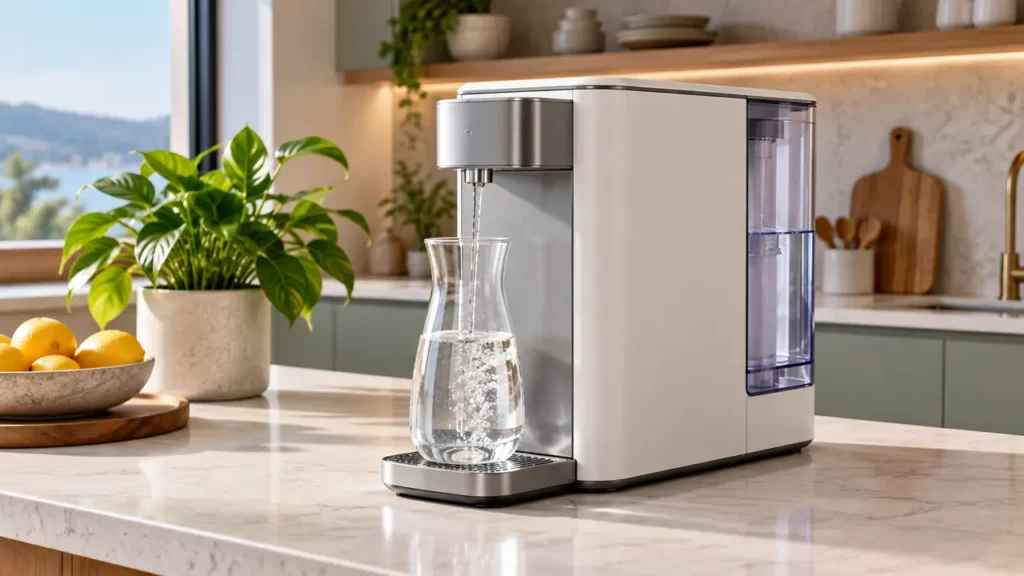
A countertop reverse osmosis system solves a very specific household problem: you want RO filtration without drilling into a cabinet, connecting a dedicated faucet, or committing to an under-sink installation. That makes these units appealing to renters, apartment residents, offices, RV owners, and anyone who prefers a self-contained appliance. The trade-off is that countertop models use reservoirs, electricity, and countertop space, so the best system depends on how much water you need and how often you want to refill it.
Buyers often compare stage counts or TDS readings as though they tell the whole story. They do not. Pay closer attention to the exact filtration claims, testing or certification language, pure-to-drain ratio, reservoir size, pitcher design, filter-life information, and maintenance controls. A small system for one or two people has different priorities than a larger countertop unit for a family or several pets. Among the options here, the Waterdrop C2SL offers the most balanced mix of mineral addback, monitoring, glass-pitcher convenience, and stated water efficiency for many countertop users.
The products below cover several distinct approaches. Some emphasize a compact footprint and low-waste operation, while others add UV, glass carafes, larger reservoirs, or stronger published testing claims. The AquaTru Glass Carafe is especially appealing for buyers who place certification language and named contaminant coverage near the top of their list, while the larger DREO and Mate 3 models make more sense for households that need more stored water.
If you are comparing options quickly, the table provides a compact view of system type, capacity, filtration details, and the evidence stated for each model.
Quick Answer
- Best Overall: Waterdrop C2SL Countertop Reverse Osmosis Water Filter for mineral addback, monitoring, a glass pitcher, and a stated 3:1 pure-to-drain ratio.
- Best for Certification Evidence: AquaTru Glass Carafe Countertop RO System for buyers who want named contaminant claims and IAPMO testing and certification language.
- Best for Larger Households: DREO Countertop RO System 5L for its 5-liter tank and two 1.1-liter pitchers.
- Best With UV: Bluevua RO100ROPOT-UV for a countertop system that combines RO filtration, UV, remineralization, and a glass carafe.
Best Countertop Reverse Osmosis Systems Comparison Table
| Product | Best For | System Type | Capacity or Pitcher | Notable Evidence or Feature |
|---|---|---|---|---|
| Waterdrop C2SL | Balanced everyday use | Countertop RO | 108 oz feed tank, 40 oz glass pitcher | 7-stage filtration, mineral filter, 3:1 ratio |
| AquaTru Glass Carafe | Named contaminant claims | Countertop RO | Glass carafe | 4-stage filtration, IAPMO testing and certification claim |
| Bluevua RO100ROPOT-UV | UV and mineral addback | Countertop RO | Glass carafe | 6 stages, UV, remineralization, 2:1 ratio |
| DREO Countertop RO 5L | Higher stored-water needs | Countertop RO | 5L tank, two 1.1L pitchers | 3:1 ratio, BPA-free materials, TDS monitor |
| Mate 3 UV | Families and pet households | Countertop RO with UV | 169 oz tank, 44 oz pitcher | UV, mineral enhancement, self-cleaning, 3:1 ratio |
| Bluevua RO100ROPOT | Glass-carafe RO with remineralization | Countertop RO | Glass carafe | 5 stages, remineralization, 2:1 ratio |
| DREO Countertop RO With Two Pitchers | Compact multi-pitcher use | Countertop RO | 3L tank, two pitchers | 7-in-1 filtration claim, self-cleaning |
| DREO Countertop RO With Autofill Pitcher | Simple compact operation | Countertop RO | Countertop reservoir and pitcher | 7-in-1 filtration claim, TDS and filter-life monitoring |
| DREO Countertop RO 3L | Small daily-use setups | Countertop RO | 3L tank, 1.1L pitcher | 3:1 ratio, auto-fill, self-cleaning |
The individual reviews add the context that a comparison table cannot, especially around reservoir size, published evidence, monitoring, and maintenance.
1. Waterdrop C2SL Countertop Reverse Osmosis Water Filter — Best Overall

The Waterdrop C2SL is the most rounded countertop package in this group because its features address the small daily annoyances that can make reservoir-style filtration tiresome. It has a 108-ounce feed-water tank and automatically fills a detachable 40-ounce Maxblue glass pitcher. That pitcher can move to the refrigerator or dining table, so filtered water does not have to remain beside the machine. The system also uses a mineral filter, which gives buyers a clearly stated mineral-addback option after RO treatment.
Its published specifications identify a 0.0001 μm RO membrane and laboratory testing claims for PFOA, PFOS, microplastics, lead, chlorine, and fluoride. Those figures are product-specific published test claims, not a universal guarantee for every water condition. The display shows filter life and operating status, while voice alerts cover a low feed tank or filter replacement. For a couple, roommate setup, or home coffee station, that combination is unusually practical, with the stated 3:1 pure-to-drain ratio adding a useful water-efficiency advantage.
Pros
- Includes a 108-ounce feed-water tank and detachable 40-ounce glass pitcher.
- Uses a 7-stage RO configuration with a stated mineral filter.
- Publishes SGS laboratory reduction claims for several named contaminants, including PFOA, PFOS, microplastics, lead, chlorine, and fluoride.
- Provides filter-life and operating-status information with voice alerts.
- Lists a 3:1 pure-to-drain ratio and up to 528 gallons or 12 months of filter use.
Cons
- The published capacity and filter-life figures are stated as maximums, so actual service intervals may vary.
- The system is identified as suitable for one to two people, which may mean more refilling for larger households.
The C2SL fits buyers who want a countertop system that feels organized rather than bare-bones. Choose a larger DREO or Mate 3 model if several people or pets will draw water throughout the day. For smaller households that value a glass pitcher, mineral addback, and specific monitoring features, this is the easiest model here to recommend without stretching the evidence.
To buy this product, click here.
2. AquaTru Glass Carafe Countertop RO System — Best for Certification Evidence

AquaTru takes a more evidence-focused approach than many countertop listings. Its product information names 84 contaminants, including PFOA, PFOS, lead, microplastics, fluoride, chromium-6, and arsenic. It also says the system was tested and certified to NSF standards by IAPMO. That wording matters because it identifies a certification organization and testing claim, rather than relying solely on a broad statement about RO technology.
The four-stage design uses a pre-carbon filter, RO filter, and VOC carbon filter, with published service figures of up to 300 gallons or six months for the pre/carbon filter and up to 600 gallons or one year for the RO filter. A removable glass carafe with a lid gives the unit a familiar serving format, and the listing states that no plumbing, drilling, or installation is required. Buyers should still leave enough room to fill the reservoir and remove the carafe without bumping nearby appliances.
Pros
- Names 84 contaminants in its product information, including PFOA, PFOS, lead, microplastics, fluoride, chromium-6, and arsenic.
- States that the system was tested and certified to NSF standards by IAPMO.
- Uses a four-stage configuration with pre-carbon, RO, and VOC carbon filtration.
- Includes a removable glass carafe with a lid.
- Lists specific maximum service figures for the pre/carbon and RO filters.
Cons
- The supplied information does not clearly state a pure-to-drain ratio.
- The product information does not identify a built-in TDS or filter-life display.
This model is a strong fit for a buyer who wants named contaminant coverage and certification language to carry more weight than mineral addback or smart alerts. A Waterdrop or Bluevua model may be more convenient for buyers who specifically want a self-monitoring display or remineralization stage. AquaTru makes sense where the glass carafe and documented treatment claims are the main draw.
To buy this product, click here.
3. Bluevua RO100ROPOT-UV Countertop Reverse Osmosis Water Filter — Best With UV
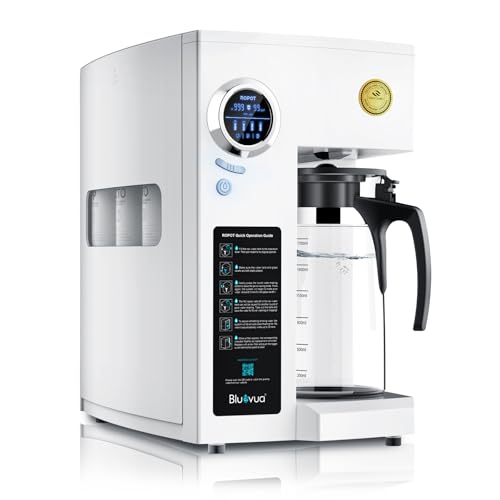
The Bluevua RO100ROPOT-UV is for shoppers who want more than a basic countertop RO cycle. Its six-stage configuration includes a 0.0001 μm RO membrane, UV light, and a remineralization filter. The supplied information names reductions for TDS, PFOA, PFOS, chlorine, fluoride, arsenic, and lead, while also stating that the system was tested by SGS. It separately identifies WQA certification against NSF/ANSI/CAN 372 for lead-free materials, so those testing and certification details should not be read as the same claim.
A high-borosilicate glass carafe replaces the usual plastic pitcher, and the system enters a power-saving standby mode when idle. The stated 2:1 pure-to-drain ratio may appeal to buyers who want to reuse the leftover water for suitable household tasks. A filter-life monitor displays service information, with the listing describing filter life between 12 and 24 months. The exact replacement schedule still depends on usage and water conditions, but the display makes that information easier to track.
Pros
- Combines six filtration stages with UV light and a remineralization filter.
- Uses a high-borosilicate glass carafe.
- Names several contaminant reduction claims and identifies SGS testing.
- States WQA certification against NSF/ANSI/CAN 372 for lead-free materials.
- Lists a 2:1 pure-to-drain ratio and a filter-life monitor.
Cons
- The supplied information does not establish a specific UV microbiological safety claim.
- The published price positioning is higher than the simpler countertop systems in this roundup.
Choose this Bluevua when UV, a glass carafe, and mineral addback all matter in the same purchase. The AquaTru is more focused on named contaminant claims and certification language, while the Waterdrop C2SL offers more detailed day-to-day alerts at a lower-cost positioning. The RO100ROPOT-UV is a feature-rich pick, but buyers should be comfortable paying for those added functions.
To buy this product, click here.
4. DREO Countertop RO System 5L — Best for Larger Households

The 5-liter DREO model addresses the most obvious weakness of small countertop reservoirs: constant refilling. Its 5-liter tank and two 1.1-liter pitchers are listed as suitable for three to four people, giving it a more useful scale for shared apartments, small families, or a home where pets also need filtered water. The unit keeps the countertop format, so the appeal is stored capacity without a plumbing project.
DREO lists a 3:1 pure-to-drain ratio, a 265-gallon or 1,000-liter filter capacity, real-time TDS monitoring, and filter-life reminders. The supplied information also identifies BPA-free materials for the pitcher and tank, plus a twist-to-install filter replacement process. Its broad 7-in-1 and contaminant language should be read alongside the specific published claims, rather than as proof that every possible contaminant is reduced in every source water.
Pros
- Uses a 5-liter tank and includes two 1.1-liter pitchers.
- Lists the system for daily use by three to four people.
- Provides real-time raw-water and purified-water TDS readings.
- States a 3:1 pure-to-drain ratio and a 265-gallon filter capacity.
- Identifies BPA-free pitcher and tank materials and twist-in filter replacement.
Cons
- The larger tank and two-pitcher setup require more counter and storage space than the smallest options.
- The supplied information does not clearly specify a detailed contaminant-by-contaminant reduction table for this exact model.
This is the DREO to choose when reservoir capacity matters more than a glass carafe or remineralization stage. A smaller C2SL or 3-liter DREO will be easier to place in a tight space, while the Mate 3 adds UV and a larger stated tank. For shared daily use, the 5-liter format is the central reason to prefer this version.
To buy this product, click here.
5. Mate 3 UV Countertop Reverse Osmosis Water Filter — Best for Families and Pet Households

The Mate 3 UV combines a relatively large 169-ounce tank with a 44-ounce BPA-free borosilicate glass pitcher. The listing positions it for one to four people, and the larger reservoir may reduce the refill rhythm that comes with smaller countertop units. A pet-owning household may also appreciate the stated use case, although the system should still be operated and maintained according to its instructions.
Its nine-stage configuration includes RO, UV, and mineral enhancement, along with a self-cleaning cycle that flushes internal lines and concentrated wastewater. The touch display supports selectable water volumes, auto-sensing dispensing, and filter-life alerts. DREO and Waterdrop offer similar 3:1 ratio claims, but Mate 3 combines that stated ratio with the larger reservoir and UV feature. The listing also says SGS testing was performed and references NSF/ANSI 42, 53, and 58 compliance claims. Those standards should be understood as specific references, not a blanket promise about every contaminant.
Pros
- Includes a 169-ounce tank and 44-ounce borosilicate glass pitcher.
- Combines RO filtration, UV, and mineral enhancement.
- Provides auto-sensing dispensing and selectable water volumes.
- Lists self-cleaning, filter alerts, and a 3:1 pure-to-waste ratio.
- References SGS testing and NSF/ANSI 42, 53, and 58 compliance claims.
Cons
- The nine-stage configuration and larger reservoir may occupy more space than compact two-person models.
- The supplied information does not identify a complete contaminant-by-contaminant certification scope for each referenced standard.
Mate 3 is the better fit for households that need more stored water and want UV, mineral enhancement, and hands-free dispensing in one appliance. The 5-liter DREO is a simpler capacity-focused alternative, while the Bluevua UV model offers a glass-carafe format with a smaller stated ratio and different monitoring details. Select Mate 3 for its combination of capacity and controls, not simply because it lists more stages.
To buy this product, click here.
6. Bluevua RO100ROPOT Countertop Reverse Osmosis Water Filter — Best Glass-Carafe Option

The standard Bluevua RO100ROPOT shares the glass-carafe concept with the UV version, but its five-stage configuration omits the specifically listed UV stage. It includes remineralization, which gives buyers a clear mineral-addback feature without moving to the more elaborate RO100ROPOT-UV setup. That distinction may appeal to someone who wants a glass serving vessel and a simpler filtration architecture.
The system uses a stated 2:1 pure-to-drain ratio and enters standby mode when idle. Its monitor displays water quality and filter service information, while the listing describes filter life between 12 and 24 months. The product information also identifies a one-year limited manufacturer warranty after registration. Since the supplied information does not list a detailed contaminant test table for this exact standard model, buyers seeking specific contaminant evidence may prefer AquaTru or the Waterdrop C2SL.
Pros
- Uses a five-stage RO configuration with a remineralization filter.
- Includes a high-borosilicate glass carafe.
- Lists a 2:1 pure-to-drain ratio.
- Provides a monitor for water quality and filter service information.
- States a one-year limited warranty after registration.
Cons
- This version does not list UV filtration in the supplied product information.
- The published details do not identify the same specific contaminant testing claims listed for some competing models.
The standard RO100ROPOT makes sense for buyers who want remineralization and a glass carafe but do not need the UV version’s added stage. Choose AquaTru for more prominent named-contaminant and IAPMO evidence, or choose the Waterdrop if alerts and a detachable refrigerator-friendly pitcher are more useful. This model’s appeal is its middle ground between simple and heavily featured.
To buy this product, click here.
7. DREO Countertop RO With Two Autofill Pitchers — Best for Multi-Pitcher Convenience

This DREO version is built around a small footprint and two autofill pitchers rather than a large family-size tank. Its listed dimensions are 14.51 inches long, 6.73 inches wide, and 13.35 inches high, which gives shoppers a useful way to judge shelf or counter clearance before ordering. Two pitchers can be convenient for separating serving water from a backup container, although the product information does not specify the capacity of both pitchers in this listing.
DREO describes the system as a 7-in-1 RO filter with self-cleaning operation and a 3:1 pure-to-drain ratio. The listing also says it was tested by SGS and met NSF/ANSI 58 standards. That is best reported as a supplied testing and standards claim rather than expanded into a broad certification statement. The system’s install-free countertop format suits renters and temporary setups, while the unspecified filter-life details mean buyers should verify replacement information before relying on it for high-volume use.
Pros
- Includes two autofill pitchers according to the product title.
- Lists a slim 14.51 by 6.73 by 13.35-inch footprint.
- States a 3:1 pure-to-drain ratio.
- Includes self-cleaning operation.
- Identifies SGS testing and a claim of meeting NSF/ANSI 58 standards.
Cons
- The supplied information does not clearly state the capacity of the two pitchers.
- The listing details do not provide a clear filter-life figure for this exact version.
This DREO is worth considering when two pitcher containers are more useful than a single carafe, especially in a compact apartment or office. The Waterdrop C2SL provides stronger published detail around filter capacity and contaminant testing, while the larger DREO 5L serves more people between refills. Pick this version for its pitcher arrangement and footprint, but confirm replacement-filter details before purchase.
To buy this product, click here.
8. DREO Countertop RO With Autofill Pitcher — Best Simple DREO Format

This DREO listing presents a more focused countertop arrangement with an autofill pitcher and a self-cleaning purifier. The product information identifies a 7-in-1 RO filter and the same broad SGS and NSF/ANSI 58 testing language associated with the DREO countertop range. For a renter or office user who wants a plug-in appliance without a faucet connection, that basic operating format keeps the setup straightforward.
The trade-off is limited published detail in the supplied listing. Unlike the larger DREO 5L model, this version does not clearly identify a tank size, filter capacity, TDS monitor, or detailed pitcher measurements. That does not prove those features are absent, but it makes direct capacity planning harder. Buyers who primarily need a compact self-contained RO system may still find the format useful, while higher-demand households should favor a model with a clearly stated reservoir.
Pros
- Uses a countertop, installation-free format according to the product information.
- Includes an autofill pitcher.
- Identifies a 7-in-1 RO filtration configuration.
- Includes self-cleaning operation.
- Lists a 3:1 pure-to-drain ratio for the DREO filtration system.
Cons
- The supplied information does not clearly state the reservoir or pitcher capacity for this exact listing.
- The product details do not identify a filter-life figure or integrated TDS monitor.
This model is most suitable for a buyer who values a compact autofill format and does not need to plan around a published large reservoir. The C2SL is easier to evaluate for maintenance and capacity, while the 5L DREO is better supported for larger daily demand. Its main advantage is the simple operating concept, with less specification detail available for careful capacity comparisons.
To buy this product, click here.
9. DREO Countertop RO System 3L — Best Compact DREO Capacity
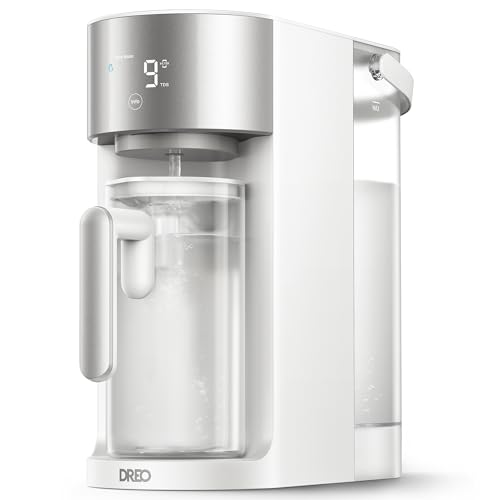
The 3-liter DREO is aimed at lighter daily demand, with a listed 3-liter tank and 1.1-liter pitcher. Its footprint matches the compact DREO format at 14.51 inches long, 6.73 inches wide, and 13.35 inches high, so it can suit a small apartment, bedroom, office, or secondary hydration station. The smaller reservoir means less stored water than the 5-liter version, but it also gives buyers a clearer fit for one or two people.
Its strongest practical features are real-time TDS and filter-life monitoring, auto-fill sensing, self-cleaning, and a stated 3:1 pure-to-drain ratio. DREO also lists a 265-gallon or 1,000-liter filter capacity and twist-in replacement. The product information says the system was tested by SGS and met NSF/ANSI 58 standards. Since TDS monitoring describes dissolved-solids readings rather than every specific contaminant, it should be treated as a maintenance and comparison tool, not a complete water-safety sensor.
Pros
- Includes a 3-liter tank and 1.1-liter pitcher.
- Lists a compact 14.51 by 6.73 by 13.35-inch footprint.
- Provides real-time raw-water and pure-water TDS monitoring.
- States a 265-gallon or 1,000-liter filter capacity.
- Includes auto-fill, self-cleaning, and a 3:1 pure-to-drain ratio.
Cons
- The stated one-to-two-person positioning limits its appeal for high daily demand.
- The supplied information does not identify a remineralization stage, UV stage, or glass pitcher for this exact model.
The 3-liter DREO is the practical choice for a small household that wants monitoring and a modest countertop footprint. Move up to the 5-liter DREO if several people will use the machine, or choose Waterdrop if mineral addback and a glass pitcher are priorities. Its value rests on compact capacity and maintenance prompts rather than premium materials or the broadest feature set.
To buy this product, click here.
Buying Guide
Start With Countertop Space and Reservoir Access
A countertop RO system needs more than its listed width. Leave room to lift the feed reservoir, remove a carafe, and pour wastewater without shifting the appliance. Compact DREO models list a narrow footprint, while the 5-liter DREO and Mate 3 use larger storage capacities. Measure vertical clearance beneath cabinets as carefully as the front-to-back space.
Match Stored Water to Daily Demand
Reservoir size affects how often the system needs attention. A 3-liter tank or 40-ounce pitcher can suit one or two people, but a 5-liter tank or 169-ounce reservoir is more practical for repeated filling across a household. A larger tank does not prove faster filtration, so avoid treating capacity as a flow-rate specification.
Read Ratio Language Carefully
Several systems list a 3:1 or 2:1 pure-to-drain ratio. The ratio should be read exactly as the product information presents it. Do not convert an ambiguous marketing ratio into a recovery percentage or assume that every model defines the numbers in the same direction. If water use matters, check how the manufacturer describes the ratio and plan a way to reuse suitable leftover water.
Separate Testing From Certification
The products use several types of evidence. Waterdrop lists SGS laboratory reduction claims and NSF/ANSI/CAN 372 certification for lead-free materials. AquaTru identifies IAPMO testing and certification language. DREO says its system was tested by SGS and met NSF/ANSI 58 standards. These statements are not interchangeable, and none should be expanded into a guarantee for every contaminant or water condition.
Decide Whether Mineral Addback Matters
Waterdrop C2SL and both Bluevua models identify remineralization or mineral filtration, while Mate 3 lists mineral enhancement. That feature may appeal to buyers who specifically want mineral addback after RO treatment. It does not automatically establish an alkaline pH, a particular mineral concentration, or a health benefit. Buyers who prefer a simpler configuration can focus on RO and carbon stages instead.
Plan for Filters and Electricity
Countertop RO systems in this roundup require electricity, and replacement filters remain part of ownership. Waterdrop lists up to 528 gallons or 12 months, DREO lists 265 gallons or 1,000 liters on selected models, and AquaTru provides separate maximum figures for its pre/carbon, RO, and VOC carbon filters. Treat “up to” figures as published limits rather than guaranteed schedules, and confirm replacement availability for the exact model.
Best Countertop Reverse Osmosis Systems FAQ
Do Countertop Reverse Osmosis Systems Need Plumbing?
The products in this roundup are described as countertop systems that plug into an outlet and use a feed reservoir rather than a permanent faucet connection. AquaTru, Waterdrop, DREO, Bluevua, and Mate 3 listings describe no-plumbing or installation-free operation. They still need a suitable counter, access to electricity, and routine filling or emptying.
Are Countertop RO Systems Better Than Under-Sink Systems?
Neither format is automatically better. Countertop models avoid drilling and permanent plumbing changes, which can matter in rentals or temporary spaces. Under-sink systems may suit buyers who want a hidden installation and a dedicated faucet. This roundup focuses on countertop convenience, reservoir design, and appliance footprint rather than under-sink capacity.
What Does a TDS Monitor Tell Me?
A TDS monitor reports total dissolved solids in the water. It can help compare the feed-water reading with the purified-water reading and provide a general operating reference. It does not identify individual contaminants such as PFAS, lead, arsenic, microplastics, bacteria, or pesticides, so a lower TDS reading should not be treated as universal contaminant proof.
Is a 3:1 Ratio Better Than a 2:1 Ratio?
A stated 3:1 or 2:1 ratio may indicate a different pure-to-drain or water-use relationship, but the listing must define the direction before making a direct comparison. Do not invert the ratio or convert it into a recovery percentage without clear supporting information. If reducing water waste is a priority, compare the exact wording used by each manufacturer.
Do All Countertop RO Systems Remove the Same Contaminants?
No. Reverse osmosis is a filtration technology, but product-specific evidence varies. AquaTru names 84 contaminants and IAPMO testing and certification language. Waterdrop lists specific SGS laboratory reduction claims. Other models use broader contaminant language. Review the exact claims for the model you are considering rather than transferring a claim from one brand or product version to another.
Does Remineralization Make RO Water Alkaline?
Not automatically. A remineralization stage or mineral filter indicates mineral addback, but it does not establish a particular pH unless the product information provides that figure. The systems in this roundup should not be treated as alkaline-water products solely because they include mineral enhancement.
How Often Do Countertop RO Filters Need Replacement?
Replacement timing depends on the exact model, published capacity, usage, and water conditions. Waterdrop lists up to 528 gallons or 12 months for the C2SL, DREO lists 265 gallons or 1,000 liters on selected systems, and AquaTru provides separate figures for multiple cartridges. Use the monitor or manufacturer guidance where available, and treat maximum life claims as limits rather than promises.
Final Verdict
The Waterdrop C2SL is the strongest overall fit because it connects several useful countertop details in one model: a glass pitcher, mineral filtration, filter-life and operating alerts, named laboratory reduction claims, and a stated 3:1 pure-to-drain ratio. Its 108-ounce feed tank and one-to-two-person positioning also make the intended use clear. It is a particularly sensible choice for buyers who want more guidance than a simple reservoir appliance provides.
Different priorities point elsewhere. AquaTru is the better evidence-focused alternative for shoppers drawn to named contaminants and IAPMO testing and certification language. Bluevua adds glass-carafe options, with the UV model bringing UV and remineralization into the same configuration. The 5-liter DREO and Mate 3 suit higher stored-water needs, while the smaller DREO systems keep the footprint and daily capacity more modest. Compare the exact model’s reservoir, filter evidence, maintenance information, and stated ratio before choosing.
