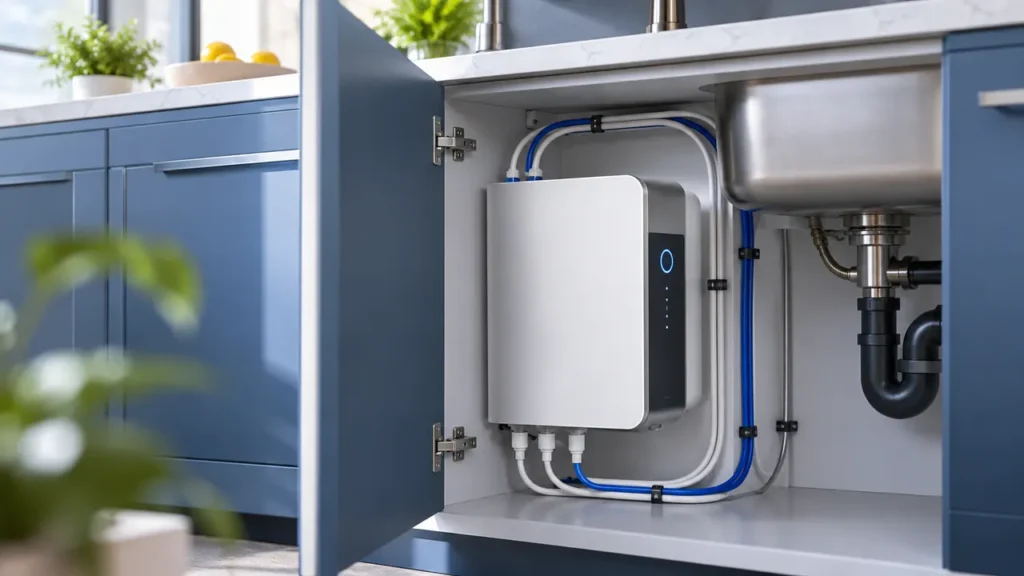
A tankless reverse osmosis system has to solve several problems at once. It needs to fit inside a cabinet, produce water at a useful pace, limit drain water, and provide filtration information that is more meaningful than a flashy stage count. Buyers often focus on GPD first, yet rated capacity does not prove better contaminant reduction, lower maintenance, or universal compatibility. A compact 450 GPD system may be a smarter fit than an 800 GPD model if cabinet space, faucet installation, or filter access matters more.
The strongest comparisons here focus on the details that change ownership: tankless architecture, stated production capacity, pure-to-drain information, certification language, filter replacement, electricity, countertop drilling, and monitoring. Some systems add minerals after RO treatment, while others concentrate on higher flow or more clearly identified certification. A household filling pitchers throughout the day has different priorities from someone who wants a slim unit for occasional cooking and drinking water. The Waterdrop G3P800 is the strongest overall match for buyers seeking high stated capacity, useful certification evidence, smart monitoring, and a 3:1 pure-to-drain ratio.
Before choosing, measure the cabinet and check whether a power outlet and separate RO faucet are practical. Several models require electricity, while some require drilling through the countertop. Also read ratio claims carefully, since a pure-to-drain figure describes water use rather than filtration quality. The recommendations below separate those trade-offs so the most impressive number does not automatically win.
Quick Answer
- Best Overall: Waterdrop G3P800 for high stated capacity, certification coverage, monitoring, and a 3:1 pure-to-drain ratio.
- Best Compact Option: Philips Tankless Reverse Osmosis System for its small listed body, self-flushing, and 600 GPD rating.
- Best With Mineral Addback: Waterdrop G5P700A for 700 GPD capacity and an alkaline mineralization stage.
- Best Certification-Focused Alternative: iSpring RO500AK for its supplied NSF/ANSI 58 complete-system certification claim and alkaline remineralization filter.
Best Tankless Reverse Osmosis Systems Comparison Table
| Product | Best For | Rated Capacity | Pure-to-Drain | Certification or Testing |
|---|---|---|---|---|
| Waterdrop G3P800 | High daily demand | 800 GPD | 3:1 | NSF/ANSI 42, 53, 58, 372, IAPMO R&T |
| Philips Tankless RO System | Compact installation | 600 GPD | 2.3:1 | NSF/ANSI 372, SGS, UL/CSA, FCC |
| Waterdrop G5P700A | High flow with minerals | 700 GPD | 2:1 | SGS testing stated |
| Waterdrop G3P600 | Balanced performance | 600 GPD | 2:1 | NSF/ANSI 42, 58, 372, SGS |
| Waterdrop G5P500A | Mineralized water in a smaller system | 500 GPD | 2:1 | SGS testing stated |
| Waterdrop G2P600 | Simple 600 GPD setup | 600 GPD | 2:1 | NSF/ANSI 372 |
| APEC Four-in-One Tankless RO | Single-cartridge maintenance | 600 GPD | 2:1 | Product-specific certification not clearly identified |
| Waterdrop WD-T4-A | Two water-flow choices | 450 GPD | 2:1 | NSF/ANSI 372 |
| iSpring RO500AK | Certification-focused mineralized water | 500 GPD | 2:1 | NSF/ANSI 58 certification stated |
The reviews below put the capacity, filtration claims, installation details, and maintenance trade-offs into practical context.
1. Waterdrop G3P800 Tankless Reverse Osmosis Water Filter System, 800 GPD — Best Overall
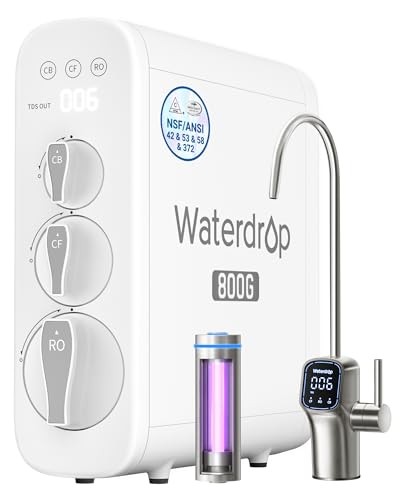
The G3P800 is the most complete match for a busy household that wants a tankless under-sink unit with high stated capacity and clear monitoring. Its published 800 GPD rating is the highest among the residential systems selected here, and the listing states that it can filter one cup in about five seconds under its specified conditions. That does not guarantee the same output in every home, but it gives the system a useful edge for repeated filling, cooking, and pitcher use.
Its certification information is unusually detailed in the supplied specifications. IAPMO R&T certification is identified for NSF/ANSI 58 TDS reduction, along with NSF/ANSI 42 and 53 claims and NSF/ANSI 372 lead-free material certification. The 10-stage configuration also includes stated reduction claims for PFOA, PFOS, fluoride, lead, chromium, iron, nitrate, chloride, and radium. A smart faucet displays TDS and filter status, while the stated 3:1 pure-to-drain ratio gives it a water-use advantage over the many 2:1 systems here.
Pros
- Published 800 GPD rated capacity.
- Supplied information identifies NSF/ANSI 42, 53, 58, and 372 certification claims.
- Smart faucet displays TDS and filter-life information.
- Published 3:1 pure-to-drain ratio.
- 10-stage filtration includes specifically named contaminant claims.
Cons
- Requires under-sink electricity.
- The listing does not provide cabinet dimensions in the supplied information.
Choose this model if repeated daily demand and documented certification details matter more than keeping the purchase simple. A smaller system may suit occasional use, while the G3P800 makes more sense for households that will actually use its higher stated capacity and monitoring features.
To buy this product, click here.
2. Philips Tankless Reverse Osmosis System, 600 GPD — Best Compact Option

Philips takes a different route from the high-capacity Waterdrop models by emphasizing a compact body and self-cleaning operation. The listed dimensions are approximately 15.8 inches long, 4.3 inches wide, and 12.3 inches high, making the footprint especially relevant for a cabinet with limited vertical or lateral room. Its 600 GPD rating and stated eight-ounce fill time of about eight seconds provide a useful balance for ordinary drinking, cooking, and bottle filling.
The product information identifies Aquaporin Inside membrane technology and filtration down to 0.0001 micron, along with claims involving TDS, chlorine, odors, particulates, and other unwanted substances. Auto-cycle self-flushing is included, and the listing identifies twist-and-replace filters with stated maximum periods of up to 12 and 24 months. Installation still requires an under-sink outlet and a dedicated faucet hole, and adapters may be needed for connections other than the listed 1/2-inch NPT or T-valve arrangement.
Pros
- Compact listed body measuring approximately 15.8 by 4.3 by 12.3 inches.
- 600 GPD rated capacity.
- Auto-cycle self-flushing is specified.
- NSF/ANSI 372 lead-free material certification is identified.
- Two filters are included.
Cons
- Faucet installation may require drilling.
- Compatibility with 3/8-inch or other connections may require an adapter or support confirmation.
This is a sensible fit for a tight cabinet where a taller system would be awkward. Buyers seeking broader NSF/ANSI certification coverage or a higher stated capacity may prefer the G3P800, while Philips is more appealing if the compact dimensions and self-flush cycle carry greater weight.
To buy this product, click here.
3. Waterdrop G5P700A Alkaline Mineral Reverse Osmosis Water Filter, 700 GPD — Best High-Flow Mineral Option

The G5P700A sits between mainstream 600 GPD systems and the larger 800 GPD models. Its 700 GPD rating and stated six-ounce fill time of six seconds suit buyers who want a quick stream without moving to the largest system in this group. The tankless cabinet format also leaves more room than a traditional storage-tank design, although the supplied information does not provide the main unit dimensions.
Mineralization is the defining feature. The product information describes an 8-stage system with a 0.0001 μm RO membrane and an alkaline mineralization stage that adds calcium, magnesium, sodium, and potassium. That gives buyers a clear reason to choose it over the standard G3P600, but it should not be read as proof of a particular finished-water pH or a health benefit. The listing also states a 2:1 pure-to-drain ratio and Waterdrop XT connections for ice makers, refrigerators, and other water-using appliances.
Pros
- Published 700 GPD rated capacity.
- Alkaline mineralization stage is identified.
- 0.0001 μm RO membrane is specified.
- Stated six-ounce fill time is six seconds.
- Waterdrop XT appliance connections are listed.
Cons
- Faucet installation requires drilling a countertop hole.
- Product-specific certification is not clearly identified beyond stated SGS testing.
Buyers who want higher stated flow plus mineral addback have a clear reason to look here. Those who place certification scope above mineralization may find the G3P800 or iSpring RO500AK easier to evaluate from the supplied evidence.
To buy this product, click here.
4. Waterdrop G3P600 Tankless Reverse Osmosis Water Filter System, 600 GPD — Best Balanced System

The G3P600 offers a broadly useful mix of output, monitoring, certification, and cabinet efficiency. Its published 600 GPD rating and eight-ounce fill time of eight seconds are aimed at routine drinking and food preparation rather than specialized high-demand service. The stated dimensions, 18.12 inches long by 5.67 inches wide by 17.72 inches high, make measuring the cabinet particularly important before installation.
An 8-stage configuration includes supplied claims involving TDS, chromium, PFAS, radium, fluoride, arsenic salt, iron, calcium, chlorine, and several other substances. Certification information identifies NSF/ANSI 58 for TDS reduction, NSF/ANSI 372 for lead-free materials, and NSF/ANSI 42 for chlorine, taste, and odor reduction. Its smart faucet displays TDS and filter status, while the 2:1 ratio and tool-free filter-change design keep the ownership details straightforward.
Pros
- 600 GPD rated capacity.
- NSF/ANSI 42, 58, and 372 certification claims are supplied.
- Smart faucet shows TDS and filter life.
- Published 2:1 pure-to-drain ratio.
- Stated filter changes take seconds without tools or moving the unit.
Cons
- Requires under-sink electricity.
- The listed 17.72-inch height may be restrictive in shorter cabinets.
This model fits buyers who want a familiar middle ground rather than maximum capacity or mineral addback. The G3P800 offers higher capacity and a 3:1 ratio, while the G3P600 may be easier to justify for ordinary household demand if its cabinet dimensions work.
To buy this product, click here.
5. Waterdrop G5P500A Reverse Osmosis System, 8-Stage RO Filtration, Alkaline — Best Value With Mineralization
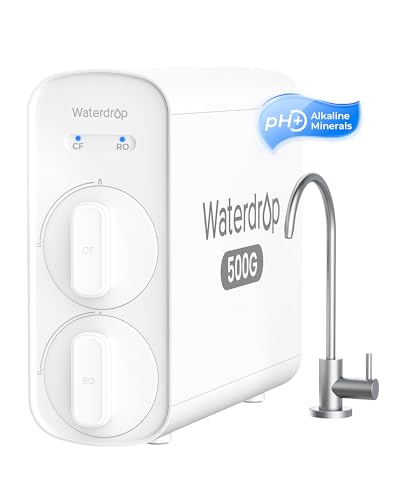
The G5P500A is aimed at buyers who want tankless RO treatment with mineral addback without stepping up to the higher-capacity models. Its stated 500 GPD rating and six-ounce fill time of eight seconds cover routine use, while the 2:1 pure-to-drain ratio gives the system a clearly stated water-use profile. The listing also says Waterdrop XT can connect to refrigerators, ice makers, and other appliances.
The 8-stage configuration combines a 0.0001 μm RO membrane with alkaline mineralization. The supplied claims name PFOA, PFOS, chlorine, lead, fluoride, heavy metals, taste, odor, and other impurities, but the information does not identify a specific pH result. Faucet installation requires drilling, and the faucet dimensions are listed as 6.6 inches long by 3.2 inches wide by 11.3 inches high, so the installation plan deserves attention before ordering.
Pros
- Alkaline mineralization technology is specified.
- 500 GPD rated capacity.
- Published 2:1 pure-to-drain ratio.
- 0.0001 μm RO membrane is identified.
- Waterdrop XT appliance connection capability is listed.
Cons
- Countertop drilling is required for faucet installation.
- Product-specific certification is not clearly identified in the supplied information.
This is a good match for a household that values mineral addback and appliance connections more than the highest possible output. The G5P700A provides more stated capacity, while the G5P500A keeps the same general feature direction in a lower-capacity format.
To buy this product, click here.
6. Waterdrop G2P600 Under-Sink RO System, 600 GPD Tankless Water Filtration — Best for Simple Filter Changes

The G2P600 keeps the central proposition straightforward: a tankless under-sink RO system rated at 600 GPD, with a published eight-second fill time for a 200 ml cup. That makes it relevant for drinking, food preparation, and repeated filling without moving into the higher-capacity G3P800 category. The product information also describes a 7-stage filtration configuration and includes two filters.
Maintenance is the main reason to choose this model. Its twist-and-pull filter design is described as tool-free, and filter-life indicators provide replacement reminders. The supplied information identifies NSF/ANSI 372 certification for lead-free materials, plus a 2:1 low-drain ratio. It also says installation can be completed by a buyer in about 30 minutes, although actual installation depends on the plumbing and cabinet setup.
Pros
- 600 GPD rated capacity.
- Stated eight-second fill time for a 200 ml cup.
- NSF/ANSI 372 certification is identified.
- Twist-and-pull filter replacement requires no tools.
- Published 2:1 low-drain ratio.
Cons
- The supplied information does not identify NSF/ANSI 58 certification.
- The system requires the installation and replacement filters associated with this exact model.
Households that want uncomplicated filter access may prefer the G2P600 over a more feature-heavy unit. Buyers seeking a smart TDS faucet or broader certification evidence should look higher in the ranking, particularly at the G3P600 or G3P800.
To buy this product, click here.
7. APEC WATER Tankless Reverse Osmosis Water Filter System Four-in-One — Best Single-Filter Maintenance

APEC takes a compact maintenance-focused approach with a four-in-one filter cartridge rather than a long list of separate replacement housings. The stated footprint is 5.75 by 11.75 by 17.5 inches, and the system is rated at 600 GPD. That combination could appeal to buyers who want a tankless cabinet unit while keeping filter replacement consolidated in one cartridge.
The supplied description breaks the cartridge into four layers: activated carbon fiber for sediment and residual chlorine, an RO layer for dissolved solids and heavy metals, carbon block for colors and odors, and polypropylene conditioning. It also lists claims involving arsenic, lead, mercury, fluoride, nitrates, PFAS, chlorine, and TDS. A smart filter indicator and auto-flush function are included, and the listing states a filter life of 12 to 18 months depending on water intake quality.
Pros
- 600 GPD rated capacity.
- Four filtration layers are combined in one cartridge.
- Published 2:1 pure-to-drain ratio.
- Smart filter alert and auto-flush are specified.
- Stated dimensions provide a useful cabinet-planning reference.
Cons
- Product-specific NSF/ANSI certification is not identified in the supplied information.
- The single replacement cartridge means buyers must use the exact compatible filter.
APEC is strongest for someone who values consolidated maintenance and a clearly stated footprint. A certification-focused buyer may prefer a Waterdrop or iSpring model with more explicit certification information, while this system keeps the replacement routine more centralized.
To buy this product, click here.
8. Waterdrop WD-T4-A Alkaline pH+ Reverse Osmosis Water Filter — Best Dual-Flow System
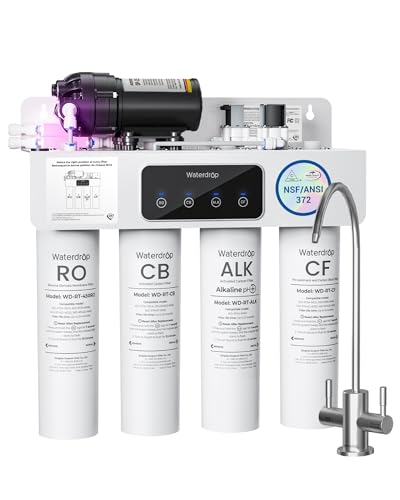
The WD-T4-A is the most differentiated option for buyers who want two treated-water paths. The system provides a standard RO stream and a mineral-enhanced alkaline stream, allowing the user to select between them at the faucet. That arrangement is more flexible than a single remineralized output, although alkaline labeling does not establish a particular pH or a health outcome.
Its 10-stage configuration is paired with a 450 GPD rating and a stated 2:1 pure-to-drain ratio. The supplied information identifies reduction claims for PFOA, PFOS, chlorine, heavy metals, rust, and colloids, plus NSF/ANSI 372 certification. Filter reminders use indicator lights and buzzer alerts, with listed maximum replacement periods of six months for the CF filter, 12 months for the carbon block and alkaline mineralizer, and 24 months for the RO membrane.
Pros
- Offers separate standard RO and mineral-enhanced water flows.
- 10-stage filtration configuration is specified.
- NSF/ANSI 372 certification is identified.
- Published 450 GPD rated capacity.
- Filter alerts and listed replacement periods are supplied.
Cons
- Requires electricity and countertop drilling for the faucet.
- Lower stated capacity than the 600, 700, and 800 GPD alternatives here.
This model suits buyers who want control over whether mineralized water is dispensed. Someone who prefers a single output, higher capacity, or simpler configuration may find the G3P600 or G5P700A easier to live with.
To buy this product, click here.
9. iSpring RO500AK Alkaline Reverse Osmosis System, 500 GPD — Best Certification-Focused Alternative

The iSpring RO500AK appeals to buyers who want a tankless 500 GPD system with a clearly stated certification claim and mineral addback. The supplied information identifies NSF/ANSI 58 certification for TDS reduction for the complete system, rather than presenting certification as a component-only detail. It also lists up to 0.4 GPM flow and an approximate 10-second eight-ounce fill time, preserving the distinction between flow and GPD.
Its alkaline remineralization filter adds a separate feature path after RO treatment, and the front-panel lights and buzzer provide filter reminders. Auto-flush after 24 hours of non-use is also specified. The listed dimensions are 16.13 inches long by 5.13 inches wide by 16.25 inches high. Installation requires electricity, while quick-connect support for 1/2-inch and 3/8-inch connections may simplify plumbing work when those connections match.
Pros
- Complete-system NSF/ANSI 58 certification is stated for TDS reduction.
- Alkaline remineralization filter is included.
- Published 500 GPD rated capacity and up to 0.4 GPM flow.
- Auto-flush after 24 hours of non-use is specified.
- Filter reminders and replacement model names are supplied.
Cons
- Requires under-sink electricity.
- Its 500 GPD rating is lower than the G3P800, G5P700A, and 600 GPD alternatives.
The RO500AK is a better fit for buyers who put complete-system NSF/ANSI 58 information and mineral addback ahead of maximum capacity. Those who need the highest stated output or the lowest stated drain ratio should compare it with the G3P800 before deciding.
To buy this product, click here.
Buying Guide
Start With Cabinet Measurements and Power
Tankless systems save storage-tank space, but they still occupy a defined vertical and horizontal footprint. The Philips listing provides a compact body measurement, while the Waterdrop G3P600 lists a taller 17.72-inch height. Measure around plumbing, outlets, and shutoff valves rather than measuring an empty cabinet. Every selected system requires electricity according to its supplied information, so an outlet under the sink is part of the installation plan.
Separate GPD From Faucet Flow
GPD is a rated daily production figure, while a cup-fill statement describes dispensing speed under specified conditions. The G3P800 lists 800 GPD and a five-second cup, while the iSpring RO500AK lists 500 GPD and up to 0.4 GPM. These figures answer different questions. A higher GPD number does not automatically mean better filtration, and it does not guarantee that a home will produce that volume under every water condition.
Read Pure-to-Drain Claims Carefully
The products here list ratios ranging from 2:1 to 3:1, with Philips listing a 2.3:1 ratio and approximately 70% recovery. The G3P800 has the most favorable stated ratio in this group, while the 2:1 systems remain common alternatives. Treat the ratio as a water-use specification, not proof of contaminant reduction. Actual operation can depend on source-water conditions, pressure, temperature, and other factors, so avoid converting an ambiguous marketing statement into a guaranteed household recovery rate.
Give Certification Scope More Weight Than Stage Count
A 10-stage system is not automatically superior to an 8-stage or 7-stage system because manufacturers may count layers differently. Look at the exact standard and scope. The G3P800 information identifies NSF/ANSI 42, 53, 58, and 372 claims through IAPMO R&T, while the G3P600 identifies NSF/ANSI 42, 58, and 372 claims. The iSpring listing states complete-system NSF/ANSI 58 certification for TDS reduction. Those statements should remain separate from general third-party testing claims.
Decide Whether Mineral Addback Is Worth Prioritizing
The G5P700A, G5P500A, WD-T4-A, and iSpring RO500AK include mineralization or remineralization features. The WD-T4-A is unusual because it offers both a standard RO stream and a mineral-enhanced stream. Mineral addback may matter to buyers who prefer that configuration, but it does not establish a specific pH, mineral concentration, or health result. If you want a straightforward RO output, the G3P600, G3P800, or G2P600 may be easier to compare.
Plan for Filter Replacement
Filter design affects the routine after installation. The G3P600 and G2P600 describe quick twist-and-pull replacement, while the APEC system consolidates its filtration into a four-in-one cartridge. Philips identifies two replacement filters with stated maximum periods of up to 12 and 24 months. The WD-T4-A provides separate listed intervals for several components. Use these figures as published maximums rather than fixed schedules, and verify the exact replacement model before ordering.
Check Faucet and Appliance Requirements
Several systems require a separate faucet hole, and the G5P500A and G5P700A list Waterdrop XT connections for refrigerators, ice makers, and other water-using appliances. That feature does not establish universal appliance compatibility for every installation. Confirm tubing, connection, pressure, and placement requirements before routing water to an appliance. If drilling is not practical, the systems that require a dedicated faucet may be poor fits regardless of their filtration specifications.
Best Tankless Reverse Osmosis Systems FAQ
What Does Tankless Mean In a Reverse Osmosis System?
Tankless means the system does not rely on a traditional pressurized storage tank for its treated-water supply. The selected systems are under-sink tankless models, and the listings describe direct production through the filtration unit. Tankless construction can free cabinet space, but it still requires room for the unit, tubing, filters, and usually an electrical connection.
Is a Higher GPD Rating Better?
A higher GPD rating indicates a higher stated production capacity, not automatically better filtration. The G3P800 lists 800 GPD, while several alternatives list 450, 500, or 600 GPD. Compare GPD with dispensing speed, cabinet dimensions, certification evidence, drain ratio, and filter design. Household output can differ from the rated figure under actual operating conditions.
Which System Has the Lowest Stated Drain Ratio?
The Waterdrop G3P800 lists a 3:1 pure-to-drain ratio. Philips lists 2.3:1, and many other selections list 2:1. These figures should be read exactly as published. They describe a water-use relationship, not a contaminant-rejection percentage, and real operation can vary with source-water conditions and other factors.
Do Tankless RO Systems Need Electricity?
Yes, electricity is identified as a requirement for the tankless systems selected here. The Waterdrop G3P600, Philips system, iSpring RO500AK, and several other models specifically mention an under-sink power connection. Check the outlet location before installation, and do not assume a tankless system can operate without power simply because it does not use a storage tank.
Do These Systems Remove PFAS?
Several product listings include PFAS, PFOA, or PFOS in their supplied reduction claims, but those terms are not interchangeable. The G3P800 information names PFAS and separately names other substances, while the G5P700A and WD-T4-A identify PFOA and PFOS. These claims should not be expanded to every PFAS compound or treated as a universal certification unless the product information supports that exact scope.
Does Remineralization Make Water Alkaline?
A remineralization stage adds minerals, while alkaline labeling describes the product’s intended configuration. The supplied information does not establish one universal finished-water pH for these systems. Do not treat mineral addback as proof of a health benefit, and compare a standard RO stream with a mineralized stream if you want control over the output.
Do Tankless Systems Produce Wastewater?
Yes. Tankless architecture does not mean zero wastewater. The selected products list pure-to-drain ratios such as 2:1, 2.3:1, and 3:1. Those ratios describe stated water-use performance, while actual results can depend on operating conditions. A drain connection and a plan for wastewater remain part of the installation.
Which Details Should I Confirm Before Installation?
Confirm cabinet dimensions, outlet access, faucet-hole requirements, inlet and drain connections, filter availability, and any appliance connection needs. The Philips listing says an adapter may be required for some connection sizes, while several Waterdrop listings state that faucet installation requires drilling. A measurement check before purchase can prevent a system from failing to fit even when its filtration specifications look suitable.
Final Verdict
The Waterdrop G3P800 is the strongest overall selection because it combines the highest stated residential capacity in this group with a detailed certification profile, smart faucet monitoring, a 3:1 pure-to-drain ratio, and named contaminant claims. Its higher output is not a guarantee of better filtration, but the package gives high-demand households more of the information and operating headroom they are likely to seek. The under-sink electricity requirement and cabinet fit still need confirmation.
For a compact installation, the Philips system offers unusually clear body dimensions, self-flushing, and a 600 GPD rating. The Waterdrop G5P700A is the better mineralization-oriented alternative for buyers who want 700 GPD capacity, while the iSpring RO500AK deserves attention from shoppers who prioritize the supplied complete-system NSF/ANSI 58 certification claim. Match the final choice to the available cabinet, faucet installation, daily demand, drain-water preference, and exact filter replacement plan rather than choosing by stage count alone.
