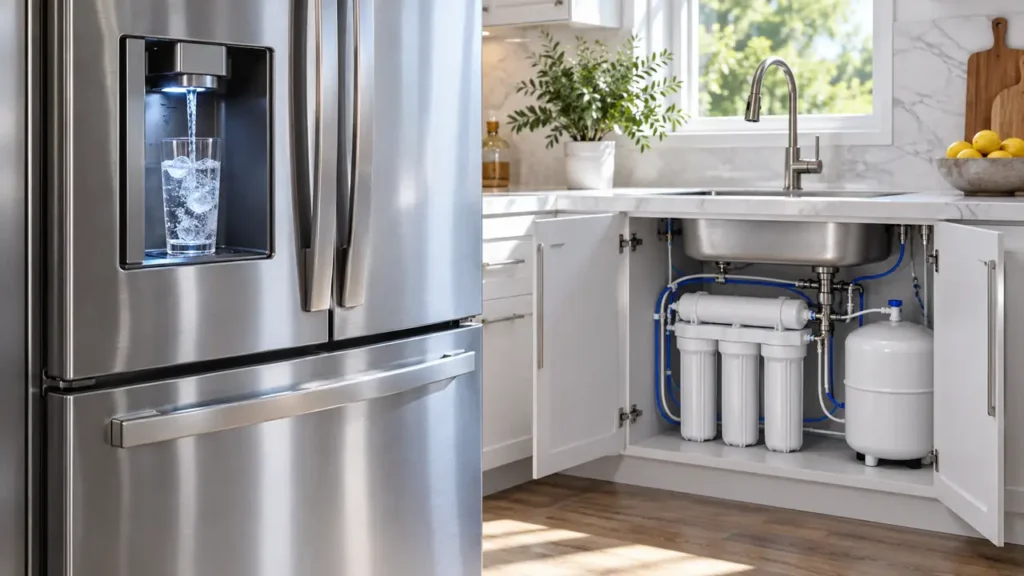
A refrigerator can expose the weak point in an otherwise good water filtration setup. A system may produce clean water at a dedicated faucet, yet still leave shoppers wondering whether it can supply an ice maker, reach a dispenser, or keep up with repeated filling throughout the day. That is why the best reverse osmosis systems for refrigerator use need to be judged by more than filtration stages. Connection support, stated capacity, tank or tankless design, installation requirements, and wastewater information all matter.
A common mistake is assuming that every under-sink RO system automatically works with every refrigerator. The supplied product information confirms direct refrigerator or ice-maker support for some models, while other systems are described more generally for drinking and cooking. Capacity figures also need careful reading. GPD is a rated production figure, not a promise of identical household output under every water condition, and a TDS display does not identify individual contaminants. For the broadest refrigerator-focused feature set, the Waterdrop G5P500A is the strongest overall recommendation in this group.
Different buyers will prioritize different details. A household with a large dispenser may prefer a high-capacity tankless model, while another buyer may want a conventional tank system, remineralization, UV treatment, a lower stated drain ratio, or a system that includes a refrigerator connection kit. The choices below separate those priorities so you can match the RO system to the refrigerator, cabinet, plumbing, and daily demand rather than relying on a generic filtration claim.
Quick Answer
- Best Overall: Waterdrop G5P500A for its stated refrigerator connection capability, 500 GPD rating, alkaline stage, and 2:1 pure-to-drain ratio.
- Best Premium: Home Master TMHP-L HydroPerfection for its included fridge connection kit, UV stage, remineralization, and 9-stage configuration.
- Best High-Capacity Tankless: Waterdrop G3P800 for its stated 800 GPD capacity, 3:1 pure-to-drain ratio, and smart faucet.
- Best Value With Refrigerator Support: Pentair OMNIFilter RO2050 for its included tank, faucet, refrigerator and ice-maker positioning, and straightforward four-stage layout.
Best Reverse Osmosis Systems for Refrigerator Comparison Table
| Product | Best For | System Type | Rated Capacity | Refrigerator Evidence |
|---|---|---|---|---|
| Waterdrop G5P500A | Best overall | Tankless under-sink | 500 GPD | Waterdrop XT connection support |
| Home Master TMHP-L HydroPerfection | Premium refrigerator setup | Under-sink RO with tank | 75 GPD | Fridge connection kit included |
| Waterdrop G3P800 | High-capacity tankless use | Tankless under-sink | 800 GPD | Refrigerator connection not clearly specified |
| Waterdrop G3P600 | Monitoring and compact tankless design | Tankless under-sink | 600 GPD | Refrigerator connection not clearly specified |
| iSpring RCC7AK-BN | Remineralization and certification | Under-sink RO with tank | 75 GPD | Direct refrigerator support not clearly specified |
| APEC ROES-50 | Conventional five-stage filtration | Under-sink RO with tank | 50 GPD | Direct refrigerator support not clearly specified |
| iSpring RCC7-BN | Non-alkaline iSpring configuration | Under-sink RO with tank | 75 GPD | Direct refrigerator support not clearly specified |
| FS-TFC 5-Stage RO System | Lower stated drain ratio | Under-sink RO | 100 GPD | Direct refrigerator support not clearly specified |
| Pentair OMNIFilter RO2050 | Simple refrigerator and ice-maker setup | Under-sink RO with tank | 15 GPD | Positioned for refrigerator and ice maker |
The reviews below focus on refrigerator connection evidence first, then compare capacity, filtration configuration, installation, monitoring, and ownership trade-offs.
1. Waterdrop G5P500A — Best Overall

The G5P500A is the most complete match for a refrigerator-focused search because its product information specifically identifies connection support for fridges, ice makers, and other water-using appliances through Waterdrop XT. That detail matters more than a vague promise of household filtration. A dedicated refrigerator line still needs a compatible connection path, suitable tubing, and enough available production for the way the dispenser and ice maker are used, so the stated appliance support gives this model a useful advantage.
Its tankless design and 500 GPD rated capacity point toward a system built for frequent demand rather than a small occasional-use setup. The listing also reports an 8-second fill for a 6-ounce cup and a 2:1 pure-to-drain ratio, although those figures should be read as published specifications rather than guaranteed results in every home. An alkaline mineralization stage adds a separate water-treatment feature, while the 0.0001-micron RO membrane and eight-stage configuration address buyers looking for a broader filtration layout. Countertop drilling is required for the faucet, which could affect installation plans.
Pros
- Product information specifically supports connection to refrigerators, ice makers, and other water-using appliances.
- Tankless under-sink design is intended to free under-sink space compared with a conventional storage tank.
- Published specifications list a 500 GPD rated capacity.
- Includes alkaline mineralization and an eight-stage filtration configuration.
- Lists a 2:1 pure-to-drain ratio and an 8-second fill for a 6-ounce cup.
Cons
- Faucet installation requires drilling a countertop hole.
- The supplied information does not identify a refrigerator-specific pressure requirement or confirm compatibility with every refrigerator model.
Households adding filtered water to an ice maker and dispenser should start here, especially if they want a tankless design and a substantial stated capacity. Buyers who cannot drill for the faucet or who prefer an included refrigerator kit may find the Home Master TMHP-L easier to match to their installation plan. Verify the refrigerator connection details and cabinet measurements before choosing.
To buy this product, click here.
2. Home Master TMHP-L HydroPerfection — Best Premium

The Home Master TMHP-L takes a different route from the tankless Waterdrop models. It uses an under-sink system with a 75 GPD high-hardness Dow Filmtec membrane, a 9-stage configuration, and an included refrigerator connection kit. That kit is the key refrigerator-oriented detail here. Rather than leaving the buyer to identify a separate connection accessory, the product information says the loaded model includes the hardware for connecting a fridge, along with a brushed nickel Lux faucet and garbage-disposal drain adapter.
This model also includes UV treatment and a two-pass remineralization design. The listing identifies an EPA registration for the LED UV sterilizer and states that the system includes a 1:1 waste ratio, although the exact operating conditions behind that ratio are not detailed. The product information also describes reduction claims for chlorine, chloramines, chemicals, lead, heavy metals, fluoride, microplastics, TDS, and other substances. Those claims belong to this model’s supplied information and should not be transferred to similar Home Master systems. Its larger feature set brings more components to install and maintain than a simpler four- or five-stage system.
Pros
- Includes a refrigerator connection kit according to the product information.
- Includes UV treatment and a listed EPA registration for the LED UV sterilizer.
- Uses a 9-stage configuration with two-pass remineralization.
- Lists a 75 GPD Dow Filmtec high-hardness membrane.
- Product information states a 1:1 waste ratio and includes a five-year limited warranty.
Cons
- The more involved configuration may require more installation and maintenance attention than simpler systems.
- The supplied information does not explain the precise conditions used for the 1:1 waste-ratio claim.
This is the premium pick for a buyer who wants refrigerator hardware included and values UV, remineralization, and a broad treatment configuration in the same system. A simpler tankless model may be a better fit for a small cabinet or a buyer who wants fewer components. Its refrigerator kit makes the TMHP-L particularly worth examining before adding separate connection parts.
To buy this product, click here.
3. Waterdrop G3P800 — Best High-Capacity Tankless Option
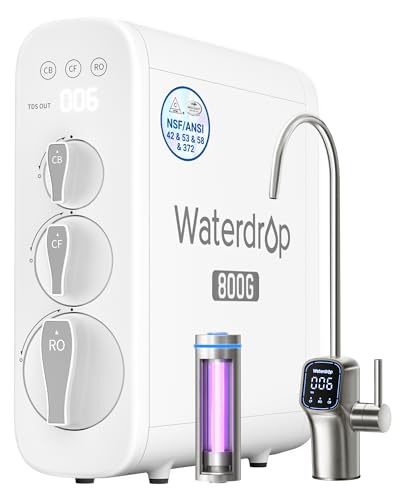
The G3P800 is built around a very high stated production capacity and a tankless footprint. Its published 800 GPD rating and five-second cup-filling claim make it attractive for a refrigerator that sees regular dispenser use, frequent ice production, or a household that draws water in several places. GPD remains a rated capacity rather than a guarantee of identical real-world output, but the number gives this model a clear capacity-focused identity.
Its product information identifies IAPMO R&T certification against NSF/ANSI 58 for TDS reduction, NSF 42 and 53 certifications for chlorine, taste, and odor reduction, and NSF/ANSI 372 for lead-free materials. Those standards should be read separately rather than treated as one universal contaminant certification. The system also lists a 3:1 pure-to-drain ratio, a smart faucet with TDS display, and a 10-stage configuration. The supplied information does not clearly establish direct refrigerator compatibility, so a buyer should verify the connection path before planning a dispenser installation.
Pros
- Lists an 800 GPD rated capacity for high-demand point-of-use use.
- Product information identifies NSF/ANSI 42, 53, 58, and 372 certification details through IAPMO R&T.
- Includes a smart faucet with a TDS display.
- States a 3:1 pure-to-drain ratio and a five-second cup-filling claim.
- Tankless architecture can reduce the space required for a storage tank.
Cons
- Direct refrigerator or ice-maker compatibility is not clearly specified in the supplied information.
- The system requires under-sink installation, and the listing does not identify all refrigerator-side connection requirements.
The G3P800 makes sense for a high-demand household that can confirm its refrigerator connection requirements and has suitable under-sink power and space. The G5P500A is a more direct refrigerator match because its listing explicitly mentions appliance connections. Choose the G3P800 for its capacity and certification details, not simply because its GPD number is larger.
To buy this product, click here.
4. Waterdrop G3P600 — Best for Monitoring

The G3P600 sits between a conventional tank system and the larger G3P800 in this roundup. It uses tankless under-sink architecture, lists a 600 GPD capacity, and includes a faucet that reports TDS and filter life. For a refrigerator project, that monitoring can help the owner track the system’s reported dissolved-solids reading and replacement status, though neither display should be treated as a test for lead, PFAS, bacteria, or other individual contaminants.
The listing identifies NSF/ANSI 58 certification for TDS reduction, NSF/ANSI 372 certification for lead-free material, and NSF 42 certification for chlorine, taste, and odor reduction. It also describes eight-stage filtration, a 2:1 low-drain ratio, and an 8-second fill for an 8-ounce cup. This system requires under-sink electricity, and its listed dimensions should be checked against the cabinet before installation. Refrigerator compatibility is not clearly identified, so the buyer must confirm how the filtered line would connect to the specific appliance.
Pros
- Lists a 600 GPD rated capacity in a tankless under-sink format.
- Includes a smart display faucet with TDS and filter-life information.
- Product information identifies NSF/ANSI 58, NSF/ANSI 372, and NSF 42 certification details.
- States a 2:1 low-drain ratio and an 8-second fill for an 8-ounce cup.
- Filter changes are described as possible without tools or moving the system.
Cons
- Requires under-sink electricity.
- Direct refrigerator compatibility is not clearly specified.
This model suits buyers who care about a filter-life display and TDS readout as much as production capacity. The G5P500A is the safer refrigerator-specific choice because its listing names appliance connections, while the G3P600 needs a compatibility check before purchase. Measure the cabinet and confirm the refrigerator plumbing route first.
To buy this product, click here.
5. iSpring RCC7AK-BN — Best With Remineralization

The RCC7AK-BN is a conventional under-sink RO system with a 75 GPD rating, a six-stage configuration, and an alkaline mineral stage. That combination may appeal to refrigerator owners who want a remineralization stage before sending water toward an ice maker or dispenser. The supplied product information describes the stage as restoring minerals and alkalinity, but it does not establish a specific final pH or a health outcome. Its transparent first-stage housing also gives the owner a direct visual reference for sediment buildup.
Certification is a major part of this model’s appeal. The product information identifies NSF/ANSI 58 certification for the complete RO system and provides listed reduction figures for TDS, PFAS, chlorine, asbestos, barium, cadmium, chromium, copper, fluoride, lead, selenium, and other contaminants. Those claims are specific to the published model information. The top-mounted faucet fastener is intended to simplify faucet installation from above, while quick-fitting connections and replacement-filter options support ongoing ownership. Direct refrigerator compatibility is not clearly stated, so a separate connection assessment remains necessary.
Pros
- Lists a 75 GPD rated capacity.
- Includes an alkaline remineralization stage.
- Product information identifies NSF/ANSI 58 certification for the complete system.
- Provides specific published reduction claims for several named contaminants.
- Includes a transparent first-stage housing and top-mounted faucet fastener.
Cons
- Direct refrigerator or ice-maker compatibility is not clearly specified.
- The tank-based under-sink arrangement requires the buyer to verify available cabinet space and connection needs.
The RCC7AK-BN is a good match for someone who values documented NSF/ANSI 58 system certification and mineral addback more than a tankless footprint. The Home Master is better supported for a refrigerator connection because it includes a fridge kit, while the Waterdrop G5P500A offers a tankless format. Confirm the appliance connection path before treating this as a refrigerator-ready installation.
To buy this product, click here.
6. APEC ROES-50 — Best Conventional Five-Stage System

The ROES-50 keeps the architecture familiar: a five-stage under-sink system with a tank, installation kit, color-coded tubing, and a brushed nickel faucet. Its 50 GPD rating is lower than the tankless Waterdrop figures, yet that does not make it a poor filtration choice. It simply places the model in a more conventional capacity category. For a refrigerator installation, the tank and included plumbing components may be useful, but the supplied information does not directly confirm refrigerator or ice-maker compatibility.
APEC’s product information identifies reduction claims for arsenic, chlorine, lead, fluoride, heavy metals, PFAs, microplastics, and more than 1,000 impurities. It also says the included filter set may be replaced on a six- to 24-month schedule based on incoming water quality. That range reinforces the need to treat replacement timing as water-condition dependent rather than automatic. Buyers who prefer a straightforward tank system with common-style tubing may find the ROES-50 easier to understand than a digitally monitored tankless unit.
Pros
- Uses a five-stage under-sink configuration with a storage tank.
- Lists a 50 GPD rated capacity.
- Includes a faucet, installation kit, color-coded tubing, and a filter set.
- Product information identifies reduction claims for arsenic, chlorine, lead, fluoride, heavy metals, PFAs, and microplastics.
- Published replacement guidance gives a six- to 24-month range based on incoming water quality.
Cons
- Direct refrigerator or ice-maker compatibility is not clearly specified.
- Its stated 50 GPD capacity is lower than the 500, 600, and 800 GPD tankless models in this roundup.
The ROES-50 is suited to buyers who want a conventional tank system and a supplied installation package, then plan to verify the refrigerator connection separately. A high-demand dispenser user may prefer a tankless model with a higher stated capacity. This APEC is a calmer, simpler alternative for homes where a 50 GPD rating is sufficient.
To buy this product, click here.
7. iSpring RCC7-BN — Best Non-Alkaline iSpring Option

The RCC7-BN shares the familiar under-sink, tank-based format of the alkaline RCC7AK-BN, but its supplied configuration centers on five-stage RO filtration without the listed AK remineralization stage. That distinction matters for refrigerator owners who prefer a more direct RO setup rather than mineral addback. The product information lists a 75 GPD capacity, a brushed nickel faucet, a transparent first-stage housing, and a check valve intended to prevent backflow.
The model is identified as NSF/ANSI 58 certified, with published claims covering PFAS, chlorine, fluoride, lead, arsenic, asbestos, calcium, sodium, and more than 1,000 harmful contaminants. It also states an 80% to 90% TDS reduction claim and describes filtration down to 0.0001 microns. Those statements describe the supplied product information, not an independent measurement. Refrigerator compatibility is not clearly established, so the system should be paired with an appliance connection plan rather than assumed to feed a dispenser automatically.
Pros
- Lists a 75 GPD rated capacity.
- Product information identifies NSF/ANSI 58 certification.
- Includes a transparent first-stage housing for visual inspection.
- Uses a five-stage configuration without a listed alkaline remineralization stage.
- Includes a check valve and lead-free designer faucet according to the product information.
Cons
- Direct refrigerator or ice-maker compatibility is not clearly specified.
- It does not include the alkaline remineralization stage identified for the RCC7AK-BN.
This model fits buyers who want the iSpring five-stage arrangement and published NSF/ANSI 58 information without selecting the alkaline version. The RCC7AK-BN is the better match for mineral addback, while the Home Master is more convenient for refrigerator installation because its fridge kit is included. Check the refrigerator line, tank placement, and cabinet clearance before committing.
To buy this product, click here.
8. FS-TFC 5-Stage RO System — Best Stated Low-Drain Option

The FS-TFC gives refrigerator shoppers a capacity and wastewater angle that differs from the conventional 50 and 75 GPD systems. Its product information lists a 100 GPD rating, an 18-liter-per-hour full flow rate under stated test conditions, and a 1:1 drain ratio. The listing also says a 200 ml cup can fill in five seconds at 60 PSI. Those figures are useful for comparison, but they depend on the conditions described by the seller and do not establish a guaranteed refrigerator flow rate in every home.
The system is promoted as an NSF-certified five-stage RO purifier and includes four extra replacement filters. It is described as operating without electricity, with quick installation fittings and a compact design for standard sinks. The listing identifies claims covering chlorine, taste, odor, VOCs, fluoride, arsenic, lead, nitrates, and heavy metals. Direct refrigerator compatibility is not clearly specified, so the buyer should confirm the outlet, tubing route, and appliance requirements before connecting an ice maker or dispenser.
Pros
- Lists a 100 GPD rated capacity.
- Product information states a 1:1 drain ratio.
- Includes four extra replacement filters.
- Lists an 18-liter-per-hour full flow rate under stated 60 PSI conditions.
- Described as a five-stage system that operates without electricity.
Cons
- Direct refrigerator or ice-maker compatibility is not clearly specified.
- The supplied information does not explain the exact basis or operating conditions for the 1:1 drain-ratio claim beyond the listing description.
This model deserves attention from buyers who place unusual weight on the published drain ratio and included replacement filters. For a confirmed refrigerator connection, the Pentair or Home Master has clearer appliance-specific information. The FS-TFC is better treated as a high-capacity under-sink candidate that still requires connection verification.
To buy this product, click here.
9. Pentair OMNIFilter RO2050 — Best Simple Refrigerator Setup
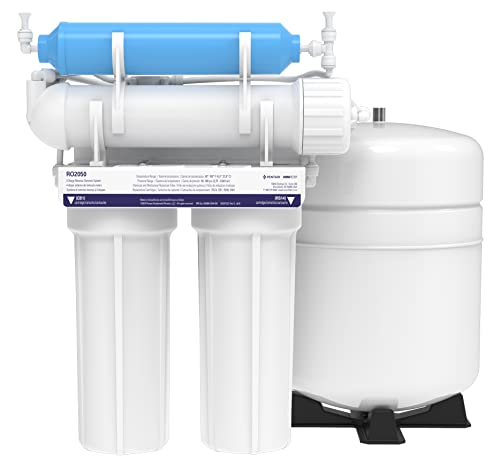
The Pentair OMNIFilter RO2050 is one of the clearest matches for a buyer who wants a conventional RO system positioned for refrigerator and ice-maker use. Its product information explicitly says it is ready for a refrigerator and ice maker, and the package includes a 2.8-gallon tank, lead-free chrome faucet, color-coded tubing, and installation components. The system uses four stages: a sediment filter, carbon block, RO membrane, and inline carbon cartridge.
Its 15 GPD output is modest beside the larger tankless systems, so this model belongs on the shortlist for lighter demand rather than high-volume dispensing. The supplied information identifies NSF/ANSI 58 certification for reducing cysts by mechanical means and lists reductions for sediment, lead, TDS, chlorine taste and odor, and pentavalent arsenic. A TDS test kit is included, which can help track dissolved-solids readings, but that meter does not replace contaminant-specific testing. Filter replacement guidance is tied to reduced flow or water-quality changes rather than a fixed universal interval.
Pros
- Product information specifically positions the system for refrigerator and ice-maker use.
- Includes a 2.8-gallon storage tank, faucet, color-coded tubing, and installation hardware.
- Uses a clearly identified four-stage filtration configuration.
- Lists NSF/ANSI 58 certification for cyst reduction by mechanical means.
- Includes a TDS test kit for checking dissolved-solids readings.
Cons
- Its stated 15 GPD output is much lower than the high-capacity tankless models.
- Filter replacement guidance is based on changes in flow or water quality rather than a fixed interval.
The RO2050 is a sensible choice for a refrigerator or ice maker with moderate demand, especially when included connection-oriented components matter more than high production capacity. Buyers with a large dispenser or frequent ice use may prefer the Waterdrop G5P500A or G3P800. Its simpler four-stage layout can be easier to understand, but the lower stated output deserves careful matching to household use.
To buy this product, click here.
Buying Guide
Confirm Refrigerator Support Before Comparing Filter Stages
A refrigerator connection is a plumbing question as much as a filtration question. The Home Master TMHP-L and Pentair RO2050 explicitly include or identify refrigerator-related connection support, while the Waterdrop G5P500A describes connection to fridges and ice makers through Waterdrop XT. Several other systems in this roundup provide under-sink drinking water but do not clearly state direct refrigerator compatibility. Treat that difference as meaningful. Check the RO outlet, tubing size, shutoff arrangement, distance to the appliance, and any refrigerator-specific pressure requirements before ordering.
Match Rated Capacity to Dispenser and Ice-Maker Demand
GPD is a rated production figure. It helps separate a 15 GPD system such as the Pentair from the 500, 600, and 800 GPD Waterdrop models, but it does not guarantee that a refrigerator will receive water at a particular speed. Source-water conditions and installation details can affect output. A household that fills a large dispenser repeatedly may want a higher stated capacity, while occasional ice use may place less pressure on the system. Do not use GPD as a shortcut for filtration quality.
Read Pure-to-Drain Ratios Carefully
The products provide several different water-efficiency claims, including 1:1, 2:1, and 3:1 ratios. Those figures should remain in the form presented by each product listing because the direction of the ratio is not always explained in identical language. A tankless design does not mean zero wastewater, and a higher stated capacity does not automatically mean lower waste. If wastewater matters to your installation, verify how the manufacturer defines the ratio and what operating conditions apply.
Separate Certification From Broad Marketing Claims
Certification details vary significantly. The iSpring RCC7AK-BN and RCC7-BN identify NSF/ANSI 58 certification, the Waterdrop G3P800 lists several standards through IAPMO R&T, and the Pentair identifies NSF/ANSI 58 certification for a specific cyst-reduction claim. Those statements do not mean the products share identical certification scopes. NSF/ANSI 42, 53, 58, and 372 address different areas, so read the exact standard rather than treating a general “NSF certified” label as universal proof of every contaminant claim.
Decide Whether You Want a Tank or Tankless System
Tankless models can reduce the space used by a storage tank and may offer high stated production figures, but the Waterdrop G3P600 listing requires under-sink electricity. Conventional systems such as the Pentair, APEC, and iSpring models use tank-based arrangements and may be a better fit where powered equipment is inconvenient. A tank also changes how water is stored and delivered to the refrigerator. Compare cabinet dimensions, electrical access, faucet installation, and the planned tubing route before focusing on the stage count.
Plan Filter Replacement and Appliance Connections Together
Replacing filters is easier if the system remains accessible after the refrigerator line is installed. The iSpring RCC7AK-BN offers named replacement-filter sets, the FS-TFC includes four extra filters, and the Waterdrop G3P600 includes a filter-life display. Those features can simplify ownership, but they do not eliminate the need to follow model-specific replacement guidance. Leave enough room to reach cartridges, shut off the water before service, and keep the refrigerator connection separate from any unsupported assumption about filter life.
Best Reverse Osmosis Systems for Refrigerator FAQ
Can Any Reverse Osmosis System Connect to a Refrigerator?
No. An under-sink RO system may provide filtered water at its own faucet without confirming that it can feed a refrigerator or ice maker. The Waterdrop G5P500A, Home Master TMHP-L, and Pentair RO2050 have the clearest supplied refrigerator-related information in this group. For other models, verify the connection hardware, tubing, pressure requirements, and refrigerator compatibility before installation.
Which System Is Best for a Refrigerator and Ice Maker?
The Waterdrop G5P500A is the strongest overall match because its product information identifies connection support for fridges and ice makers while also listing a 500 GPD capacity and a 2:1 pure-to-drain ratio. The Home Master TMHP-L is a premium alternative with an included fridge connection kit. The Pentair RO2050 is a simpler option with a lower stated 15 GPD output and explicit refrigerator and ice-maker positioning.
Does a Higher GPD Rating Guarantee Faster Refrigerator Filling?
No. GPD describes rated daily production, while refrigerator filling depends on the complete installation and operating conditions. A higher rating can be relevant for heavier demand, but it does not guarantee a particular dispenser flow rate or ice-maker recovery time. Compare the published flow information separately from GPD.
Do Tankless RO Systems Work Better With Refrigerators?
Tankless systems can offer a smaller storage footprint and high stated capacities, but tankless architecture alone does not confirm refrigerator compatibility or better filtration. The Waterdrop G5P500A specifically identifies appliance connection support, while the G3P600 and G3P800 listings supplied here do not clearly establish direct refrigerator compatibility. Check the exact model rather than relying on the tankless label.
Is a TDS Monitor Enough to Confirm Safe Refrigerator Water?
No. A TDS monitor reports total dissolved solids. It does not identify individual substances such as PFAS, lead, arsenic, bacteria, or microplastics. The Waterdrop G3P600, G3P800, and Pentair include TDS-related monitoring or testing information, but those features should be used for their stated purpose and not treated as complete contaminant analysis.
Does Remineralization Make RO Water Alkaline?
Remineralization and alkalinity should not be treated as identical claims. The iSpring RCC7AK-BN, Waterdrop G5P500A, and Home Master TMHP-L include mineral or remineralization features in their supplied product information. That does not establish a specific final pH, mineral concentration, or health benefit unless the product information directly states it.
How Much Cabinet Space Does a Refrigerator RO System Need?
The answer depends on tank or tankless architecture, filter layout, and the connection route to the refrigerator. Tankless models can reduce the space used by a storage tank, while the Pentair, APEC, and iSpring systems include tank-based configurations. Measure the cabinet width, depth, and height, then reserve room for filter changes and tubing bends. The Waterdrop G3P600 listing provides specific dimensions, while other models may require a model-specific measurement check.
Final Verdict
The Waterdrop G5P500A is the strongest overall choice for this refrigerator-focused roundup because its product information directly addresses appliance connections rather than leaving that question open. Its tankless format, 500 GPD rated capacity, alkaline stage, and stated 2:1 pure-to-drain ratio give it a broad set of refrigerator-relevant features. The faucet drilling requirement and the need to verify the exact refrigerator connection still matter, but its documented appliance support places it ahead of systems that only describe general under-sink drinking-water use.
The Home Master TMHP-L is the premium alternative for buyers who want an included fridge connection kit, UV treatment, and remineralization. The Pentair RO2050 is better suited to moderate demand and a simpler tank-based installation, while the Waterdrop G3P800 offers the highest stated capacity among the selected systems but requires a closer compatibility check. Match the final choice to the refrigerator’s connection requirements, expected ice and dispenser demand, cabinet space, electrical access, certification scope, and filter-maintenance plan.
