
Reef tanks are unusually unforgiving of inconsistent source water. Tap water can carry dissolved solids, chlorine, chloramines, metals, and other compounds that complicate salinity control or encourage unwanted changes in a carefully balanced aquarium. An RO/DI system gives reef keepers a way to start with highly purified water before mixing saltwater or replacing evaporation, which is why this equipment becomes such a practical part of regular tank maintenance.
The common mistake is choosing by gallon-per-day rating alone. A 100 GPD label does not tell you whether the unit includes deionization, how it handles chloramines, whether it has useful pressure or TDS monitoring, or how filter changes are managed. Reef keepers also have different priorities. A nano tank may need an affordable compact unit, while a large reef system may benefit from higher output, visible gauges, automatic shutoff, or easier cartridge replacement. The Bulk Reef Supply Value Plus is the strongest overall choice here because it combines a 75 GPD RO/DI configuration with monitoring, a flush valve, and an automatic shutoff system.
There is also a clear distinction between a complete RO/DI system and an RO-only filter. The latter can be useful as a foundation, but it does not provide the final deionization stage unless you add one separately. That distinction matters for reef tanks, where the final DI polish is often the feature that makes an RO/DI unit different from a general-purpose RO filter. The options below are ranked around filtration configuration, aquarium relevance, stated capacity, maintenance features, and practical limitations.
Quick Answer
- Best Overall: Bulk Reef Supply 4 Stage Value Plus 75 GPD RO/DI Reverse Osmosis Deionization System for monitoring and complete RO/DI filtration.
- Best Chloramine-Focused Option: AquaticLife 4-Stage RO/DI Filter with Carbon Plus for its stated chloramine and chlorine reduction claims.
- Best High-Capacity Option: NU Aqua 4-Stage RODI System for a stated 100 GPD rating and aquarium-focused positioning.
- Best Simple Maintenance: Aquatic Life Twist-in 4-Stage RO/DI Aquarium Filter for its tool-free twist-in cartridges.
Best RO/DI Systems for Reef Tanks Comparison Table
| Product | Best For | RO/DI Configuration | Rated Capacity |
|---|---|---|---|
| Bulk Reef Supply 4 Stage Value Plus | Monitoring and overall control | 4-stage RO/DI | 75 GPD |
| AquaticLife Carbon Plus | Chloramine-conscious reef keepers | 4-stage RO/DI | 100 GPD |
| NU Aqua Reef Series | Higher stated output | 4-stage RO/DI | 100 GPD |
| Aquatic Life Twist-in | Quick cartridge changes | 4-stage RO/DI | 75 GPD |
| 4 Stage Aquarium RO+DI System | Wall-mounted monitoring | 4-stage RO/DI | 100 GPD |
| Max Water 6 Stage Aquarium System | Multi-stage aquarium filtration | 6-stage RO/DI | 100 GPD |
| Max Water 6 Stage 100 GPD RODI System | RO/DI with inline carbon finishing | 6-stage RO/DI | 100 GPD |
| Aquatic Life RO Buddie 4-Stage | Lower-capacity reef setups | 4-stage RO/DI | 50 GPD |
| AquaticLife 5-Stage Hydroponic RO Filter | High-volume RO production with separate DI planning | RO, no DI stated | 200 GPD |
The detailed reviews explain where each system fits, which specifications matter for reef use, and where an option may require an extra component or a different maintenance approach.
1. Bulk Reef Supply 4 Stage Value Plus 75 GPD RO/DI Reverse Osmosis Deionization System: Best Overall

For a reef keeper who wants more information than a simple filter housing can provide, this Bulk Reef Supply system has a useful control-oriented layout. Its four stages include sediment filtration, chlorine and VOC reduction, RO filtration, and DI resin polishing. The stated 75 GPD capacity is substantial for routine saltwater preparation, although actual production depends on operating conditions that are not specified here.
The built-in TDS meter gives the owner a way to watch water quality before DI and after the RO membrane, while the pressure gauge helps track the sediment pre-filter. Those details can turn filter maintenance from guesswork into observation. The automatic shutoff solenoid and flush valve add useful operating controls, especially for reef keepers who produce water in batches and do not want to supervise every minute of the process.
Pros
- Complete four-stage RO/DI configuration for aquarium water.
- Stated 75 GPD membrane capacity.
- Built-in TDS monitoring at key filtration points.
- Pressure gauge helps monitor pre-filter performance.
- Includes automatic shutoff and a flush valve.
Cons
- The published information does not clearly specify a wastewater or recovery ratio.
- Minimum inlet pressure and exact operating requirements are not clearly identified.
This system suits reef keepers who want visible operating information and a more controlled maintenance routine. Someone seeking the simplest low-cost unit may find the added gauges and valves unnecessary, while a hobbyist with frequent water changes can make better use of them. Its combination of complete RO/DI filtration and monitoring gives it the broadest practical fit among these options.
To buy this product, click here.
2. AquaticLife 4-Stage RO/DI Filter with Carbon Plus, 100 GPD: Best for Chloramine Concerns
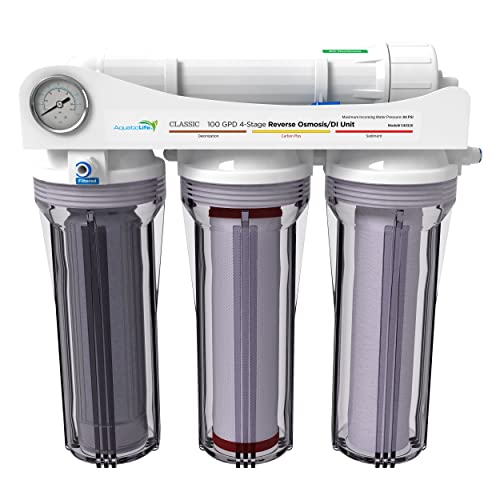
Municipal water treated with chloramines creates a different pre-filtration concern than water containing chlorine alone. This AquaticLife model specifically identifies a Carbon Plus cartridge with stated reduction claims for up to 98% of chloramines and 99% of chlorine. That makes its configuration especially relevant to reef keepers who want a product listing that addresses chloramine treatment directly rather than relying on a generic carbon description.
The system pairs that carbon stage with sediment filtration, a 100 GPD RO membrane, and a refillable 10-inch color-changing DI cartridge. A pressure gauge, automatic shutoff solenoid, and flush valve add practical feedback and control. The listing also says the unit is not intended for drinking water, which is an important boundary. For reef preparation, that aquarium-oriented positioning is appropriate, but the product should be evaluated as an aquarium water system rather than a household drinking-water filter.
Pros
- Complete four-stage RO/DI configuration.
- Stated 100 GPD capacity.
- Carbon Plus cartridge specifically addresses chloramines and chlorine.
- Color-changing DI resin makes resin condition visible.
- Includes a pressure gauge, automatic shutoff, and flush valve.
Cons
- The listing says the system is not intended for drinking water.
- Recovery and wastewater performance are not clearly specified.
This is a strong match for reef keepers who have chloramine-related concerns and want that issue addressed in the stated cartridge configuration. A smaller aquarium with modest water demand may not need its 100 GPD rating, while users seeking a system for household drinking water should choose a product specifically intended for that purpose.
To buy this product, click here.
3. NU Aqua 4-Stage RODI Deionization Reverse Osmosis System 100 GPD Filtration: Best for Higher Stated Output

The NU Aqua Reef Series is aimed directly at aquarium use, including reef, saltwater, and freshwater applications. Its four-stage path starts with sediment removal, moves through carbon filtration and an RO membrane, then finishes with DI polishing. The stated 100 GPD rating gives it a useful capacity advantage over 50 and 75 GPD choices, although the rating should be read as a published production figure rather than a guarantee of daily output in every installation.
Quick-connect fittings and the product’s maintenance-focused design may appeal to an aquarist who regularly replaces cartridges and wants less downtime between water-making sessions. The supplied information also identifies a 120-day home trial, a three-year manufacturer warranty, and lifetime support. Those ownership terms are part of the product information, but the listing does not specify replacement-filter intervals, recovery performance, or the exact conditions behind the capacity rating.
Pros
- Aquarium-focused four-stage RO/DI system.
- Stated 100 GPD filtration capacity.
- Includes sediment, carbon, RO, and DI stages.
- Quick-connect fittings support cartridge maintenance.
- Product information identifies a 120-day trial and three-year warranty.
Cons
- Recovery rate and wastewater ratio are not clearly specified.
- The listing does not identify a built-in TDS meter or pressure gauge.
Reef keepers who want a 100 GPD aquarium RO/DI system with a stated trial and warranty may find this a sensible fit. Buyers who depend on real-time TDS or pressure feedback will likely prefer the Bulk Reef Supply model, while smaller tanks may have little practical need for the higher rated output.
To buy this product, click here.
4. Aquatic Life Twist-in 4-Stage RO/DI Aquarium Filter, 75 GPD: Best for Simple Cartridge Changes
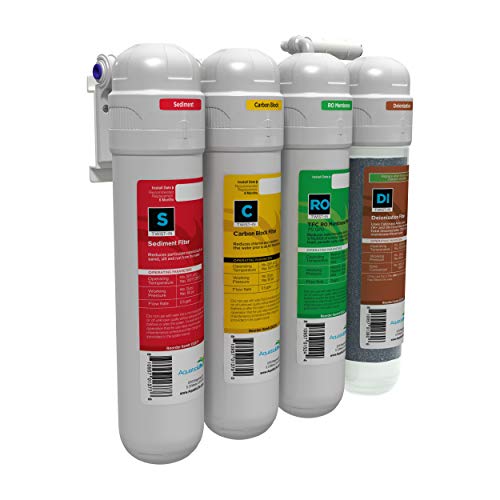
Maintenance feels very different when cartridge replacement involves twisting a cartridge out rather than opening a housing with a wrench. This Aquatic Life system uses twist-in cartridges across a four-stage sediment, carbon, RO, and DI layout. For an aquarist who keeps a regular water-change schedule, that design can make routine servicing less fiddly, especially in a fish room where several tasks compete for attention.
The product information states a 75 GPD capacity and identifies a color-changing DI resin that shifts from blue toward tan as it becomes exhausted. It also states that the RO membrane reduces TDS at a 1:10,000 ratio. That figure describes the stated membrane ratio, not a universal contaminant-removal guarantee. The listing specifically says the system does not remove chloramines, so source-water treatment should be checked before choosing it for a municipal supply with chloramine disinfection.
Pros
- Complete four-stage RO/DI filtration path.
- Stated 75 GPD capacity.
- Twist-in cartridges require no tools for changes.
- Color-changing DI resin provides a visible replacement cue.
- Product is identified for aquarium and other water-sensitive applications.
Cons
- The product information says it does not remove chloramines.
- Pressure monitoring and recovery information are not clearly specified.
This unit is a good fit for reef keepers who value straightforward cartridge servicing and have source water compatible with its stated carbon limitations. If chloramines are a concern, the Carbon Plus AquaticLife model is a more relevant alternative. If monitoring matters more than tool-free replacement, the Bulk Reef Supply system has the stronger control package.
To buy this product, click here.
5. 4 Stage Reverse Osmosis Aquarium Water Filter System RO+DI, 100GPD: Best Wall-Mounted Option
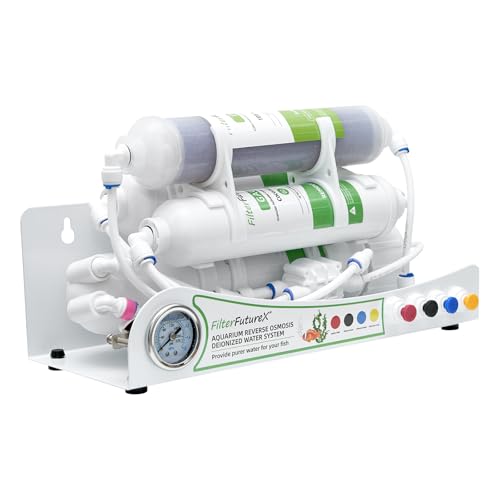
This four-stage aquarium system combines PP cotton, activated carbon, an RO membrane, and DI resin in a 100 GPD configuration. Its wall-mounted bracket may be useful in a fish room, aquarium cabinet area, or dedicated work space where keeping the housings supported and off a work surface matters. The supplied information also identifies a pressure gauge, which gives the owner a way to watch system pressure during operation.
The transparent housing lets users observe the DI resin color change, and the listing describes standard 10-inch quick-change cartridges. It also describes an RO membrane with 0.0001-micron precision and a TDS value close to zero after the RO/DI process. Those statements come from the product information. They should not be expanded into certification or universal contaminant claims, since the supplied details do not identify a specific NSF certification or independent test scope.
Pros
- Complete four-stage RO and DI aquarium configuration.
- Stated 100 GPD capacity.
- Wall-mounted bracket supports a dedicated installation.
- Built-in pressure gauge provides system feedback.
- Transparent housing and quick-change cartridges support visual maintenance.
Cons
- A specific certification is not established by the supplied product information.
- The stated low-waste performance does not include a clearly defined recovery ratio.
This model fits reef keepers who want a wall-mounted unit with visible resin condition and pressure monitoring. It may be less appealing to someone who prefers a compact, portable arrangement or wants a more established monitoring package with pre-DI and post-membrane TDS readings.
To buy this product, click here.
6. Max Water 6 Stage Aquarium System with Deionization Filter: Best for a Six-Stage Layout

Some reef keepers prefer a more elaborate filtration path because it separates treatment functions across additional stages. This Max Water system is identified as a six-stage RO/DI unit with a 100 GPD rating. The supplied claims include reduction of odors, lead, fluoride, copper, cysts, and other metallic ions, along with a stated 0 TDS result after DI. Those claims should be read as published product claims rather than independent verification, and TDS should not be treated as a test for every contaminant.
The system uses color-coded quick connects and labeled filter housings, which can make tubing and replacement decisions easier to follow. BPA-free components are also identified in the product information. A float valve is not included according to the supplied details, so an automatic aquarium reservoir setup may require a separate compatible component. That small omission can become significant if the unit will be left producing water without close supervision.
Pros
- Six-stage RO/DI configuration for aquarium use.
- Stated 100 GPD capacity.
- Color-coded quick connects simplify hose identification.
- Labeled housings support filter replacement tasks.
- Product information identifies BPA-free components.
Cons
- A float valve is not included according to the product information.
- The published contaminant claims are not accompanied by a specific certification scope.
This Max Water model suits aquarists who want multiple treatment stages and clearly labeled connections. Buyers who prefer fewer stages with stronger built-in monitoring may find the Bulk Reef Supply unit easier to track, while anyone planning an automated reservoir should budget for the separate float-valve requirement.
To buy this product, click here.
7. Max Water 6 Stage 100 GPD RODI Water Filtration System: Best With Inline Carbon Finishing

This Max Water system shares a six-stage, 100 GPD RO/DI structure with the other Max Water option, but its supplied information adds a specific note about an inline carbon filter after the DI stage. The listing says the DI stage drops TDS to zero, while the final carbon stage may contribute a measurable output reading from small carbon particles. That warning is useful because it shows why a final meter reading should be interpreted in relation to the system’s stage order.
Color-coded quick connects and labeled housings again support setup and maintenance, while the product is positioned for aquarium use and identifies BPA-free components. The listing also says that a float valve must be purchased separately if one is needed. Reef keepers should therefore distinguish the filtration package from the equipment needed to automate a storage container or shutoff arrangement.
Pros
- Six-stage RO/DI system with a stated 100 GPD rating.
- Product information identifies aquarium use.
- Includes an inline carbon finishing stage according to the listing.
- Color-coded connections support organized installation.
- Filter housings are labeled for maintenance.
Cons
- The listing warns that the final carbon stage may affect the output TDS reading.
- A float valve is not included according to the product information.
This version makes sense for reef keepers who want the extra inline carbon stage and are comfortable interpreting readings in context. The other Max Water model may be easier to compare if a simpler post-DI path is preferred, while the Bulk Reef Supply option offers more explicitly integrated monitoring hardware.
To buy this product, click here.
8. Aquatic Life RO Buddie 4-Stage Aquarium Water Filter System: Best Lower-Capacity Option
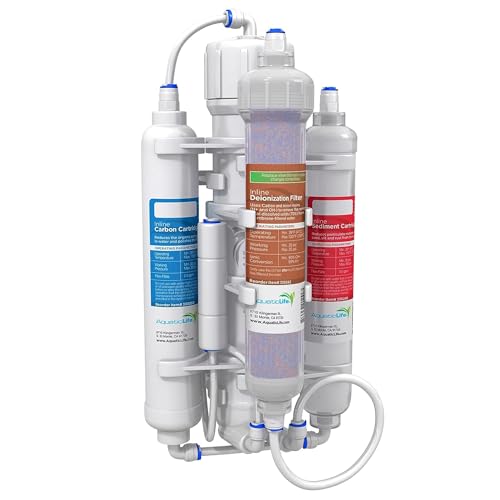
The RO Buddie uses a straightforward four-stage path with sediment, carbon, RO, and color-changing DI resin. Its 50 GPD rating is the lowest among the complete RO/DI systems in this guide, which can be perfectly reasonable for a smaller aquarium or a hobbyist who makes water in planned batches rather than preparing large volumes at once. Capacity still depends on operating conditions, and the supplied information does not identify a recovery ratio.
The sediment stage is described as catching dirt, sand, and silt, while the carbon block helps reduce chlorine and odors. The listing specifically says the carbon block does not remove chloramines. After the RO membrane, the color-changing DI resin provides a visible replacement cue by shifting from blue toward tan. That combination keeps the functional layout easy to understand, though the lack of chloramine treatment may narrow its suitability for some municipal supplies.
Pros
- Complete four-stage RO/DI aquarium configuration.
- Stated 50 GPD capacity for lower-volume use.
- Sediment stage addresses sand, silt, and related debris.
- Color-changing DI resin provides a visible condition cue.
- Product is identified for fish tanks, fountains, and other applications.
Cons
- The product information says the carbon stage does not remove chloramines.
- It has a lower stated capacity than the 75 and 100 GPD alternatives.
This is the sensible budget-oriented pick for a smaller reef setup that still needs a complete DI stage. Larger systems with frequent water changes may be better served by a 75 or 100 GPD model, and chloramine-treated municipal water calls for closer attention to the pre-filtration limitation.
To buy this product, click here.
9. AquaticLife 5-Stage Hydroponic RO Water Filter, 200 GPD: Best High-Capacity RO Base

This AquaticLife unit is different from the other picks because the supplied information identifies it as a five-stage RO filter for hydroponic use, not a complete RO/DI system. Its stated 200 GPD capacity is the highest in this group, and the package includes two 100 GPD RO membranes, sediment filtration, activated carbon blocks, and a Carbon Plus chloramine cartridge. For a reef keeper producing substantial volumes, that high-capacity RO base may be useful, but a separate DI stage would be needed for a complete RO/DI setup.
The built-in wall bracket, automatic shutoff valve, garden hose faucet adapter, and included wrenches give it a practical installation package. The listing describes reduction of chlorine, chloramines, heavy metals, and TDS, but it does not identify a DI resin stage. That distinction should remain front and center. This is a specialized alternative for someone who already has a compatible DI plan, not a direct substitute for the complete aquarium RO/DI systems above.
Pros
- Stated 200 GPD RO capacity.
- Includes two 100 GPD RO membrane cartridges according to the listing.
- Carbon Plus cartridge addresses chloramine reduction claims.
- Wall bracket supports a secured installation.
- Includes an automatic shutoff valve and connection accessories.
Cons
- The supplied product information does not identify a DI resin stage.
- It is labeled for hydroponic RO use rather than as a complete reef-tank RO/DI system.
This model belongs on the shortlist only for reef keepers who specifically want high RO output and are prepared to add or integrate a compatible DI stage. Anyone seeking a ready-to-use RO/DI unit should choose one of the first eight products instead, since their listed configurations include deionization.
To buy this product, click here.
Buying Guide
Start With a Complete RO/DI Configuration
For reef tanks, look for a listed sequence that includes sediment filtration, carbon filtration, an RO membrane, and DI resin. The DI stage is the final distinction between the complete systems here and the AquaticLife hydroponic RO filter. A higher RO capacity does not compensate for the absence of DI if your goal is water polished through a complete RO/DI process.
Check the Carbon Stage Against Your Source Water
Chlorine and chloramines are different source-water concerns. Several products describe chlorine reduction, while the AquaticLife Carbon Plus models specifically identify chloramine reduction claims. The Aquatic Life Twist-in and RO Buddie listings say they do not remove chloramines, so that limitation deserves attention before installation.
Do Not Treat GPD as a Guaranteed Daily Output
A 50, 75, 100, or 200 GPD figure is a rated capacity stated by the product information. It is useful for comparing the general scale of the systems, but it does not establish a guaranteed household or aquarium production rate under every condition. The supplied data does not consistently identify pressure, temperature, or recovery conditions, so capacity should be used as a comparison point rather than a promise.
Use TDS Monitoring Correctly
A TDS meter can help show how the filtration stages are performing and when DI resin may need attention. It does not identify every contaminant, and a low TDS reading is not the same as contaminant-specific certification. The Bulk Reef Supply model provides the clearest built-in monitoring package, while several other systems rely on visual DI resin changes rather than an integrated meter.
Think About Maintenance Before Mounting the Unit
Color-changing DI resin gives a visual cue, while pressure gauges can help identify a restriction or pre-filter issue. Twist-in cartridges may appeal to people who want tool-free changes, while standard housings can offer a more familiar replacement approach. A unit that produces water regularly should be mounted where cartridge access, tubing, and collection containers remain practical.
Separate Filtration From Automation
Some reef keepers produce water into a reservoir equipped with a float valve or another shutoff arrangement. The Max Water listings state that a float valve is separate, so the RO/DI system itself should not be confused with the equipment used to automate collection. Check every included-component list before planning an unattended fill setup.
Be Careful With Certification and Contaminant Language
The supplied product information includes various reduction claims, but it does not establish a common certification standard across these products. Claims about TDS, metals, chlorine, chloramines, or other substances should be read as model-specific published information. Do not transfer one system’s claim to another model simply because both use RO/DI terminology.
Best RO/DI Systems for Reef Tanks FAQ
Do Reef Tanks Need RO/DI Water?
Many reef keepers choose RO/DI water because it provides a purified starting point for saltwater mixing and evaporation replacement. The value of the DI stage is that it polishes the water after RO filtration. The exact setup should still reflect the aquarium, source water, and maintenance routine.
Is a 100 GPD System Better Than a 50 GPD System?
It offers a higher stated capacity, but that does not automatically make it better in filtration quality. A 50 GPD system may be adequate for a smaller aquarium, while a larger reef with frequent water changes may benefit from a higher rated unit. Actual production conditions are not fully specified for every product.
Does a TDS Reading of Zero Prove the Water Is Safe for a Reef Tank?
No. TDS is a measurement of total dissolved solids, not a complete contaminant test. A zero or near-zero reading can show that the RO/DI process is producing highly low-TDS water, but it does not establish a universal contaminant profile or certification result.
Should I Choose a System That Removes Chloramines?
If your source water uses chloramines, a system with a stated chloramine-treatment claim deserves closer attention. The AquaticLife Carbon Plus models specifically identify chloramine reduction claims, while the RO Buddie and Twist-in listings state that they do not remove chloramines. Check your local water information before deciding.
Is the AquaticLife 200 GPD Filter a Complete RO/DI System?
The supplied product information identifies it as a five-stage RO water filter and does not identify a DI resin stage. It may serve as a high-capacity RO base, but it should not be treated as a complete RO/DI system without adding a compatible DI stage.
What Does Color-Changing DI Resin Tell Me?
It provides a visual indication that the resin is changing condition. Several systems describe resin shifting from blue toward tan, while the newer four-stage listing describes purple resin darkening. That cue can help with maintenance, but it does not replace careful water-quality monitoring where a meter is available.
Do I Need a Float Valve With an RO/DI System?
Only if your collection setup requires automatic filling or a specific reservoir-control arrangement. The Max Water product information says a float valve is separate. Check the included accessories and the design of your storage container before assuming automation hardware is included.
Can I Use an Aquarium RO/DI System for Drinking Water?
Do not assume that an aquarium-focused RO/DI system is intended for drinking water. The AquaticLife Carbon Plus listing specifically says it is not intended for drinking water. Choose a product with clear household drinking-water suitability if that is your intended application.
Final Verdict
The Bulk Reef Supply 4 Stage Value Plus is the strongest overall fit because it combines a complete RO/DI configuration with a stated 75 GPD capacity, TDS monitoring, a pressure gauge, automatic shutoff, and a flush valve. Those features address the practical rhythm of reef keeping, where producing water is only part of the job and knowing when filtration needs attention matters just as much.
The AquaticLife Carbon Plus is the more targeted choice for chloramine concerns, while the NU Aqua Reef Series and the four-stage 100 GPD aquarium system suit buyers who want higher stated output. The Aquatic Life Twist-in is attractive for simpler cartridge changes, and the RO Buddie remains a sensible lower-capacity route for smaller setups. If maximum output is the priority, the AquaticLife 200 GPD model has potential as an RO base, but it requires separate DI planning. Match the system to your source water, aquarium volume, monitoring preference, and willingness to manage replacement components.
