
An RV turns water treatment into a space, plumbing, and portability problem at the same time. A system that works neatly beneath a fixed kitchen sink may be awkward in a camper, while a countertop unit can be far more practical if it connects to a faucet and stores easily between trips. Source water also changes from campground to campground, so buyers often look for reverse osmosis to reduce dissolved solids and selected contaminants without hauling cases of bottled water.
The common mistake is to rank systems by stage count or GPD alone. A high-capacity under-sink model may require drilling, a dedicated faucet, cabinet space, and connections that make little sense in an RV. A countertop model may fit the travel lifestyle better, but its reservoir, electrical needs, production speed, and filter replacement process matter more than a flashy specification. The strongest options here are separated by those practical differences, with the portable 5-stage system from Universal taking the overall position because its supplied information specifically identifies RV use and faucet attachment.
Different RV owners will want different things. A full-timer may prefer a plumbed under-sink installation with a storage tank, while a weekend traveler may want a removable countertop unit. Some buyers will prioritize remineralization, others certification evidence, UV treatment, higher stated capacity, lower stated drain ratios, or a compact footprint. The comparison below highlights those trade-offs without treating a TDS figure, GPD rating, or stage count as a universal measure of water quality.
Quick Answer
- Best Overall: Universal 5-Stage Portable RO System for an RV-focused, faucet-connected setup with a stated 75 GPD membrane and approximately 3 gallons per hour.
- Best Countertop Remineralization: MyWaterClub Mineral Countertop RO System for portable use with a stated 100 GPD membrane and post-remineralization filter.
- Best for High Stated Capacity: Waterdrop G5P500A for buyers prepared to install an under-sink tankless system with a stated 500 GPD rating.
- Best Countertop Monitoring: Bluevua RO100ROPOT for a countertop design with a glass carafe, display-based filter monitoring, UV, and a stated 2:1 pure-to-drain ratio.
Best Reverse Osmosis Systems for RVs Comparison Table
| Product | Best For | System Type | Rated Capacity | Notable Evidence |
|---|---|---|---|---|
| Universal 5-Stage Portable RO System | RV and travel use | Countertop, faucet-connected | 75 GPD membrane | Approximately 3 gallons per hour, RO/DI postfilter |
| MyWaterClub Mineral Countertop RO System | Portable remineralization | Countertop, dual connection | 100 GPD membrane | Post-remineralization filter, stated RV use |
| Bluevua RO100ROPOT | Premium countertop setup | Countertop, plug-in | Not clearly specified | UV, glass carafe, 2:1 stated ratio |
| Waterdrop G5P500A | High stated capacity | Under-sink, tankless | 500 GPD | Alkaline stage, 2:1 stated ratio |
| iSpring RCC7AK-UV | Under-sink UV and mineral stage | Under-sink, tank-based | Not clearly specified | NSF/ANSI 58 and 372 claims, LED UV |
| iSpring RCC7AK-BN | Under-sink remineralization | Under-sink, 6-stage | 75 GPD | NSF/ANSI 58 claim, AK mineral stage |
| APEC ROES-50 | Traditional under-sink RO | Under-sink, tank-based | 50 GPD | 5-stage system, tank and faucet included |
| iSpring RCC7-BN | Standard 5-stage installation | Under-sink, tank-based | 75 GPD | NSF/ANSI 58 claim, no power source required |
| VIVA21 V21RS5S01 | Certification and leak detection | Under-sink, tank-based | Not clearly specified | WQA Gold Seal, NSF/ANSI 58 and 372 claims |
The detailed picks below separate genuinely portable countertop units from systems that require a more permanent RV installation.
1. Universal 5-Stage Portable RO System — Best Overall

For an RV owner, the most useful feature here is the connection method. The product information identifies a faucet-attached design that does not require a plumber, and it specifically lists RVs and travel among its intended uses. That makes it a more natural match for a camper than a cabinet-mounted system that expects a permanent drain, dedicated faucet, and fixed water line. A traveler can set up the unit near a compatible faucet, produce water, and avoid adding another built-in appliance to a compact galley.
The system uses five stages, a stated 75 GPD membrane, and a DI mixed-bed postfilter described as producing water close to 0 PPM. The published information also gives an approximate output of 3 gallons per hour and lists reduction claims for substances including lead, fluoride, nitrate, arsenic, and sodium. Those claims belong to the product information and should not be treated as a universal guarantee across every source-water condition. The DI stage may also be more specialized than many RV drinkers need, particularly if they want ordinary drinking water rather than very low-TDS water.
Pros
- Product information specifically identifies RV and travel use.
- Faucet attachment is described without requiring a plumber.
- Uses a stated 75 GPD RO membrane.
- Published output is approximately 3 gallons per hour.
- Includes a DI mixed-bed postfilter described as close to 0 PPM.
Cons
- The supplied information does not identify a named NSF or WQA certification.
- The DI postfilter may be unnecessary for buyers seeking conventional drinking-water filtration.
This is the clearest fit for RV owners who want a removable faucet-connected system and can work with its production pace. Buyers who need a permanently plumbed installation, integrated storage, or certification evidence should examine the under-sink alternatives instead.
To buy this product, click here.
2. MyWaterClub Mineral Countertop RO System — Best Countertop Remineralization

This MyWaterClub model takes a similarly portable route but adds a post-remineralization filter. Its supplied description lists RVs, apartments, homes, aquariums, and travel, so the system is aimed at people who may need to move it rather than commit to a fixed under-sink installation. The dual connection setup, with a faucet connection and a garden or laundry hose adapter, could be useful around different travel setups, although the exact compatibility of a particular RV faucet or hose should be checked before purchase.
The stated 100 GPD membrane is higher than the 75 GPD rating of the Universal option, but the supplied information does not give a comparable hourly output. That distinction matters because GPD is a rated production figure, not a guarantee of real-world speed under every pressure and temperature condition. The product information says the system removes more than 400 contaminants and uses four media to add minerals back, including calcium and magnesium. It does not establish a resulting pH or health benefit, so the main practical reason to choose it is mineral addback within a portable format.
Pros
- Product information specifically lists RV and travel applications.
- Countertop format avoids a permanent under-sink installation.
- Uses a stated 100 GPD membrane.
- Includes a post-remineralization filter.
- Offers faucet and garden or laundry hose connection options.
Cons
- The supplied information does not identify a named NSF or WQA certification.
- No hourly production figure is clearly provided.
This model suits RV owners who want a portable system with mineral addback and more than one connection approach. The Universal system provides clearer hourly output and a DI stage, while this one is the more natural choice for buyers who specifically prefer remineralization.
To buy this product, click here.
3. Bluevua RO100ROPOT — Best Premium Countertop System
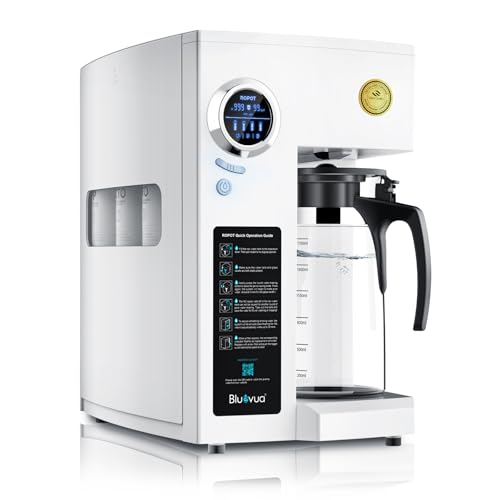
The Bluevua RO100ROPOT is the most feature-rich countertop alternative in this group. It does not require plumbing according to the supplied information, and its glass carafe gives the system a distinct travel-friendly serving format. For an RV owner who wants a unit that can sit on a counter and be unplugged between trips, that may be more appealing than managing tubing beneath a small sink. The unit does require access to power, and the available counter space still needs to be measured around the carafe and reservoir.
Its six-stage configuration includes an RO membrane, UV light, and remineralization filter. The product information also identifies a WQA certification against NSF/ANSI/CAN 372 for lead-free construction and says the unit was tested by SGS, while separately listing reduction claims for TDS, PFOA, PFOS, chlorine, fluoride, arsenic, lead, and more. Those certification and testing descriptions should remain separate. A display monitors filter life and water quality, while the published 2:1 pure-to-drain ratio provides a stated water-use figure. The listing says filters last 12 to 24 months, but actual replacement needs can vary.
Pros
- Countertop design requires no plumbing according to the product information.
- Uses a glass carafe rather than a conventional plastic serving container.
- Includes UV and remineralization stages.
- Provides display-based filter-life and water-quality monitoring.
- Lists a 2:1 pure-to-drain ratio.
Cons
- The supplied information does not clearly state an RV-specific compatibility claim.
- Requires electrical power and countertop space during operation.
This is a sensible premium pick for RV owners who value a polished countertop appliance, UV, a glass carafe, and monitoring. Buyers focused on simpler faucet attachment or lower equipment complexity may prefer either of the first two portable systems.
To buy this product, click here.
4. Waterdrop G5P500A — Best High-Capacity Option

The Waterdrop G5P500A is a very different proposition from a portable RV countertop unit. It is identified as a compact tankless under-sink system with a stated 500 GPD capacity, an 8-stage configuration, and a 6-ounce cup fill time of 8 seconds in the product information. Those numbers may attract RV owners who live full-time in a larger coach and want a more permanent installation, but they do not make the system portable. The listing also says faucet installation requires drilling a countertop, a serious point for renters and travelers.
A 2:1 pure-to-drain ratio is stated, though the product information does not define the direction of that ratio in enough detail to convert it into a recovery percentage. The system includes alkaline mineralization and is described as compatible with ice makers, refrigerators, and other appliances through Waterdrop XT. Those connections may be useful in a fixed RV build, yet the supplied information does not establish compatibility with every RV plumbing arrangement. This is a capacity-led choice, not a simple grab-and-go travel filter.
Pros
- Tankless under-sink design can free cabinet space compared with a tank-based system.
- Lists a 500 GPD rated capacity.
- States an 8-second fill time for a 6-ounce cup.
- Includes alkaline mineralization.
- Lists a 2:1 pure-to-drain ratio and appliance connection capability.
Cons
- Requires under-sink installation and drilling for the faucet according to the listing.
- RV-specific compatibility is not clearly established.
Choose this model only for a fixed RV installation where drilling, electricity, and plumbing changes are acceptable. For a removable weekend setup, its high stated capacity does not outweigh the installation burden.
To buy this product, click here.
5. iSpring RCC7AK-UV — Best Under-Sink UV Option

For a larger RV with a dedicated water-treatment bay, the RCC7AK-UV adds features that portable countertop systems do not provide. The listing describes a 7-stage under-sink system with an LED UV stage, alkaline mineral stage, storage tank, and top-mounted faucet fastener. Smart flow activation turns on the UV stage when water flows, according to the product information. This is a permanent-style installation, so it belongs on a shortlist only if the RV has enough cabinet room and the owner accepts the plumbing work.
The product information states whole-system NSF/ANSI 58 and 372 certification and identifies reduction figures for TDS, fluoride, lead, arsenic-related substances are not listed, and several metals. It also describes layered cartridges, a transparent first-stage housing, and replacement filter sets identified by service periods. UV should be understood as an additional treatment stage, not a guarantee of universal microbiological safety. The supplied data does not identify an RV-specific installation kit or a particular feed-pressure requirement.
Pros
- Includes an LED UV stage with flow-activated operation.
- Includes an alkaline mineral stage.
- Product information states whole-system NSF/ANSI 58 and 372 certification.
- Uses a top-mounted faucet fastener for the stated installation design.
- Lists replacement filter sets with identified service periods.
Cons
- Under-sink tank-based architecture is less portable than countertop alternatives.
- The supplied information does not establish RV-specific compatibility or pressure requirements.
This system fits a full-time RV owner planning a fixed installation and wanting UV alongside RO and mineral addback. Travelers who change campsites often or avoid drilling will have a much easier path with a countertop unit.
To buy this product, click here.
6. iSpring RCC7AK-BN — Best Under-Sink Remineralization

The RCC7AK-BN offers a conventional under-sink arrangement with six stages, a stated 75 GPD capacity, and an AK mineral stage. Its top-mounted faucet fastener is described as simplifying faucet installation from above, while quick fittings, a clear manual, and instructional videos support the installation process. In an RV, those details matter only after the owner has decided to build a fixed treatment system rather than use a removable countertop appliance.
The supplied product information states NSF/ANSI 58 certification for the entire system and lists reductions for TDS, PFAS, chlorine, asbestos, barium, cadmium, chromium, copper, fluoride, lead, and selenium. The listing also identifies a transparent first-stage housing for checking sediment buildup and names replacement filter sets for different service periods. The mineral stage may appeal to buyers who want addback after RO treatment, but the supplied data does not establish a specific resulting pH or mineral concentration.
Pros
- Uses a stated 75 GPD capacity.
- Includes a six-stage configuration with an AK mineral stage.
- Product information states full-system NSF/ANSI 58 certification.
- Transparent first-stage housing helps make buildup visible.
- Replacement filter sets are identified by service period.
Cons
- Under-sink architecture requires a more permanent installation than countertop RV systems.
- The listing does not clearly specify a recovery or pure-to-drain ratio.
This is a reasonable fixed-installation candidate for a larger RV where remineralization and certification evidence matter. It is less suitable for a traveler who wants to connect, filter, disconnect, and move on without modifying the coach.
To buy this product, click here.
7. APEC ROES-50 — Best Traditional 5-Stage System

The APEC ROES-50 follows the familiar tank-based under-sink format. It includes a 50 GPD rated system, storage tank, brushed nickel faucet, installation kit, instructions, and a five-stage filtration configuration. For a permanently equipped RV, that complete package may reduce the need to source separate pieces. For a small travel trailer, the tank and faucet installation can consume valuable room and may require changes that a countertop system avoids.
The listing names arsenic, chlorine, lead, fluoride, heavy metals, PFAS, and microplastics among the reduction claims, while also describing quick connections and colored tubing for setup. It recommends filter replacement every 6 to 24 months based on incoming water quality. That is a broad range rather than a fixed schedule, and source water from changing campgrounds may affect maintenance needs. The supplied information does not identify an RV-specific certification or a recovery ratio.
Pros
- Includes a tank, faucet, tubing, installation kit, and instructions.
- Uses a stated 50 GPD capacity.
- Provides five filtration stages.
- Colored tubing and quick connections are listed as installation aids.
- Product information identifies replacement timing of 6 to 24 months based on water quality.
Cons
- Tank-based under-sink design may use more RV cabinet space than a countertop system.
- The supplied information does not clearly specify a recovery or wastewater ratio.
The ROES-50 makes sense for an RV owner who wants a traditional, complete under-sink kit and accepts permanent installation. Buyers who move between vehicles, campgrounds, or rental spaces should look first at the faucet-connected picks.
To buy this product, click here.
8. iSpring RCC7-BN — Best Standard 5-Stage Installation

The RCC7-BN is a straightforward alternative to the alkaline version above. It uses five stages, a stated 75 GPD capacity, a brushed nickel faucet, and a tank-based under-sink format. The system does not require a power source according to the supplied information, which can be useful in an RV where electrical access and battery management are already part of daily planning. That benefit applies after installation, not during the plumbing work required to create the setup.
The product information states NSF/ANSI 58 certification and describes reductions for PFAS, chlorine, fluoride, lead, arsenic, asbestos, calcium, and sodium, along with an 80% to 90% TDS reduction claim. It includes a transparent first-stage housing, check valve, food-grade tubing, and a fine GAC polishing stage. There is no remineralization stage identified here, so it is a better match for buyers who want a conventional RO configuration rather than mineral addback.
Pros
- Uses a stated 75 GPD capacity.
- Product information states NSF/ANSI 58 certification.
- Does not require a power source according to the listing.
- Includes a transparent first-stage housing.
- Includes a check valve and food-grade tubing.
Cons
- Permanent under-sink installation is less convenient for mobile RV use.
- No remineralization stage is identified in the supplied configuration.
This model belongs in a fixed RV build where a standard five-stage system and no electrical requirement are priorities. For an owner who wants mineral addback or UV, the related iSpring models provide more relevant features.
To buy this product, click here.
9. VIVA21 V21RS5S01 — Best With Leak Detection
The VIVA21 is another complete under-sink kit, with a five-stage system, tank, faucet, tubing, installation materials, and a leak detector. That last accessory is particularly relevant in a vehicle, where a small unnoticed leak can damage cabinetry or flooring while the RV is parked. The product remains a fixed installation rather than a portable faucet attachment, so its value depends on whether the coach has a suitable treatment location and the owner is comfortable connecting it.
The supplied information identifies sediment, carbon, RO membrane, and post-carbon filtration, plus automatic shutoff and leak-resistant fittings. It also states WQA Gold Seal certification for NSF/ANSI 58 performance and NSF/ANSI/CAN 372 lead content. Those are meaningful certification references, but they should not be expanded into claims about every possible contaminant. Capacity, recovery, and filter-life figures are not clearly provided, which leaves more uncertainty for RV owners planning around limited water supplies.
Pros
- Includes a leak detector for an under-sink installation.
- Supplied kit includes a tank, faucet, tubing, and installation materials.
- Uses five identified filtration stages.
- Product information states WQA Gold Seal certification.
- Certification references include NSF/ANSI 58 and NSF/ANSI/CAN 372.
Cons
- Rated capacity is not clearly specified in the supplied information.
- Recovery rate and filter-life details are not clearly identified.
The VIVA21 deserves attention in a fixed RV installation where leak detection and certification references carry more weight than high stated capacity. Travelers seeking a quick, removable setup will find the countertop systems more practical.
To buy this product, click here.
Buying Guide
Start With Portable Versus Permanent Installation
The biggest RV decision is physical, not numerical. Faucet-connected countertop systems can suit owners who want to filter water only when parked, while under-sink systems are better suited to a dedicated installation that remains in place. Check whether the RV faucet accepts the supplied connector, whether wastewater can be handled safely, and whether the unit needs a separate power outlet. A system marketed for homes is not automatically compatible with an RV plumbing layout.
Read GPD as a Rated Capacity
GPD means gallons per day, but it is not a promise of a specific daily output in an RV. Water pressure and operating conditions can affect production, and the stated figure should not be confused with faucet flow. The Universal system also provides an approximate hourly figure, while several other models list GPD without an equivalent dispensing rate. That makes the published information easier to interpret for an RV owner planning actual fill times.
Separate Certification From Testing
The products use different types of evidence. iSpring models and the VIVA21 identify certification claims, while Bluevua separately describes WQA certification for lead-free construction and SGS testing. A statement that a product was tested to a standard is different from certification of the complete system. Keep the exact organization and standard in view, especially if a campground or household water concern involves a named contaminant.
Check What the Filtration Stages Actually Add
Five, six, seven, and eight stages do not create a universal quality ranking. The Universal model adds DI filtration, the MyWaterClub system identifies remineralization, several iSpring models add an AK mineral stage, and the UV models include a UV stage. Remineralization does not establish a particular pH, while UV does not guarantee universal microbiological safety. Match the stage configuration to the reason you are buying it.
Think About Water Waste Carefully
Bluevua and Waterdrop list a 2:1 ratio, while the DREO products provide a different countertop design but were not selected here as separate recommendations because the two supplied DREO listings appear functionally overlapping. A ratio should not be inverted or converted into a recovery percentage unless its direction is clear. Ask how wastewater will be collected or routed inside the RV before treating a marketing ratio as a practical water-saving guarantee.
Plan Filter Replacement Before a Trip
Replacement access matters more on the road. The iSpring listings identify several replacement sets and service periods, APEC gives a broad 6-to-24-month recommendation based on incoming water quality, and Bluevua lists a 12-to-24-month filter range. Those are published guidelines, not universal schedules. Carrying compatible replacements can be worthwhile if the RV visits areas with noticeably different source water or sediment levels.
Best Reverse Osmosis Systems for RVs FAQ
Can I use any countertop RO system in an RV?
No. A countertop design may still require a particular faucet connection, electrical outlet, reservoir arrangement, or wastewater process. The Universal and MyWaterClub listings specifically identify RV use, while the Bluevua listing identifies a portable countertop design without clearly stating RV compatibility. Check the connection and power requirements against the exact RV setup.
Are under-sink RO systems suitable for RVs?
They can be considered for a fixed installation in a larger RV, but the supplied information does not establish RV compatibility for every under-sink model in this guide. Under-sink systems may require cabinet space, a faucet opening, water-line connections, a drain route, and possibly electricity. A portable countertop system is usually the less invasive format for temporary or changing travel arrangements.
Is a higher GPD rating better for an RV?
Not automatically. A higher GPD rating describes rated production capacity, not filtration quality, certification, actual household output, or installation convenience. The Waterdrop G5P500A lists 500 GPD, but it also requires an under-sink installation and faucet drilling according to the product information. A lower-capacity countertop unit may be a better fit if portability is the primary concern.
Does reverse osmosis remove every contaminant in campground water?
No system should be treated as universal based on generic RO terminology alone. Product listings identify different contaminant claims, percentages, certifications, and testing descriptions. TDS reduction also does not prove reduction of a particular contaminant. If a campground or well-water report identifies a specific concern, compare that exact substance with the product’s published evidence.
Do RV RO systems need electricity?
It depends on the model. The iSpring RCC7-BN listing says that system does not require a power source, while the Bluevua countertop system is described as a plug-in appliance and the Waterdrop G5P500A is an electronic tankless design. The supplied information does not establish identical power requirements for every model, so verify this point before planning around battery power or shore power.
Is remineralized RO water alkaline?
A remineralization stage may add minerals, but it does not automatically establish a particular pH. Some products use the word alkaline or describe pH support, while the supplied data does not provide a universal pH result. Select remineralization for the filtration configuration you want, not for an unsupported health outcome.
What does a 2:1 pure-to-drain ratio mean?
The phrase describes a relationship between purified water and drain water, but the direction must be clear before interpreting it. Waterdrop and Bluevua list a 2:1 ratio, yet the supplied information does not justify converting that figure into a recovery percentage or claiming a precise number of gallons of wastewater. Plan the RV drain or collection method using the manufacturer’s exact explanation.
Final Verdict
The Universal 5-Stage Portable RO System is the strongest overall match for RV owners because its supplied information directly identifies RV and travel use, faucet attachment without a plumber, a 75 GPD membrane, and approximately 3 gallons per hour of output. Its DI postfilter makes the configuration more specialized, but that detail is clear enough for buyers to decide whether they want very low-TDS water. The MyWaterClub system is the more natural alternative for portable users who prefer a stated 100 GPD membrane and remineralization.
For a premium countertop appliance, Bluevua adds a glass carafe, UV, monitoring, and a stated 2:1 ratio. Full-time RV owners planning permanent plumbing can look at Waterdrop for its high stated capacity, iSpring for mineral or UV configurations, APEC for a complete traditional kit, or VIVA21 for leak detection and certification references. Match the system to the RV’s faucet, cabinet space, power access, drainage plan, and travel pattern before giving a higher capacity number more weight than practical fit.
