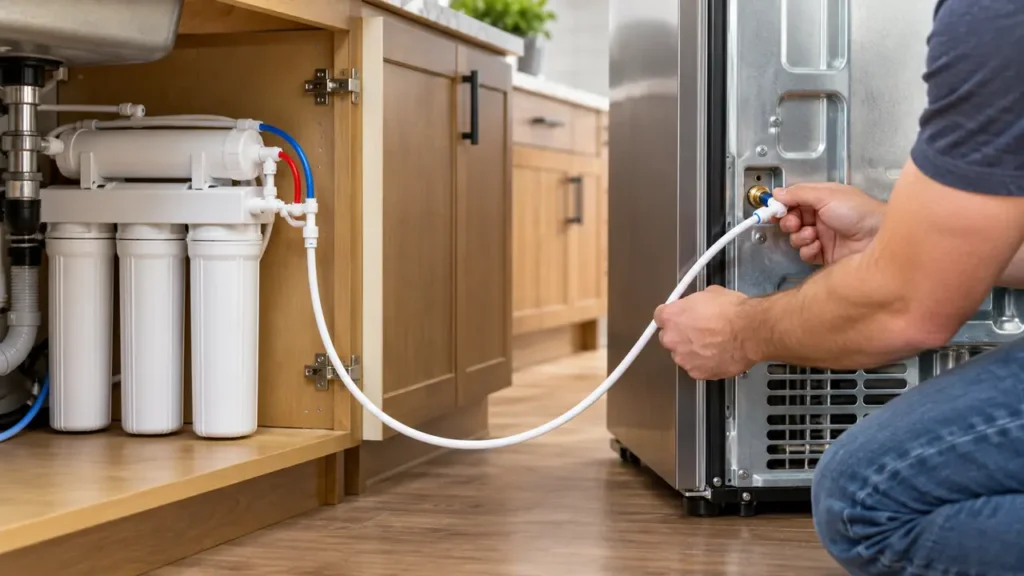
Yes. Many under-sink reverse osmosis (RO) systems can supply a refrigerator’s water dispenser and ice maker through a branch in the RO product-water line. The connection must be allowed by the RO system manufacturer, and the refrigerator must receive enough water pressure and flow to operate properly.
A conventional tank-based RO system is often the simplest configuration: its storage tank supplies water while the membrane produces more. A tankless system may also work, but its pump and controls must support a refrigerator connection. Most self-contained countertop systems are not set up for a permanent refrigerator line.
Check Compatibility Before Connecting the Lines
Read the installation instructions for both appliances before changing the plumbing. Confirm these points:
- RO connection point: The RO manufacturer permits a refrigerator branch, and its instructions identify where to connect it. This is typically on the treated-water line serving the RO faucet, after any final filter specified for that connection.
- Refrigerator requirements: The refrigerator manual permits an RO supply and states its required inlet-pressure range. Pressure from a storage tank can fall as the tank empties, so pressure at the refrigerator matters more than the RO system’s feed-water pressure alone.
- Tubing and fittings: The branch fitting, tubing, shutoff valve, and refrigerator inlet must be compatible. Do not assume similar-looking push-fit parts or tubing sizes are interchangeable.
- Refrigerator filter: Check whether the refrigerator filter should remain installed or whether the manufacturer provides an approved bypass. Do not remove a filter cartridge unless the refrigerator is configured to operate without it.
If the refrigerator already has a tap-water line, that supply must be isolated before switching to RO water. Do not connect the tap-water line and RO product-water line together.
How to Run RO Water to the Refrigerator
The following outlines a typical connection for an under-sink, tank-based RO system. The exact fitting location and startup procedure depend on the RO and refrigerator manuals.
- Shut off and depressurize the lines. Close the RO feed-water valve and storage-tank valve. Open the RO faucet to relieve pressure. Shut off the refrigerator’s existing water supply, if it has one. Follow the refrigerator manual’s instructions before moving the appliance or accessing its inlet.
- Add an approved branch fitting. Install a compatible tee at the product-water connection specified by the RO manufacturer. Keep the existing RO faucet connected, and add a shutoff valve for the refrigerator branch if the installation instructions call for one.
- Route the tubing to the refrigerator. Use water-supply tubing approved for the application. Protect it from kinks, sharp edges, heat, and damage when the refrigerator is moved. Avoid a route that could pinch the line behind the appliance.
- Connect the refrigerator inlet. Use the inlet fitting and connection method specified by its manufacturer. Securely close or remove the old tap-water line according to the plumbing arrangement.
- Restore water and check for leaks. Reopen the appropriate valves, let the RO system fill, and inspect every new connection. Dispense water to clear air and flush the new line as directed by the appliance manuals. Recheck the fittings after the system has been used and after the refrigerator has been moved back into place.
The refrigerator draws treated water from the RO product-water side. It does not need a connection to the RO drain line. If the route requires work on concealed plumbing, an unusually long run, or changes beyond the manufacturers’ instructions, use a qualified plumber and follow local requirements.
Pressure and Flow Can Limit Ice-Maker Performance
An RO system can supply good flow at its faucet yet deliver too little water at a refrigerator farther away. A long or restricted tube, a nearly empty storage tank, or a refrigerator filter can further reduce delivery. Symptoms include slow dispenser flow, small or hollow ice cubes, and an ice maker that fails to fill consistently.
Start by checking that the RO tank is full, all relevant valves are open, and the new line is free of kinks. Compare the pressure available at the refrigerator with the range in its manual. An RO membrane’s GPD rating describes production under specified conditions; it does not establish the pressure or instantaneous flow available to the refrigerator.
If pressure remains inadequate, ask the RO manufacturer about an approved way to improve delivery to the refrigerator. A booster pump that raises pressure feeding the RO membrane does not automatically solve low pressure in the product-water line. Any added pump or other component must be compatible with the RO system and the refrigerator’s pressure limits.
What Changes With a Tankless RO System?
A tankless RO system produces water on demand rather than drawing from a conventional storage tank. Some models support a refrigerator branch; others have connection, flow, or operating restrictions. Use the model’s specified refrigerator kit or connection procedure if one is provided. Do not apply tank-valve steps to a system without a tank.
For either system type, the practical test is whether the refrigerator receives water within its required pressure range throughout normal operation. Confirm that requirement before installing a branch line, then check for leaks and consistent dispenser and ice-maker performance after connection.
