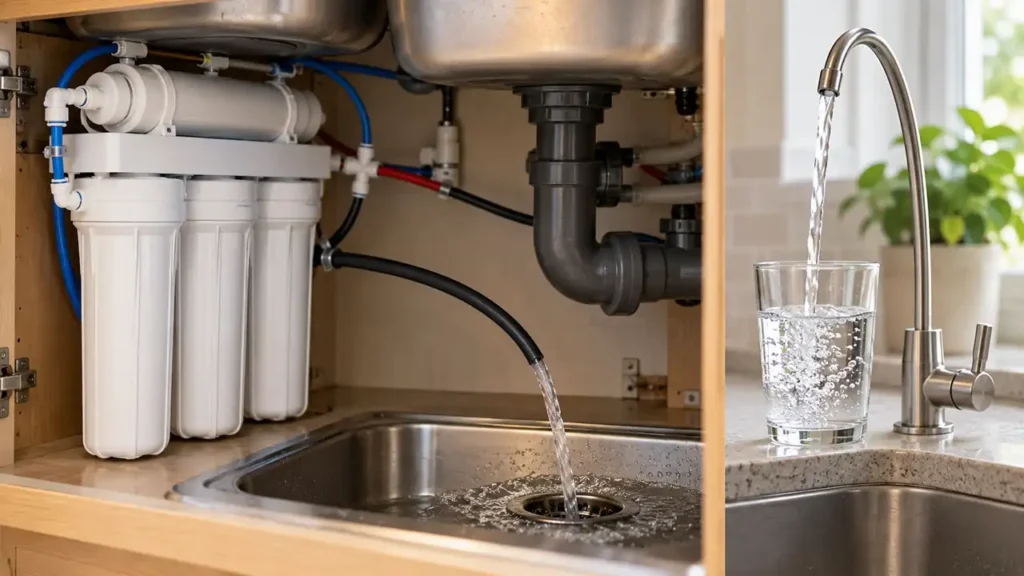
A reverse osmosis (RO) system may send several gallons of water to the drain for each gallon of drinking water it produces, but there is no single wastewater ratio that applies to every system. A conventional under-sink unit might use roughly 3 to 5 gallons of drain water per gallon produced. Some systems use less. The actual amount depends on the design, feed-water pressure, temperature, water quality, and operating condition.
For a household that produces 2 gallons of RO drinking water a day, a 3:1 drain-to-product ratio means about 6 gallons go to the drain daily, or approximately 2,190 gallons a year. That figure describes the drain water, not the household’s total water use for RO. The system would take in about 8 gallons a day to produce those 2 gallons of drinking water.
What Counts as RO “Wastewater”?
Inside an RO system, feed water is divided into two streams. Product water, also called permeate, passes through the membrane and goes to a faucet or storage tank. Concentrate, often called reject water or drain water, carries away material retained by the membrane. A continuous drain stream during water production helps limit buildup at the membrane surface.
Water sent to the drain is therefore part of normal RO operation. It is different from water lost through a leak or a malfunction that keeps the system draining after it should have stopped.
How to Read a Wastewater Ratio
Ratio labels are easy to misread because manufacturers may put product water or drain water first. Look for the words accompanying the numbers rather than relying on “3:1” alone.
| Stated ratio | What it means | Approximate recovery rate |
|---|---|---|
| 3:1 drain-to-product | 3 gallons to the drain for 1 gallon of product water | 25% |
| 1:1 drain-to-product | 1 gallon to the drain for 1 gallon of product water | 50% |
| 2:1 product-to-drain | 2 gallons of product water for 1 gallon to the drain | 67% |
Recovery rate is the percentage of incoming feed water that becomes product water. For example, at a 3:1 drain-to-product ratio, 4 gallons enter the system, 1 gallon becomes product water, and 3 gallons go to the drain. Recovery is 1 divided by 4, or 25%.
Recovery rate is separate from rejection rate, which describes how effectively a membrane rejects dissolved material. A higher recovery rate does not, by itself, establish better contaminant reduction.
Why the Amount Varies
A manufacturer’s stated ratio is typically based on specified test conditions. Household results can differ for several reasons:
- Feed-water pressure: Low pressure can reduce product-water production relative to drain flow. A booster pump may improve performance on a system designed to use one, but pressure must remain within the manufacturer’s limits.
- Water temperature: Colder water passes through an RO membrane more slowly. The effect on the drain ratio depends on the system’s flow controls.
- Storage-tank pressure: In a conventional tank-based system, increasing tank pressure as the tank fills reduces the pressure available to push water through the membrane. Its ratio over a full refill may differ from a reading taken with an empty tank.
- Membrane and flow-control design: Membranes, flow restrictors, pumps, and other controls influence how much feed water becomes product water.
- Feed-water quality and maintenance: High dissolved-solids levels, scaling, clogged prefilters, or a deteriorating membrane can change performance. Trying to reduce drain flow without regard to water chemistry can increase scaling risk.
Tankless, countertop, and tank-based units can also report efficiency under different operating conditions. Compare published figures only after checking which stream comes first in the ratio and what test conditions apply.
Estimating the Water Use and Cost
To estimate annual drain water, multiply the amount of RO water you use each day by the drain-to-product ratio, then by 365:
Daily RO product water × gallons drained per gallon produced × 365 = estimated annual drain water
At 2 gallons of product water per day, a 1:1 ratio would send about 730 gallons to the drain each year. A 5:1 ratio would send about 3,650 gallons. Actual use will vary with household demand and system performance.
For a rough operating-cost estimate, add product water and drain water to find the total feed water used, then apply your local water and sewer rates. Sewer charges can matter as much as the water-supply charge. Check how your utility bills each service rather than assuming every gallon has the same cost.
When Drain Flow May Signal a Problem
Drain flow while the system is producing water or refilling its tank is normal. Drain flow that continues long after a tank-based system’s tank is full and no RO water has been used deserves investigation. A brief observation immediately after dispensing water is not enough to establish a fault, since the tank needs time to refill.
Start with simple checks: confirm that no RO faucet, refrigerator line, or ice maker is drawing water, and look for leaks. If a conventional tank-based system continues draining after it should have shut off, possible causes include a problem with its automatic shutoff valve, check valve, tank, or feed-water pressure. Tankless and countertop systems use different controls, so their manuals should guide further checks. Contact the manufacturer or a qualified service professional before modifying valves or drain plumbing.
Ways to Reduce Unnecessary Water Use
- Maintain the system on its specified schedule. Replace prefilters and inspect membrane performance according to the manufacturer’s instructions and your water conditions.
- Check feed-water pressure against the system’s requirements. If pressure is too low, use only a pump or other correction approved for that configuration.
- Address persistent draining. Fixing a shutoff or leak problem can prevent water use that is unrelated to normal membrane operation.
- Read efficiency claims carefully. A stated wastewater ratio should identify which stream comes first and the conditions under which it was measured. A higher GPD rating describes rated daily production, not necessarily lower water use.
RO drain water should not be assumed suitable for drinking or for every reuse. It contains material concentrated from the feed water, and its composition depends on the source. Where reuse is practical, follow local requirements and avoid applications that require potable water or could be harmed by concentrated minerals.
The most useful answer to “How much water does reverse osmosis waste?” is your system’s drain-to-product ratio under your household conditions. Use the manufacturer’s documented figure for an initial estimate, then investigate if actual water use or drain flow appears unusually high.
