
A small kitchen can make reverse osmosis shopping feel like a cabinet-measuring exercise with a plumbing exam attached. Traditional tank-based systems may offer useful storage, yet the tank, faucet, drain connection, and filter housings can consume valuable space beneath a compact sink. Tankless systems reclaim cabinet room, while countertop models avoid under-sink installation altogether, but each format brings different requirements for electricity, faucet installation, reservoirs, and maintenance.
The common mistake is choosing by stage count or GPD alone. A 600 GPD rating does not automatically mean better filtration, and a 10-stage design is not automatically superior to a five-stage system. For a small kitchen, footprint, power access, faucet requirements, storage architecture, wastewater information, certification evidence, and replacement-filter access matter just as much. Different buyers may prefer a no-plumbing countertop unit, a slim tankless system, or a traditional under-sink model with a storage tank.
For the broadest balance of compact under-sink design, stated capacity, water-use information, and useful monitoring, the Waterdrop G3P600 is the strongest overall fit here. Buyers who prefer a non-electric traditional system, mineral addback, or countertop convenience have better-matched alternatives among the other selections.
Quick Answer
- Best Overall: Waterdrop G3P600 for a compact tankless under-sink setup with 600 GPD rated capacity and a display faucet.
- Best for Mineral Addback: iSpring RCC7AK-BN for an NSF/ANSI 58-certified system with an alkaline remineralization stage.
- Best Countertop Option: DREO Countertop RO System for small spaces where under-sink plumbing work is undesirable.
- Best Premium Tankless Alternative: Philips Tankless RO System for a compact design, self-flushing function, and stated 2.3:1 pure-to-drain ratio.
Best Reverse Osmosis Systems for Small Kitchens Comparison Table
| Product | Best For | System Type | Rated Capacity | Notable Space or Water Feature |
|---|---|---|---|---|
| Waterdrop G3P600 | Best overall | Tankless under-sink | 600 GPD | 2:1 low-drain ratio, display faucet |
| iSpring RCC7AK-BN | Mineral addback | Tank-based under-sink | 75 GPD | Alkaline stage, top-mounted faucet fastener |
| iSpring RCC7-BN | Traditional non-electric setup | Tank-based under-sink | 75 GPD | Top-mounted faucet design |
| APEC ROES-50 | Conventional value | Tank-based under-sink | 50 GPD | Colored tubing, included tank and faucet |
| VIVA21 5-Stage RO System | Certification-focused buyers | Tank-based under-sink | Not clearly specified | WQA Gold Seal, leak detector |
| Waterdrop WD-T4-A | Dual purified-water options | Tankless under-sink | 450 GPD | RO and mineral-enhanced streams |
| Waterdrop G2P600 | High stated capacity | Tankless under-sink | 600 GPD | 2:1 low-drain ratio, filter indicators |
| Philips Tankless RO System | Compact premium alternative | Tankless under-sink | 600 GPD | Self-flushing, 2.3:1 pure-to-drain ratio |
| DREO Countertop RO System | Small households and no under-sink installation | Countertop | Not clearly specified | 3L tank, 1.1L pitcher, 3:1 pure-to-drain ratio |
The reviews below focus on the practical differences that matter most in a compact kitchen, including cabinet space, installation, rated output, water-use claims, monitoring, and filter upkeep.
1. Waterdrop G3P600 — Best Overall

Small cabinets benefit most from the G3P600’s tankless layout. The published dimensions are 18.12 inches long, 5.67 inches wide, and 17.72 inches high, so it still requires careful measuring, but it avoids the separate storage tank that occupies much of the space in a conventional under-sink arrangement. Its stated 600 GPD capacity and listed ability to fill an 8-ounce cup in eight seconds also give it a clear practical advantage for repeated filling, cooking, or bottle use.
The system also supplies more information at the faucet than a basic model. Its display provides TDS readings and filter-life information, although a TDS display should be treated as a dissolved-solids indicator rather than a detector for specific contaminants. The listing identifies NSF/ANSI 58 certification for TDS reduction, NSF/ANSI 372 certification for lead-free materials, and NSF 42 testing and certification for chlorine, taste, and odor reduction. It requires under-sink electricity, a detail that can decide whether it works in an older or tightly configured kitchen.
Pros
- Tankless under-sink design avoids a separate storage tank.
- Published rated capacity is 600 GPD.
- Listed 2:1 low-drain ratio.
- Display faucet provides TDS and filter-life information.
- NSF/ANSI 58, NSF/ANSI 372, and NSF 42 claims are identified in the product information.
Cons
- Requires an under-sink electrical outlet.
- Published dimensions still need to be checked against the cabinet.
This is the best fit for a small kitchen with power available beneath the sink and a preference for direct-flow tankless hardware. Buyers without a nearby outlet may prefer the iSpring RCC7-BN or APEC ROES-50, while shoppers seeking mineral addback should look toward an alkaline model instead.
To buy this product, click here.
2. iSpring RCC7AK-BN — Best With Remineralization

The RCC7AK-BN takes the familiar tank-based under-sink route and adds an AK remineralization stage after reverse osmosis. That gives small-kitchen buyers a way to choose mineral addback without moving to a larger countertop appliance. The product information also identifies a 75 GPD rating, a transparent first-stage housing for visual inspection, and a brushed nickel faucet with a top-mounted fastener that can simplify access above the counter during installation.
Its strongest evidence is the stated NSF/ANSI 58 certification for the complete RO system, along with published reduction figures for several named substances. Those claims should still be read as product information rather than independent household results. Filter sets are identified for six-month, one-year, two-year, and three-year intervals, using “up to” language where applicable. The system is a better match for buyers who have room for a tank and want a traditional setup with mineral addback, rather than those seeking maximum cabinet efficiency.
Pros
- 75 GPD rated capacity is identified.
- Includes an alkaline remineralization stage.
- Product information states NSF/ANSI 58 certification for the complete system.
- Transparent first-stage housing allows visual filter inspection.
- Top-mounted faucet fastener and quick-fitting connections are specified.
Cons
- Tank-based architecture uses more cabinet space than a tankless system.
- The listing uses alkaline and pH-plus language without providing a specific resulting pH.
Choose this version if remineralization and certification evidence matter more than preserving every inch of cabinet space. The standard iSpring RCC7-BN is a more straightforward alternative for buyers who do not want the added AK stage.
To buy this product, click here.
3. iSpring RCC7-BN — Best Traditional Non-Electric System

The RCC7-BN keeps the arrangement familiar: a five-stage under-sink system, a storage tank, and a brushed nickel faucet. Its stated 75 GPD rating is higher than the APEC ROES-50’s 50 GPD figure, while its operation does not require a power source according to the product information. That distinction matters in a small kitchen where the cabinet may be available but an electrical outlet is not.
A transparent first-stage housing provides a quick visual check, and the listed check valve is intended to prevent backflow into the membrane housing. The supplied information identifies NSF/ANSI 58 certification and names reduction claims for PFAS, chlorine, fluoride, lead, arsenic, and other substances. It also describes food-grade tubing and a lead-free faucet. Buyers should allow for the storage tank and separate faucet installation, since this is compact compared with some systems but not tankless.
Pros
- 75 GPD rated capacity is listed.
- Does not require a power source according to the product information.
- NSF/ANSI 58 certification is identified.
- Includes a transparent first-stage housing.
- Top-mounted faucet design and check valve are specified.
Cons
- Storage tank takes more cabinet room than a tankless system.
- No remineralization stage is identified in the supplied configuration.
This model suits a small kitchen with limited electrical access and enough cabinet depth for a tank. A tankless Waterdrop system is more appropriate where cabinet volume is the primary constraint, while the RCC7AK-BN is the closer match for mineral addback.
To buy this product, click here.
4. APEC ROES-50 — Best Conventional Value

The ROES-50 is a conventional five-stage, tank-based under-sink system with a stated 50 GPD capacity. That is a more modest rated output than the 75 GPD iSpring models and far below the tankless systems in this guide, yet the simpler architecture may be enough for a compact household that mainly needs water for drinking and cooking. Colored tubing, quick connections, a tank, and a brushed nickel faucet are included according to the product information.
Its listing names reduction claims for arsenic, chlorine, lead, fluoride, heavy metals, PFAs, and microplastics. The wording is broad, so shoppers with a specific contaminant concern should seek model-specific details rather than treating a general impurity claim as proof for every substance. Filter replacement is described as occurring every six to 24 months based on incoming water quality, which is a useful reminder that maintenance depends on source water and usage.
Pros
- Five-stage under-sink RO configuration is clearly identified.
- 50 GPD rated capacity is listed.
- Includes a storage tank, faucet, installation kit, and tubing.
- Colored tubing is intended to simplify setup and servicing.
- Product information identifies reduction claims for several named substances.
Cons
- 50 GPD is the lowest stated under-sink capacity among the traditional systems here.
- The listing does not clearly identify an NSF/ANSI 58 certification for the complete system.
The ROES-50 is a sensible choice for a small kitchen that can accommodate a tank and does not need the speed or electronic features of a tankless unit. Buyers prioritizing explicit complete-system certification evidence may prefer one of the iSpring or VIVA21 models.
To buy this product, click here.
5. VIVA21 5-Stage Reverse Osmosis System — Best Certification-Focused Option
The VIVA21 targets buyers who want a complete traditional under-sink kit without sorting through separate faucet, tank, and leak-protection components. The supplied information lists a five-stage arrangement, automatic shutoff, leak-resistant fittings, a compact storage tank, faucet, tubing, installation kit, and leak detector. For a small kitchen, that all-in-one approach can reduce the chance of discovering that a required part was missing after the cabinet is already opened.
Its main differentiator is the stated WQA Gold Seal certification for NSF/ANSI 58 reverse osmosis performance and NSF/ANSI/CAN 372 lead content. That is different from claiming that every possible contaminant is covered by one standard. The listing does not clearly specify a GPD rating, recovery ratio, or detailed contaminant percentages, so the system is easier to recommend for its documented certification and included hardware than for high-output performance.
Pros
- Five-stage RO configuration is identified.
- WQA Gold Seal certification is stated for NSF/ANSI 58 and NSF/ANSI/CAN 372.
- Includes a faucet, tank, tubing, and installation kit.
- Includes a leak detector and automatic shutoff.
- Lifetime limited parts support is identified.
Cons
- The product information does not clearly specify a GPD rating.
- The listing does not clearly identify a pure-to-drain or recovery ratio.
This model fits a buyer who values certification language and a complete kit more than a published high-capacity figure. A Waterdrop tankless system is a better match for severe cabinet-space pressure, while the VIVA21 remains the more conventional route.
To buy this product, click here.
6. Waterdrop WD-T4-A — Best Dual-Flow System
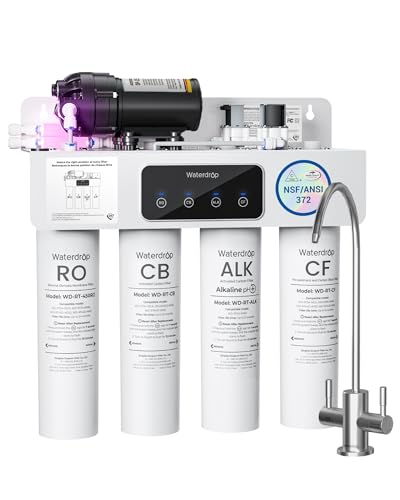
The WD-T4-A gives a small kitchen two treated-water paths: a standard RO stream and a mineral-enhanced alkaline stream. That is a functional distinction rather than a cosmetic variation, since users can select the output that suits the task. Its tankless 450 GPD design also avoids the separate storage tank, although the faucet requires drilling a countertop hole and the system needs an electrical connection.
The listing identifies a 2:1 pure-to-drain ratio, a 10-stage configuration, dual LED indicators, and filter reminders. It also provides replacement timing information for the CF filter, RO membrane, carbon block, and alkaline mineralizer. The system is a strong space-saving choice for buyers who specifically want mineral addback, but the number of stages should not be treated as proof of superior filtration. The supplied certification information identifies NSF/ANSI 372, not a complete-system NSF/ANSI 58 certification.
Pros
- Tankless design preserves space beneath the sink.
- Offers separate standard RO and mineral-enhanced water flows.
- 450 GPD rated capacity is listed.
- 2:1 pure-to-drain ratio is stated.
- Filter reminders and dual LED indicators are included.
Cons
- Requires electricity and a countertop hole for faucet installation.
- The supplied certification information identifies NSF/ANSI 372 rather than complete-system NSF/ANSI 58 certification.
This is the right direction for a small kitchen where cabinet space, mineral addback, and selectable output all matter. Buyers seeking simpler installation should look at the countertop DREO, while those wanting a conventional non-electric system may prefer the iSpring RCC7AK-BN.
To buy this product, click here.
7. Waterdrop G2P600 — Best High-Capacity Value

The G2P600 brings a 600 GPD stated capacity to a tankless under-sink format, making it appealing for a small kitchen that still has heavy daily demand. Its listing says a 200 ml cup can fill in eight seconds under the stated conditions, and it identifies a 2:1 drain ratio. Those figures address output and water use, not universal filtration quality, but they do help separate this model from slower conventional systems.
Maintenance is handled through twist-and-pull filters, filter-life indicators, and a claimed tool-free replacement process. The product information identifies NSF/ANSI 372 certification for lead-free materials. It does not provide the same broader certification detail as the G3P600, and the supplied information does not clearly state the system’s dimensions or power requirement. That leaves cabinet measurement and installation planning especially important before choosing it for a tight space.
Pros
- 600 GPD rated capacity is stated.
- Tankless architecture saves the space otherwise used by a storage tank.
- 2:1 drain ratio is identified.
- Twist-and-pull filters are described as tool-free to replace.
- NSF/ANSI 372 certification for lead-free materials is listed.
Cons
- The supplied information does not clearly specify cabinet dimensions.
- Certification evidence is narrower than the G3P600’s stated certification package.
The G2P600 suits buyers who want a high stated capacity and tankless space savings without moving to the more feature-heavy G3P600. The latter is a better match for shoppers who want a display faucet and broader stated certification information.
To buy this product, click here.
8. Philips Tankless RO System — Best Premium Compact Alternative

The Philips system is unusually compact on paper, with listed dimensions of approximately 15.8 inches long, 4.3 inches wide, and 12.3 inches high. That narrow body can be valuable under a small sink, provided the cabinet has a suitable outlet and the faucet connection can be completed. It also has a stated 600 GPD capacity and an approximate eight-second fill time for an 8-ounce cup under specified test conditions.
Water-use information is more detailed than many conventional systems. The listing gives a 2.3:1 pure-to-drain ratio and approximately 70% water recovery, while also noting that actual performance varies with pressure, temperature, and water quality. Auto-cycle self-flushing and twist-and-replace filters add maintenance features, and the product information lists NSF/ANSI 372, SGS food-contact testing, UL/CSA listings, and FCC certification. These references should be kept separate because they address different properties.
Pros
- Compact listed dimensions suit space-limited cabinets.
- 600 GPD rated capacity is identified.
- Stated 2.3:1 pure-to-drain ratio and approximately 70% recovery.
- Auto-cycle self-flushing is included.
- Two filters are included, with twist-and-replace maintenance.
Cons
- Requires an under-sink power outlet.
- Faucet installation may require drilling, and nonstandard connections may need an adapter.
This Philips model is a strong alternative for a small cabinet where physical dimensions matter more than mineral addback or a storage tank. Check the electrical supply, faucet-hole situation, and connection size first. Buyers who want a more explicitly documented complete-system NSF/ANSI 58 claim may prefer the G3P600 or an iSpring model.
To buy this product, click here.
9. DREO Countertop RO System — Best No-Under-Sink Option
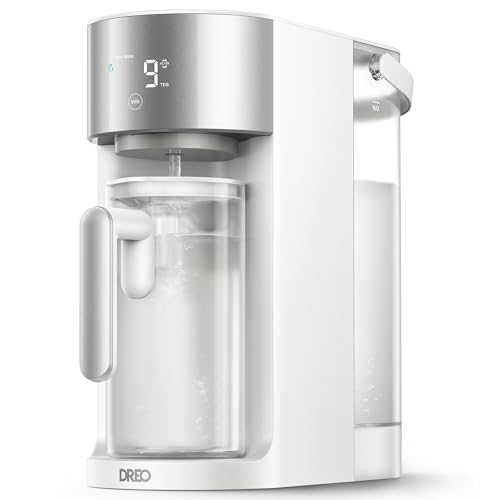
The DREO takes a different route for a small kitchen. Rather than competing for cabinet space, it sits on the counter and uses a 3L tank plus a 1.1L pitcher. That format can be useful in a rental, a kitchenette, or a home where drilling for a dedicated faucet is impractical. Its listed footprint is 14.51 inches long, 6.73 inches wide, and 13.35 inches high, so the counter still needs a clear landing area.
The product information describes real-time raw-water and purified-water TDS monitoring, filter-life reminders, auto-fill sensing, self-cleaning, and a 3:1 pure-to-drain ratio. It also states a filter capacity of 265 gallons, or 1,000 liters, and identifies testing by SGS against NSF/ANSI 58 standards. Testing against a standard should not be rewritten as certification to that standard. The 1 to 2 person suitability described in the listing also makes this less attractive for a busy household filling multiple large containers throughout the day.
Pros
- Countertop format avoids under-sink plumbing installation.
- 3L tank and 1.1L pitcher are identified.
- 3:1 pure-to-drain ratio is stated.
- Includes TDS and filter-life monitoring.
- Auto-fill and self-cleaning functions are listed.
Cons
- Uses valuable countertop space rather than cabinet space.
- Published information describes SGS testing against NSF/ANSI 58 standards, not clear certification to NSF/ANSI 58.
This is the most practical choice for a small kitchen where reversibility and countertop access matter more than a plumbed faucet. Buyers with a dedicated cabinet and heavier demand should look at a tankless under-sink system, while renters may appreciate avoiding faucet drilling and drain connections.
To buy this product, click here.
Buying Guide
Start With Cabinet Measurements
Small-kitchen systems fail the planning stage more often than the filtration stage. Measure width, height, depth, the position of the drain, and the space needed to remove filters. Tankless models generally avoid a separate tank, but their bodies still need room for tubing and service access. The Philips listing supplies compact dimensions, while the Waterdrop G3P600 listing gives a larger footprint that should be checked against the cabinet opening.
Choose Countertop or Under-Sink
A countertop unit is often the cleanest route for renters or kitchens where modifying plumbing is undesirable. It trades cabinet competition for counter space and reservoir handling. Under-sink systems keep the counter clearer, yet they may require a dedicated faucet hole, drain connection, electricity, or a storage tank. Do not assume that countertop means completely installation-free, or that every under-sink model suits every cabinet.
Separate Capacity From Filtration Quality
GPD is a rated production-capacity figure. It is useful for comparing stated output, but it does not prove better contaminant reduction or guarantee that a household will receive that amount under every condition. Flow figures, such as an eight-second cup-fill claim, should also remain separate from GPD. For a compact household, a 50 or 75 GPD tank-based system may be adequate, while frequent bottle filling favors a higher-capacity tankless design.
Read Certification Language Carefully
Certification, testing, and material compliance are different claims. The iSpring models identify NSF/ANSI 58 certification, the VIVA21 identifies WQA Gold Seal certification for named standards, and the DREO information describes SGS testing against NSF/ANSI 58 standards. Those statements should remain attributed to the product information. NSF/ANSI 372 concerns lead-free materials, while NSF/ANSI 42 and NSF/ANSI 58 address different performance areas.
Check Water-Use Information
Traditional RO systems can send some feed water to the drain, so a stated ratio may be useful when comparing ownership trade-offs. The Waterdrop models list a 2:1 ratio, the Philips model lists 2.3:1, and the DREO lists 3:1. Preserve the ratio as published and do not assume every manufacturer defines it in precisely the same way. Tankless construction alone does not mean zero wastewater.
Plan for Maintenance and Power
Filter reminders, transparent housings, twist-in cartridges, and self-flushing can make maintenance easier to track, but they do not remove the need for replacement parts. The WD-T4-A lists separate intervals for several filter components, while the Philips system identifies replacement filters with “up to” service periods. Also verify whether the chosen system needs electricity. The G3P600, WD-T4-A, Philips, and other tankless designs may require an outlet, while the iSpring RCC7-BN is described as operating without one.
Best Reverse Osmosis Systems for Small Kitchens FAQ
Is a tankless RO system better for a small kitchen?
It can be a better space fit because it avoids a separate storage tank. That does not make every tankless system superior. Check cabinet dimensions, outlet access, faucet requirements, stated capacity, and water-use information before choosing one.
Are countertop RO systems suitable for small kitchens?
Countertop units can suit kitchens where under-sink plumbing or faucet drilling is impractical. They require clear counter space and may use reservoirs that need refilling. The DREO selected here lists a 3L tank and a 1.1L pitcher.
Does a higher GPD rating mean better filtration?
No. GPD describes a rated production capacity. It does not establish contaminant reduction, certification, water taste, or actual household output under every operating condition.
Do reverse osmosis systems need electricity?
Some do and some do not. The iSpring RCC7-BN is described as operating without a power source, while the Waterdrop G3P600, WD-T4-A, and Philips tankless models identify an electrical requirement. Confirm the exact model before installation.
Is remineralized water the same as alkaline water?
No. A remineralization stage adds minerals according to the product description, while alkaline language refers to an alkaline or pH-related output claim. A remineralization stage does not establish a specific pH or a health benefit.
What certification should small-kitchen RO buyers look for?
Look for the exact organization, standard, and scope. NSF/ANSI 58, NSF/ANSI 42, NSF/ANSI 372, and WQA certification are separate claims. Also distinguish a product certified to a standard from a product tested against or using components associated with that standard.
How much cabinet space does an under-sink RO system need?
There is no universal answer. Tank-based systems require room for the filtration assembly and storage tank, while tankless models require room for their housing, tubing, and service access. Measure the cabinet and compare it with the model’s published dimensions where available.
Final Verdict
The Waterdrop G3P600 is the strongest overall match for a small kitchen that has an under-sink outlet and needs a compact tankless arrangement. Its stated 600 GPD capacity, 2:1 low-drain ratio, display faucet, filter-life information, and identified certification claims create a well-documented balance of space use and functionality. The iSpring RCC7AK-BN is the better direction for mineral addback and a traditional non-electric installation, while the APEC ROES-50 provides a simpler 50 GPD tank-based alternative.
For the tightest cabinet, compare the G3P600, G2P600, WD-T4-A, and Philips system by dimensions, electrical access, faucet requirements, and replacement-filter plans. If plumbing changes are the main obstacle, the DREO countertop model is the more practical format, provided its reservoir capacity fits daily demand. The best choice is the one whose architecture, certification evidence, stated water-use characteristics, and maintenance requirements match the physical limits of the kitchen.
